
Spermidine is a naturally occurring polyamine found in human cells, plants, animals, microorganisms, and many foods. It belongs to the same family of small, positively charged molecules as putrescine and spermine and plays fundamental roles in cellular growth, protein translation, and polyamine metabolism [1,2].

Spermidine has attracted attention in aging research because experimental studies have linked it to autophagy, mitochondrial function, immune regulation, and lifespan in model organisms. However, the evidence in humans is much more limited than the animal and cell research.
Human trials have examined spermidine supplementation in areas such as cognition, immune function, safety, and polyamine metabolism. Results are mixed, and spermidine has not been proven to reverse aging or extend human lifespan.
This guide explains what spermidine is, how the body makes and uses it, how it differs from other polyamines, where it comes from, and what human research actually shows.
What Is Spermidine?
Spermidine is a naturally occurring polyamine. Polyamines are small organic molecules containing multiple amino groups and are present in essentially all living cells [1].
The three major polyamines commonly discussed in mammals are:
- putrescine;
- spermidine; and
- spermine.
These molecules participate in processes involving RNA, protein synthesis, cell growth, and cellular metabolism [1].
Chemically, spermidine is a triamine with the molecular formula C7H19N3. Its chemical name can be written as N-(3-aminopropyl)butane-1,4-diamine.
Spermidine is not:
- a peptide;
- a vitamin;
- a hormone; or
- a prescription anti-aging drug.
It is a normal biological metabolite that the body can produce and that is also obtained from food.
Is Spermidine a Polyamine?
Yes. Spermidine is one of the major naturally occurring polyamines in humans and other organisms.
Polyamines are called "polyamines" because their molecular structures contain multiple amino groups. At normal physiological pH, they carry positive charges that allow them to interact with negatively charged cellular molecules such as RNA, DNA, phospholipids, and proteins [1].
Research suggests that one of their particularly important functions is regulation of protein translation.
Is Spermidine From Sperm?
No. The spermidine used by the body or found in foods is not "made from sperm."
The unusual name comes from the history of polyamine research.
In 1678, Antonie van Leeuwenhoek observed crystals in human semen. The compound later associated with those observations was named spermine. Spermidine was subsequently identified as a related polyamine, which is how it acquired its similar name [3].
Spermidine is now known to occur throughout living organisms and tissues—not only in reproductive fluids.
Your cells make it through normal metabolism, microorganisms can produce it, and many common foods contain it.
Spermidine vs Putrescine vs Spermine
Putrescine, spermidine, and spermine are chemically related polyamines that form part of the same metabolic network.
| Polyamine | Relationship | Key distinction |
|---|---|---|
| Putrescine | Precursor to spermidine | Diamine produced downstream of ornithine |
| Spermidine | Produced from putrescine | Triamine required for eIF5A hypusination |
| Spermine | Produced from spermidine | Larger polyamine with four amino groups |
The simplified mammalian pathway is:
Ornithine → Putrescine → Spermidine → Spermine
Spermidine synthase converts putrescine into spermidine by transferring an aminopropyl group from decarboxylated S-adenosylmethionine. Spermine synthase then uses spermidine to produce spermine [4].
The pathway is dynamic. Cells regulate the synthesis, breakdown, conversion, uptake, and export of polyamines according to their metabolic needs.
What Is Spermidine Made Of?
From a chemical perspective, spermidine is a small carbon-, hydrogen-, and nitrogen-containing molecule with the formula C7H19N3.
Biologically, the body does not simply assemble spermidine from dietary spermidine molecules. It can synthesize spermidine through the polyamine pathway.
In that pathway:
- ornithine is converted into putrescine;
- decarboxylated S-adenosylmethionine supplies an aminopropyl group; and
- spermidine synthase transfers that group to putrescine to form spermidine [4].
Spermidine can subsequently be converted into spermine or broken back down through polyamine catabolism.
What Does Spermidine Do in the Body?
Spermidine participates in several fundamental cellular processes.
Its functions are broader than the "anti-aging" label often attached to spermidine supplements.
Research has linked normal polyamine biology to:
- protein synthesis and translation;
- cell growth and proliferation;
- RNA interactions;
- regulation of cellular metabolism;
- the formation of hypusine on eIF5A; and
- experimental pathways related to autophagy and cellular stress responses.
One of the most distinctive biological functions of spermidine involves a protein called eIF5A.
Spermidine and eIF5A Hypusination
Spermidine is required to produce a rare amino-acid modification called hypusine.
Hypusine is found on the translation factor eIF5A and is created through two enzyme-driven steps [5]:
Spermidine → DHPS → deoxyhypusine-eIF5A → DOHH → hypusinated eIF5A
The first enzyme, deoxyhypusine synthase (DHPS), transfers an aminobutyl portion of spermidine to a specific lysine residue on eIF5A.
The second enzyme, deoxyhypusine hydroxylase (DOHH), converts that intermediate into hypusine.
Hypusinated eIF5A is important for normal protein translation, particularly when ribosomes encounter sequences that can otherwise cause translational stalling [5].
This pathway provides a direct biological link between spermidine metabolism and protein synthesis.
How Does Spermidine Work?
There is no single mechanism that explains every biological effect associated with spermidine.
Instead, spermidine participates in a network of cellular processes involving:
- polyamine metabolism;
- eIF5A hypusination;
- protein translation;
- gene regulation;
- cell growth;
- protein acetylation; and
- autophagy-related signaling.
This is why it is overly simplistic to say that spermidine merely "switches on autophagy."

Does Spermidine Increase Autophagy?
Experimental research supports a relationship between spermidine and autophagy, but the strongest mechanistic evidence comes from cells and animal models rather than human supplementation trials.
Autophagy is a cellular recycling process through which cells break down and reuse selected damaged or unnecessary components.
Laboratory studies have found that spermidine can influence autophagy-related pathways. One frequently studied mechanism involves the acetyltransferase EP300.
Cell-based experiments found that spermidine inhibited EP300 activity, reduced protein acetylation, and increased markers of autophagic flux [6].
Other research suggests that spermidine's effects on eIF5A hypusination and protein translation may also interact with autophagy-related biology.
However, this does not establish a specific oral spermidine dose that "triggers autophagy" in humans.
Questions such as:
- how many milligrams of spermidine are needed for autophagy;
- how quickly autophagy begins after taking spermidine; or
- whether a supplement reproduces the effects of fasting
do not currently have validated human answers.
For a deeper discussion of the mechanisms and research, see our guide to spermidine and autophagy.
Where Does Spermidine Come From?
Humans are exposed to spermidine from three broad sources:
- the body's own synthesis;
- food; and
- polyamines produced within the gastrointestinal environment.
Your Body Produces Spermidine
Cells synthesize spermidine through the polyamine pathway.
Ornithine is first converted to putrescine. Spermidine synthase then uses putrescine and an aminopropyl donor derived from S-adenosylmethionine to produce spermidine [4].
The body carefully regulates polyamine concentrations through synthesis, conversion, degradation, transport, and excretion.
Spermidine Is Found in Food
Spermidine also occurs naturally in food.
Common dietary sources include foods such as:
- wheat germ;
- soybeans and other legumes;
- mushrooms;
- peas;
- whole grains;
- some aged cheeses; and
- various plant foods.
Spermidine content can vary considerably according to the food, variety, processing, fermentation, storage, and analytical method used [7].
For detailed food concentrations and comparisons, see our guide to foods high in spermidine.
The Gut Microbiome Also Contributes to Polyamine Availability
Microorganisms in the gastrointestinal tract can produce and metabolize polyamines.
This means circulating and tissue polyamine biology reflects more than just the amount of spermidine listed on a food or supplement label [7].
What Happens After You Take Spermidine?
The pharmacokinetics of supplemental spermidine are more complicated than simply absorbing it and seeing blood spermidine rise.
In a randomized crossover study involving 12 healthy adults, participants took 15 mg of spermidine per day for five days [8].
Researchers did not observe a significant increase in plasma spermidine or putrescine compared with placebo. Plasma spermine increased instead.
The researchers proposed that some ingested spermidine may be converted before reaching systemic circulation [8].
This finding is important because it challenges an overly simple model such as:
"More supplemental spermidine → proportionally higher blood spermidine → more autophagy."
Human polyamine metabolism appears to be tightly regulated.
What Does Human Spermidine Research Show?
Spermidine has extensive cell and animal research, but human supplementation studies remain relatively limited.
| Research area | What human evidence currently shows |
|---|---|
| Memory and cognition | A 12-month randomized trial did not significantly improve the primary memory outcome [9] |
| Dietary spermidine and mortality | Observational studies are inconsistent; they do not establish a causal longevity effect [10,11] |
| Circulating spermidine after supplementation | 15 mg/day for five days did not significantly raise plasma spermidine in one small trial [8] |
| High-dose short-term safety | 40 mg/day for 28 days was well tolerated in one small study of healthy older men [12] |
| Immune response in older adults | A small 2026 pilot trial reported promising effects in vaccine non-responders; confirmation is needed [13] |
| Human lifespan extension | Not established |
| Anti-aging effect | Not established as a clinical outcome |
Spermidine and Memory
Early pilot research created interest in spermidine for cognition, but the larger follow-up trial produced a more cautious result.
The SmartAge randomized clinical trial included 100 adults aged 60 to 90 years with subjective cognitive decline. Participants received a spermidine-rich wheat-germ supplement providing 0.9 mg of spermidine per day or placebo for 12 months [9].
The trial found no significant difference in its primary memory outcome or secondary outcomes between the spermidine and placebo groups.
Exploratory analyses suggested possible signals involving verbal memory and inflammation, but the investigators stated that these findings require validation [9].
Spermidine should therefore not currently be described as a proven memory-enhancing or dementia-prevention supplement.
Spermidine and Immune Function
A small 2026 randomized pilot study tested 6 mg of spermidine daily for 13 weeks in 40 adults over age 65 following COVID-19 vaccination [13].
The researchers reported favorable changes in several vaccine-response and immune-senescence measures, particularly among participants who initially showed poor vaccine responses.
This is interesting early human evidence, but the study was small, involved older adults in a very specific vaccination context, and should not be generalized into the broad claim that spermidine "boosts immunity."
Does Spermidine Extend Lifespan?
Spermidine has not been proven to extend human lifespan.
A substantial amount of the longevity interest comes from experiments in model organisms, where spermidine supplementation has been associated with longer lifespan or improved health-related measures in several species.
Human evidence is much less direct.
A 2018 prospective cohort study involving 829 adults found an association between higher estimated dietary spermidine intake and lower all-cause mortality [10].
But observational studies cannot establish that spermidine itself caused the lower mortality. People who consume spermidine-rich diets may differ in many other ways, including overall diet, lifestyle, socioeconomic factors, and health behaviors.
Importantly, a much larger Japanese cohort study involving more than 29,000 adults did not find a significant association between spermidine intake and all-cause or cause-specific mortality after adjustment for relevant factors [11].
Therefore:
Animal longevity results and observational dietary associations are not evidence that taking a spermidine supplement extends human lifespan.
Can Spermidine Reverse Aging?
No human clinical trial has established that spermidine reverses aging.
Spermidine is scientifically interesting because it interacts with cellular pathways involved in protein translation, autophagy, metabolism, and aging biology.
But involvement in an aging-related pathway is not the same thing as demonstrating that supplementation makes a person biologically younger.
Human trials have not established that spermidine:
- reverses biological age;
- extends human lifespan;
- removes wrinkles;
- restores youthful appearance;
- prevents age-related disease; or
- reproduces all effects of fasting or calorie restriction.
For a closer review of potential outcomes rather than the basic biology, see our guide to spermidine benefits.
What Has Spermidine Not Been Proven to Do?
Current human evidence does not establish that spermidine supplements:
- extend human lifespan;
- reverse aging;
- prevent dementia;
- treat Alzheimer's disease;
- cause weight loss;
- regrow hair;
- prevent cancer;
- treat cardiovascular disease;
- produce a predictable level of autophagy;
- replace fasting; or
- provide a clinically validated "anti-aging dose."
Many of these topics have biological rationale or encouraging preclinical research, but the clinical evidence is not strong enough to present them as established human effects.
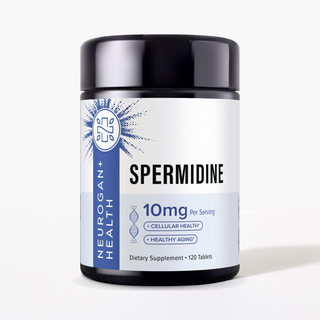
What Is a Spermidine Supplement?
A spermidine supplement is a product designed to provide spermidine beyond normal dietary intake.
Products can differ substantially in their source and composition.
Examples include:
- wheat-germ-derived extracts;
- other food-derived concentrates;
- purified spermidine;
- spermidine trihydrochloride; and
- multi-ingredient longevity formulas.
These forms should not automatically be considered clinically equivalent. A study using one source, formulation, or dose does not prove that all spermidine supplements behave identically.
If you're comparing forms, amounts, and product-quality considerations, see our guide to spermidine supplements and dosage.
You can also browse our spermidine supplements collection for product-specific ingredient and testing information.
How Much Spermidine Should You Take?
There is currently no universally established therapeutic dose of spermidine for longevity, autophagy, cognition, or other anti-aging goals.
Human studies have tested substantially different amounts and formulations.
For example:
- the 12-month SmartAge trial used a wheat-germ product delivering 0.9 mg/day [9];
- a pharmacokinetic trial used 15 mg/day for five days [8]; and
- a short-term safety study tested 40 mg/day of high-purity spermidine trihydrochloride for 28 days [12].
Those doses were chosen for particular research questions and should not be interpreted as universal recommendations.
For the dedicated dose analysis, see our spermidine dosage guide.
When Should You Take Spermidine?
Human research has not established one clinically superior time of day for spermidine supplementation.
Questions about taking spermidine in the morning, at night, with food, or while fasting are separate from what spermidine is and how it works biologically.
For the timing evidence and practical considerations, see our guide to the best time to take spermidine.
Is Spermidine Safe?
Published human studies have generally reported acceptable short-term tolerability at the amounts and durations studied, but the long-term evidence base remains limited.
For example, an exploratory randomized trial in 37 healthy men aged 50 to 70 tested 40 mg/day of high-purity spermidine for up to 28 days and reported no study-product-related adverse events or significant changes in routine clinical safety measures compared with placebo [12].
That study does not establish the safety of taking 40 mg every day for years or prove that higher doses are more effective.
The PAA data also contains frequent questions about:
- liver safety;
- medication interactions;
- who should avoid spermidine;
- excessive intake; and
- daily long-term use.
Those questions deserve more detail than belongs in an entity guide. See our dedicated guide to spermidine side effects and safety.
Spermidine FAQ
What does spermidine do?
Spermidine is a natural polyamine involved in normal cellular biology. One particularly distinctive role is providing the aminobutyl group required for hypusination of eIF5A, a modification important for normal protein translation [5]. Experimental research also links spermidine to autophagy-related pathways, although the effects of oral supplementation on human autophagy remain uncertain.
Is spermidine a polyamine?
Yes. Spermidine is one of the main naturally occurring polyamines along with putrescine and spermine [1].
Is spermidine made from sperm?
No. Spermidine is produced through normal cellular metabolism and occurs widely in plants, animals, microorganisms, and foods. Its name is related to the historical discovery of polyamines in semen rather than to a requirement for sperm as its source [3].
Where is spermidine found?
Spermidine is found throughout living cells and in many foods. Dietary sources include wheat germ, legumes, soy products, mushrooms, whole grains, and certain aged cheeses. The body also synthesizes spermidine internally, while microorganisms in the gastrointestinal tract contribute to polyamine metabolism [7].
What is the difference between spermidine and spermine?
Spermidine and spermine are related but distinct polyamines. Spermidine contains three amino groups and can be converted into spermine, which contains four. Spermidine also has the unique role of supplying the aminobutyl group required for eIF5A hypusination.
What is the difference between spermidine and putrescine?
Putrescine is an earlier molecule in the polyamine pathway. Spermidine synthase converts putrescine into spermidine using an aminopropyl group supplied by decarboxylated S-adenosylmethionine [4].
Does spermidine trigger autophagy?
Cell and animal studies show that spermidine can influence pathways associated with autophagy, including EP300-dependent acetylation [6]. However, there is no validated human dose at which oral spermidine has been proven to "trigger autophagy" in a predictable way.
Can spermidine reverse aging?
No human clinical trial has established that spermidine reverses aging or extends lifespan. Animal studies and observational research have generated interest, but those findings should not be presented as proven anti-aging effects in humans.
Is spermidine worth taking?
That depends on the reason someone is considering it and what outcome they expect. Spermidine has a well-established biological role as a natural polyamine, but many supplement claims go beyond current human evidence. Anyone considering it for a medical condition or specific health outcome should discuss that goal with a qualified healthcare professional.
How long does spermidine take to work?
There is no clinically established time after which someone should expect to "feel" spermidine working. Human studies measure different biochemical or functional outcomes over periods ranging from days to months, and there is no validated symptom that proves supplementation is having a beneficial effect.
Key Takeaway
Spermidine is a natural polyamine with important roles in normal cell biology, particularly protein translation through eIF5A hypusination.
It is produced by the body, obtained from food, and influenced by gastrointestinal polyamine metabolism.
Experimental research has linked spermidine to autophagy and multiple aspects of aging biology, but the human evidence is much less definitive.
Human supplementation trials have not established that spermidine reverses aging, extends lifespan, prevents dementia, or produces a specific level of autophagy.
The most useful way to understand spermidine is therefore as an important biological polyamine that is actively being studied—not as a proven anti-aging treatment.
For deeper topic-specific information, see:
- spermidine benefits;
- spermidine and autophagy;
- spermidine-rich foods;
- spermidine supplements and dosage;
- spermidine side effects; and
- when to take spermidine.
Resources:
- Igarashi K, Kashiwagi K. The functional role of polyamines in eukaryotic cells. International Journal of Biochemistry & Cell Biology. 2019;107:104-115. doi:10.1016/j.biocel.2018.12.012.
- Wallace HM, Fraser AV, Hughes A. A perspective of polyamine metabolism. Biochemical Journal. 2003;376(Pt 1):1-14. doi:10.1042/BJ20031327.
- Bachrach U. The early history of polyamine research. Plant Physiology and Biochemistry. 2010;48(7):490-495. doi:10.1016/j.plaphy.2010.02.003.
- Pegg AE. Mammalian polyamine metabolism and function. IUBMB Life. 2009;61(9):880-894. doi:10.1002/iub.230.
- Park MH, Wolff EC. Hypusine, a polyamine-derived amino acid critical for eukaryotic translation. Journal of Biological Chemistry. 2018;293(48):18710-18718. doi:10.1074/jbc.TM118.003341.
- Pietrocola F, Lachkar S, Enot DP, et al. Spermidine induces autophagy by inhibiting the acetyltransferase EP300. Cell Death & Differentiation. 2015;22(3):509-516. doi:10.1038/cdd.2014.215.
- Madeo F, Eisenberg T, Pietrocola F, Kroemer G. Spermidine in health and disease. Science. 2018;359(6374):eaan2788. doi:10.1126/science.aan2788.
- Senekowitsch S, et al. High-Dose Spermidine Supplementation Does Not Increase Spermidine Levels in Blood Plasma and Saliva of Healthy Adults: A Randomized Placebo-Controlled Pharmacokinetic and Metabolomic Study. Nutrients. 2023;15(8):1852. doi:10.3390/nu15081852.
- Schwarz C, Benson GS, Horn N, et al. Effects of Spermidine Supplementation on Cognition and Biomarkers in Older Adults With Subjective Cognitive Decline: A Randomized Clinical Trial. JAMA Network Open. 2022;5(5):e2213875. doi:10.1001/jamanetworkopen.2022.13875.
- Kiechl S, Pechlaner R, Willeit P, et al. Higher spermidine intake is linked to lower mortality: a prospective population-based study. American Journal of Clinical Nutrition. 2018;108(2):371-380. doi:10.1093/ajcn/nqy102.
- Dietary polyamine intake and all-cause and cause-specific mortality in Japanese adults in the Takayama study. British Journal of Nutrition. 2024. PMID: 37964604.
- Keohane P, Everett JR, Pereira R, et al. Supplementation of spermidine at 40 mg/day has minimal effects on circulating polyamines: An exploratory double-blind randomized controlled trial in older men. Nutrition Research. 2024. doi:10.1016/j.nutres.2024.09.012.
- Spermidine Mitigates Immune Cell Senescence and Boosts Vaccine Responses in Healthy Older Adults—A Pilot Study. 2026. PMID: 42169618.
Disclaimer:
The Food and Drug Administration has not evaluated the statements made regarding these products. These products are not intended to diagnose, treat, cure, or prevent any disease. The information in this article is for educational purposes and is not a substitute for advice from a qualified healthcare professional. Speak with your healthcare professional before using a dietary supplement, particularly if you have a medical condition, take medication, are pregnant or breastfeeding, or are considering combining multiple supplements.