There is currently no universally established therapeutic dose of spermidine for longevity, autophagy, memory, weight loss, or general anti-aging.
Human studies have tested very different amounts of spermidine—from less than 1 mg per day in long-term cognition research to 40 mg per day in a short-term safety study. Those doses were chosen to answer different research questions and should not be treated as points on a single “more is better” scale.
The most useful way to understand spermidine dosage is therefore to ask:
- What form of spermidine was used?
- How much was taken?
- For how long?
- Who took it?
- What outcome was measured?
This guide reviews the doses actually used in human studies and explains what those studies can—and cannot—tell us about choosing a spermidine supplement.
What Is a Typical Spermidine Dose?
There is no clinically established “standard,” “optimal,” or “anti-aging” dose of spermidine.
Published human studies have used amounts including approximately:
- 0.9 mg/day in a 12-month cognition trial [1];
- 1.5 and 3.3 mg/day in a small rice-germ extract pilot study [2];
- 6 mg/day in a 13-week immune-response pilot in older adults [3];
- 15 mg/day in a five-day pharmacokinetic study [4]; and
- 40 mg/day in a 28-day high-purity spermidine safety study [5].
These studies investigated different formulations, populations, biomarkers, and outcomes.
For that reason, it would be misleading to interpret this range as meaning that “0.9–40 mg is the recommended dose.”
Spermidine Dosage in Human Studies
| Daily dose | Form / population | Duration | What the study found | What it does not prove |
|---|---|---|---|---|
| 0.9 mg | Spermidine-rich wheat germ; adults 60–90 with subjective cognitive decline | 12 months | No significant improvement in the primary memory outcome versus placebo [1] | That 0.9 mg is an effective cognition or longevity dose |
| 1.5 or 3.3 mg | Spermidine-rich rice germ; 12 healthy adults | 56 days | The 3.3 mg group showed changes from baseline in several exploratory biomarkers [2] | That 3.3 mg is a proven autophagy or anti-aging dose |
| 6 mg | Adults over 65 after SARS-CoV-2 vaccination | 13 weeks | Promising immune-response findings, particularly among vaccine non-responders [3] | That 6 mg is a universal immune or longevity dose |
| 15 mg | Healthy adults | 5 days | Plasma spermidine did not significantly rise; plasma spermine increased [4] | That 15 mg is an optimal clinical dose |
| 40 mg | High-purity spermidine trihydrochloride; healthy men 50–70 | Up to 28 days | No product-related adverse events or significant routine safety changes were reported [5] | That 40 mg is effective, superior, or safe indefinitely |
How Much Spermidine Should You Take Per Day?
Current clinical research does not support one universal daily amount for everyone.
A dose should not be chosen simply because:
- it was used in a study;
- a higher amount sounds more potent;
- a supplement label contains more milligrams; or
- an animal study used an apparently comparable amount.
A research dose only tells us what investigators tested under a particular protocol.
For example, the SmartAge trial used 0.9 mg/day for 12 months, but the primary cognitive outcome was not significantly improved [1].
A 40 mg/day study, on the other hand, primarily investigated short-term safety and polyamine metabolism. It does not show that 40 mg provides stronger health benefits than lower doses [5].
A tolerated dose is not necessarily an effective dose, and an effective dose for one outcome would not automatically be optimal for another.
Does a Higher Spermidine Dose Work Better?
There is currently no convincing human evidence showing a simple dose-response relationship in which more spermidine produces greater health benefits.
Human polyamine metabolism appears to be tightly regulated.
In the 2023 pharmacokinetic trial, participants took 15 mg/day of spermidine for five days [4].
Researchers found:
- no significant increase in plasma spermidine;
- no significant increase in plasma putrescine; and
- a significant increase in plasma spermine.
The researchers proposed that some ingested spermidine may be converted into spermine before reaching systemic circulation [4].
This suggests the relationship is more complicated than:
higher dose → higher blood spermidine → greater benefit.
Does This Mean Doses Below 15 mg Do Not Work?
No.
The authors of the 15 mg/day pharmacokinetic study stated that doses below 15 mg/day appeared unlikely to exert short-term effects based on their findings [4].
But that conclusion needs context.
The study:
- included only 12 healthy adults;
- lasted five days;
- focused on pharmacokinetics and metabolomics; and
- did not test long-term clinical outcomes.
It therefore does not establish 15 mg as a universal minimum effective dose.
What Is the Difference Between Spermidine and Spermidine 3HCl?
Spermidine trihydrochloride, often written as spermidine 3HCl, is a salt form of spermidine.
The hydrochloride groups help create a stable form that is convenient for manufacturing and precise formulation.
This matters when comparing labels because:
“10 mg spermidine 3HCl” is not necessarily the same labeling statement as “10 mg spermidine supplied as spermidine 3HCl.”
Free spermidine and the trihydrochloride salt have different molecular weights, so shoppers should pay attention to exactly how the Supplement Facts panel describes the ingredient.
Wheat Germ Spermidine vs Spermidine 3HCl
Human studies have used several forms of spermidine, including food-derived extracts and purified spermidine preparations.
| Feature | Food-derived extract | Spermidine 3HCl |
|---|---|---|
| Source | Wheat germ, rice germ, or another food matrix | Purified salt form |
| Other polyamines | May contain spermine, putrescine, and other constituents | Can be formulated as a more isolated spermidine source |
| Dose precision | Depends on standardization of the extract | Can provide a standardized amount |
| Human research | Used in several cognition and dietary studies | Human safety and pharmacokinetic research is emerging |
| Proven superiority | Neither form has been established as universally superior for clinical outcomes | |
This distinction matters because findings from one formulation cannot automatically be transferred to another.
For example, the 0.9 mg/day SmartAge intervention used a spermidine-rich wheat-germ extract rather than 0.9 mg of isolated pure spermidine [1].
What Do Neurogan Spermidine Dosages Mean?
Neurogan Health currently offers several spermidine formats with different labeled amounts.
| Product | Current labeled amount | Form |
|---|---|---|
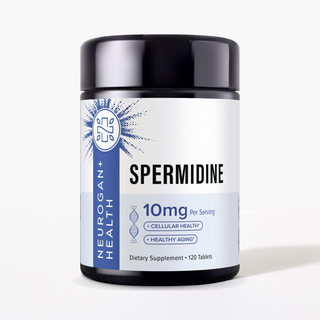
| Spermidine Tablets | 10 mg per tablet | Spermidine trihydrochloride |
| Spermidine Drops | 20 mg per 0.5 mL serving | Spermidine trihydrochloride |
| Liposomal Spermidine Capsules | 20 mg per capsule | Spermidine 3HCl/phospholipid complex |
| Spermidine Pro Capsules | 50 mg per serving | Spermidine trihydrochloride |
These are product formulation amounts, not clinically established therapeutic doses for longevity or anti-aging.
A 10 mg, 20 mg, or 50 mg product should therefore not be interpreted as meaning that the higher amount has been proven to provide greater clinical benefit.
Follow the product's labeled directions unless your qualified healthcare professional advises otherwise.
Is 10 mg of Spermidine Too Much?
There is no validated threshold showing that 10 mg/day is inherently “too much” for healthy adults.
Human studies have included amounts both below and above 10 mg/day.
However, the absence of a defined toxicity threshold does not mean that everyone needs 10 mg or that 10 mg has been proven to be more effective than lower amounts.
The relevant questions are:
- which formulation is being used;
- why it is being taken;
- how long it will be used;
- whether medications or medical conditions are present; and
- whether the amount matches the product's labeled serving.
What About 20 mg, 40 mg, or 50 mg of Spermidine?
Higher-dose human evidence is much more limited than the existence of high-dose commercial products might suggest.
20 mg per Day
There is not currently a large body of controlled human outcome research establishing 20 mg/day as an optimal longevity, autophagy, or cognitive dose.
40 mg per Day
The strongest direct evidence at this amount comes from a randomized study in 37 healthy men aged 50 to 70 [5].
Participants received 40 mg/day of high-purity spermidine for seven or 28 days.
Researchers reported:
- no significant differences in routine chemistry, lipid, hematology, or clinical safety measures versus placebo;
- no product-related adverse events; and
- minimal changes in circulating polyamine concentrations.
This supports short-term tolerability in that specific population.
It does not prove that 40 mg/day:
- is more effective than a lower dose;
- improves longevity;
- should be taken indefinitely; or
- is appropriate for every person.
50 mg per Day
There is currently much less published controlled human evidence at 50 mg/day than at lower study doses.
Therefore, a 50 mg formulation should not be described as a clinically proven “advanced longevity dose.”
Its presence on a supplement label describes the product's potency, not an established therapeutic target.
Spermidine Dosage for Autophagy
There is currently no clinically validated spermidine dose that has been proven to “switch on” a predictable amount of autophagy in humans.

One 2025 proof-of-concept pilot study investigated 1.5 mg/day and 3.3 mg/day from a spermidine-rich rice-germ extract for 56 days in just 12 adults [2].
In the 3.3 mg group, researchers reported increases from baseline in biomarkers including:
- Beclin-1;
- ULK1; and
- BDNF.
They also reported changes in several cardiometabolic biomarkers.
These findings are interesting, but the trial was extremely small and the authors themselves described it as proof-of-concept research requiring follow-up [2].
It is therefore too early to conclude that 3.3 mg is “the autophagy dose.”
For the mechanism itself, see our guide to spermidine and autophagy.
Spermidine Dosage for Longevity
No human spermidine dose has been proven to extend lifespan.
Animal longevity studies, dietary observational research, and cellular mechanisms have driven much of the interest in spermidine.
But those studies cannot establish a human “longevity dose.”
Even where higher dietary spermidine intake has been associated with lower mortality, observational associations do not show that taking the equivalent amount as a supplement will extend lifespan.
For a fuller review of those findings, see our spermidine benefits guide.
Spermidine Dosage for Memory and Brain Health
There is currently no established cognitive-health dose.
The largest longer-term randomized trial used 0.9 mg/day of spermidine from wheat-germ extract for 12 months in 100 adults aged 60 to 90 with subjective cognitive decline [1].
It did not significantly improve the trial's primary memory outcome versus placebo.
Exploratory findings suggested possible effects on verbal memory and inflammation, but those results require confirmation.
Therefore, 0.9 mg/day cannot be presented as a proven memory dose, and the negative primary result does not prove that simply increasing the dose would improve cognition.
Spermidine Dosage for Immune Function
A 2026 pilot trial used 6 mg/day for 13 weeks in 40 adults over age 65 following SARS-CoV-2 vaccination [3].
The study reported promising improvements in several vaccine-response and immune-senescence measures, especially among participants who initially responded poorly to vaccination.
However, that does not establish 6 mg/day as a general-purpose “immune dose.”
The study was small and involved a very specific older population and vaccination context.
Spermidine Dosage for Weight Loss
There is no validated spermidine dose for weight loss.
Although spermidine is involved in cellular metabolism and autophagy-related pathways, controlled human trials have not established that a particular dose reliably causes clinically meaningful weight loss.
A “spermidine weight-loss dose” should therefore not be inferred from animal studies or metabolic mechanisms.
Spermidine Dosage for Hair Growth
There is no generally established spermidine dose for treating hair loss.
Some human research has evaluated spermidine-containing nutritional preparations and hair-follicle outcomes, but those studies do not establish a universal dose of isolated spermidine for androgenetic alopecia or other forms of hair loss.
Results from multi-ingredient products should also not automatically be attributed to spermidine alone.
How Much Spermidine Is Too Much?
A universally accepted maximum safe daily intake for supplemental spermidine has not been established.
The fact that 40 mg/day was well tolerated for up to 28 days in one controlled study does not establish 40 mg—or any higher amount—as a long-term upper intake level [5].
“Too much” also depends on factors such as:
- the exact ingredient form;
- duration of use;
- other supplements;
- medications;
- medical conditions;
- pregnancy or breastfeeding; and
- the evidence supporting the intended use.
More should not be assumed to be better simply because short-term safety data exist at a higher amount.
Can You Take Spermidine Every Day?
Several human studies have administered spermidine daily, including studies lasting weeks or months, and the SmartAge trial administered a wheat-germ spermidine preparation daily for 12 months [1].
That tells us that daily administration has been studied.
It does not establish that every dose and formulation is appropriate for indefinite daily use.
Long-term safety data remain much less extensive than the widespread commercial use of spermidine supplements.
How Long Should You Take Spermidine?
There is no universally established treatment duration.
Human studies have ranged from:
- five days for pharmacokinetics [4];
- several weeks for biomarker and safety studies [2,5];
- 13 weeks for the immune pilot [3]; and
- 12 months for cognition [1].
Those durations were determined by study design and should not be interpreted as prescribed treatment courses.
Should You Take Spermidine in the Morning or at Night?
Human evidence has not established one clinically superior time of day.
This question appeared repeatedly in the PAA data, but it is a timing question rather than a dosage question.
For the full evidence review, see our guide to the best time to take spermidine.
Should Spermidine Be Taken With Food?
There is not enough comparative clinical evidence to say that taking spermidine with food universally produces better clinical outcomes.
Specific products may provide their own administration instructions based on formulation.
Follow the label directions for the product you use unless a healthcare professional advises otherwise.
What Should You Not Take With Spermidine?
This was the single most repeated question across the PAA dataset.
There is not currently a well-established list of supplements or medications that must universally be avoided with spermidine.
However, supplement-interaction data are limited, particularly for:
- prescription medications;
- complex supplement combinations;
- people undergoing cancer treatment;
- pregnant or breastfeeding individuals; and
- people with significant medical conditions.
Someone taking prescription medication or receiving treatment for a medical condition should discuss supplementation with their healthcare professional rather than relying on a general interaction list.
For a more detailed discussion, see our guide to spermidine side effects and safety.
Is Spermidine Hard on the Liver?
Available short-term human trials have not established spermidine as inherently hepatotoxic at the studied doses, but long-term high-dose liver-safety data remain limited.
In the 40 mg/day trial, researchers did not report significant changes in routine clinical chemistry measures compared with placebo over the short study period [5].
That is reassuring but should not be interpreted as proof that all doses are harmless to the liver over years of use.
Anyone with liver disease or abnormal liver tests should discuss supplement use with their healthcare professional.
Spermidine Dosage FAQ
How many milligrams of spermidine should I take per day?
There is no universally established daily therapeutic dose. Human studies have used amounts ranging from less than 1 mg/day to 40 mg/day depending on the formulation, population, duration, and research question.
Is 3 mg of spermidine enough?
A small 2025 pilot found biomarker changes with 3.3 mg/day of spermidine from rice-germ extract, but the study included only 12 participants and does not establish 3 mg as an optimal dose [2].
Is 6 mg of spermidine enough?
Six milligrams per day was used in a small 2026 immune-response trial in adults over 65, but that does not establish 6 mg as a universal effective dose [3].
Is 10 mg of spermidine too much?
No established clinical threshold defines 10 mg/day as excessive, but there is also no evidence showing that everyone benefits from taking 10 mg. Dose suitability depends on formulation, intended use, health status, and other factors.
Can you take 20 mg of spermidine per day?
Commercial products provide amounts around this level, but controlled human outcome evidence specifically establishing 20 mg/day as optimal is limited. Follow the product directions and discuss higher-dose supplementation with a qualified healthcare professional when appropriate.
Is 40 mg of spermidine safe?
In one randomized study, 40 mg/day of high-purity spermidine was well tolerated for up to 28 days in 37 healthy men aged 50 to 70 [5]. This does not establish long-term safety or prove that 40 mg provides greater benefit.
Is 50 mg of spermidine too much?
There is currently substantially less controlled human research at 50 mg/day than at lower amounts. A 50 mg product should therefore not be interpreted as representing a clinically established longevity or anti-aging dose.
What is the best spermidine dosage for autophagy?
No clinically validated autophagy dose currently exists. A small 12-person pilot reported changes in several autophagy-related biomarkers at 3.3 mg/day of rice-germ-derived spermidine, but those findings need replication [2].
Can I take spermidine every day?
Daily administration has been used in several human studies, including one lasting 12 months. However, evidence is not sufficient to establish every formulation and dose as appropriate for indefinite daily use.
Does higher-dose spermidine work better?
That has not been established. Human research does not currently demonstrate a simple relationship where increasing the dose reliably increases clinical benefit.
Key Takeaway
There is no scientifically established universal spermidine dose for longevity, autophagy, cognition, weight loss, or anti-aging.
Human research has tested a wide range of amounts, but each study answers a different question:
- 0.9 mg/day was tested for cognition over 12 months and did not improve the primary outcome [1];
- 3.3 mg/day produced preliminary biomarker signals in a very small pilot [2];
- 6 mg/day produced promising immune-response findings in a specific older population [3];
- 15 mg/day helped clarify short-term polyamine pharmacokinetics [4]; and
- 40 mg/day provided useful short-term safety information in healthy older men [5].
None of these studies establishes a universal “best dose.”
The most important principles are:
- do not confuse a study dose with a recommendation;
- do not assume a higher dose works better;
- do not assume different spermidine formulations are clinically equivalent;
- distinguish short-term safety from long-term safety;
- distinguish biomarkers from proven health outcomes; and
- follow the labeled directions for the specific product you use.
For related questions, see:
- what spermidine is;
- spermidine benefits;
- spermidine and autophagy;
- when to take spermidine;
- spermidine side effects and safety; and
- how to compare spermidine supplements.
Resources:
- Schwarz C, Benson GS, Horn N, et al. Effects of Spermidine Supplementation on Cognition and Biomarkers in Older Adults With Subjective Cognitive Decline: A Randomized Clinical Trial. JAMA Network Open. 2022;5(5):e2213875. doi:10.1001/jamanetworkopen.2022.13875.
- Bruno G, La Monica M, Ziegenfuss TN. Effects of Spermidine-Rich Rice Germ Extract Supplement on Biomarkers of Healthy Aging and Autophagy—Proof-of-Concept Pilot Study. Alternative Therapies in Health and Medicine. 2025;31(6):9-13. PMID: 40862848.
- Spermidine Mitigates Immune Cell Senescence and Boosts Vaccine Responses in Healthy Older Adults—A Pilot Study. 2026. PMID: 42169618.
- Senekowitsch S, Wietkamp E, Grimm M, et al. High-Dose Spermidine Supplementation Does Not Increase Spermidine Levels in Blood Plasma and Saliva of Healthy Adults: A Randomized Placebo-Controlled Pharmacokinetic and Metabolomic Study. Nutrients. 2023;15(8):1852. doi:10.3390/nu15081852.
- Keohane P, Everett JR, Pereira R, et al. Supplementation of spermidine at 40 mg/day has minimal effects on circulating polyamines: An exploratory double-blind randomized controlled trial in older men. Nutrition Research. 2024;132:1-14. doi:10.1016/j.nutres.2024.09.012.
Disclaimer:
The Food and Drug Administration has not evaluated the statements made regarding these products. These products are not intended to diagnose, treat, cure, or prevent any disease. The information in this article is for educational purposes and is not a substitute for advice from a qualified healthcare professional. Speak with your healthcare professional before using a dietary supplement, particularly if you have a medical condition, take medication, are pregnant or breastfeeding, or are considering combining multiple supplements.