


Spermidine supports autophagy, which is the body’s built-in cleanup mode. Resveratrol activates pathways linked to longevity genes and mimics some of the metabolic effects of eating less. Rapamycin dials down a growth-signaling switch that, when chronically overactive, appears to speed up aging.
Different mechanisms, but they're all working on the same underlying problem.
What Are Longevity Compounds?
Longevity compounds are a broad term for substances that appear to extend lifespan or healthspan (the years you spend in good health, not just alive) in laboratory organisms. Some have human data. Many don't. The category includes everything from pharmaceutical drugs to natural molecules found in food.
What ties spermidine, resveratrol, and rapamycin together is a shared connection to caloric restriction mimetics, compounds that appear to reproduce some of the well-documented anti-aging benefits of eating significantly less, without actually reducing calorie intake.
Decades of research across species from yeast to primates suggest that caloric restriction extends lifespan. These three compounds each tap into that biology through different molecular pathways.
How Spermidine Works: Autophagy Inducer
Spermidine belongs to a class of molecules called polyamines, organic compounds with multiple amino groups that play roles in cell growth, DNA stabilization, and gene expression.
Your body makes spermidine naturally, and you also get it from foods like wheat (specifically wheat germ), aged cheese, mushrooms, and legumes. But levels decline with age, and that decline tracks with reduced autophagy.
How Spermidine Triggers Cellular Cleanup
Spermidine is one of the most studied natural inducers of autophagy.
Spermidine triggers autophagy mainly by inhibiting a group of enzymes called acetyltransferases (EP300) [1]. When these enzymes are dialed down, the cell's cleanup machinery kicks into gear.
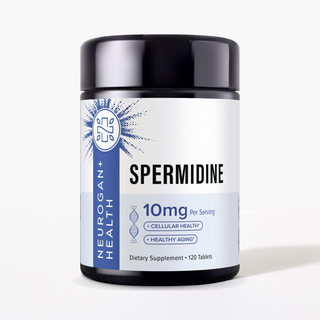
Spermidine also activates a protein called eIF5A through a process called hypusination, which helps produce the proteins needed for autophagy and healthy mitochondrial function [2]. Two separate mechanisms, both pointing the cell in the same direction.
How Resveratrol Works: Sirtuin Activation and the SIRT1 Pathway
Resveratrol is a polyphenol found in red grape skins, some berries, and peanuts. It entered the longevity conversation in the early 2000s when Dr. David Sinclair's lab at Harvard identified it as a potent activator of SIRT1 [3, 4].
Sirtuins are a family of NAD+-dependent enzymes that regulate gene expression, metabolism, and stress responses. SIRT1 is the member most closely linked to the longevity benefits of caloric restriction.
The basic idea: when you eat less, NAD+ levels rise, which activates sirtuins, which shift cells into a kind of stress-resistance and repair mode.
Resveratrol was identified as a way to activate SIRT1 without the calorie deficit [5]. It belongs to a class of molecules called STACs (sirtuin-activating compounds), and early research in yeast, worms, and mice generated significant excitement.
The Bioavailability Problem
Resveratrol has a well-known bioavailability problem. Most of it gets broken down in the gut and liver before it ever reaches target tissues, which means the dramatic effects seen in mouse studies don't always translate to humans at realistic doses.
Trans-resveratrol is the more bioavailable form worth knowing about.
It's the active isomer of resveratrol and is absorbed more efficiently than standard resveratrol supplements, making it a better starting point if you're looking to actually move the needle on circulating levels.
How Rapamycin Works: mTOR Inhibition and Cellular Growth Regulation
Rapamycin is a prescription immunosuppressant originally isolated from soil bacteria on Easter Island (the island's Polynesian name, Rapa Nui, gave the drug its name).
It works by directly inhibiting mTOR (mechanistic target of rapamycin), the master growth-regulating complex in your cells. Rapamycin literally named the pathway.
mTOR comes in two complexes: mTORC1 and mTORC2.
Rapamycin primarily targets mTORC1, which acts like your cell's grow-and-build switch. When nutrients are abundant, mTORC1 drives protein synthesis, cell growth, and proliferation. When mTORC1 is inhibited by rapamycin, cells shift toward maintenance mode: they slow growth, increase autophagy, and clear damaged components.
Growth Versus Maintenance
The logic behind rapamycin for longevity is essentially this: aging may be partly driven by the persistence of growth signaling in adult cells that no longer need to grow.
mTORC1 overactivity is linked to cancer, neurodegeneration, and metabolic dysfunction [6]. By turning down that signal, rapamycin appears to push cells toward repair rather than proliferation.
In mouse studies, rapamycin has consistently extended lifespan, even when administered late in life.
A significant component of that lifespan extension might come from rapamycin's anti-cancer properties, since cancer is the primary cause of death in most mouse strains used in longevity research [7].
Comparing Mechanisms: Autophagy, Sirtuins, and mTOR
These three compounds represent distinct approaches to reproducing the longevity benefits of caloric restriction. Here's how their primary mechanisms map out:
|
Feature |
Spermidine |
Resveratrol |
Rapamycin |
|
Primary Target |
Acetyltransferases (EP300) |
SIRT1 / Sirtuins |
mTORC1 |
|
Primary Action |
Autophagy induction |
Sirtuin activation |
Growth signal inhibition |
|
Autophagy Effect |
Direct, primary mechanism |
Indirect, via SIRT1-mediated pathways |
Indirect, via mTORC1 suppression |
|
CR Mimicry Route |
Polyamine-acetylation axis |
NAD+/sirtuin axis |
Nutrient-sensing / mTOR axis |
|
Source |
Natural polyamine (food, endogenous) |
Plant polyphenol (food) |
Bacterial metabolite (Rx drug) |
What's interesting is that all three compounds end up in the same place:
-
Spermidine triggers autophagy directly
-
Rapamycin removes the brake that normally suppresses it
-
Resveratrol gets there through a different route but arrives at the same destination.
Three different mechanisms, one outcome. That's led some researchers to suggest that autophagy itself (not any single upstream pathway) may be the key shared mechanism behind the anti-aging effects of caloric restriction and the compounds that mimic it.
Evidence and Research: From Yeast to Human Trials
The three compounds covered here sit at different points on the research spectrum. Some have decades of data behind them, others are still in early human trials.
Spermidine
Spermidine has consistently extended lifespan across yeast, flies, worms, and mice [8].
In humans, the Bruneck Study followed over 800 people for 20 years and found that higher dietary intake of spermidine was associated with significantly lower all-cause mortality [9].
It's observational data, so it's not proof, but the findings held up across subgroups and were independently replicated, making it one of the strongest observational findings we can refer to.
Resveratrol
Resveratrol extended lifespan in yeast, worms, and some fish models, but the record in mice is mixed. In the NIA's Interventions Testing Program, which is considered the gold standard for mouse longevity testing, it didn't significantly extend lifespan [10, 11].
Human trials have shown inconsistent results across metabolic, cardiovascular, and inflammation markers [12]. Whether that's because resveratrol doesn't work in humans or simply doesn't absorb well enough to have an effect remains an open question.
Rapamycin
Rapamycin has the strongest mouse data of the three. In the NIA's Interventions Testing Program, it extended median lifespan by roughly 10–15%, and notably, it worked even when treatment started late in life, equivalent to beginning at age 60 in humans [13]. That finding got a lot of attention in aging research.
Human data is still limited. A 2014 Novartis study found that a rapamycin analog improved immune function in older adults, partially reversing age-related immune decline [14]. Several small trials are underway, but large-scale human longevity data doesn't exist yet.
Safety, Side Effects, and Accessibility
The three compounds differ significantly in safety, accessibility, and the level of oversight required for their use.
Spermidine
Spermidine is available over the counter as a dietary supplement, typically derived from wheat germ extract, but you can also find it in a pure synthetic spermidine 3HCl format, which might be a better option for those avoiding wheat and gluten.
It has a long history of dietary exposure (humans have consumed polyamine-rich foods for millennia), and clinical trials to date have reported no serious adverse effects at supplemental doses.
It's not FDA-approved as a drug, but as a dietary supplement, it's widely accessible and available in capsules, drops, and gummies. For most adults, it carries a favorable safety profile based on available evidence.
Resveratrol
Resveratrol is widely available as a dietary supplement and generally considered safe at typical doses (200-500 mg). The bigger question isn't safety but whether enough is actually absorbed to offer any significant benefits. This is why we always opt for trans-resveratrol, which is the most active form of resveratrol.
Some people experience mild GI discomfort at higher doses, and it may interact with blood thinners, so check with your doctor if that's relevant.
Rapamycin
Rapamycin is a prescription drug, FDA-approved as an immunosuppressant for organ transplant recipients and certain cancers. At those clinical doses, side effects can include impaired wound healing, increased risk of infection, and metabolic changes.
Longevity-focused physicians who prescribe it off-label typically use much lower doses, often once weekly rather than daily, on the theory that intermittent use captures the anti-aging benefits without the chronic immunosuppression associated with daily use.
That's a reasonable hypothesis, but it hasn't been validated in large controlled trials. Rapamycin is not something to self-prescribe.
Here's a quick comparison of access and safety considerations:
|
Factor |
Spermidine |
Resveratrol |
Rapamycin |
|
Availability |
OTC supplement |
OTC supplement |
Prescription only |
|
FDA Status |
Dietary supplement |
Dietary supplement |
Approved drug (transplant, cancer) |
|
Common Concerns |
Minimal reported side effects |
Low bioavailability; GI upset at high doses |
Immunosuppression; metabolic side effects |
|
Medical Supervision |
Not typically required |
Recommended if on medications |
Required |
Which Longevity Compound Is Right for You?
There's no universal winner here, and anyone who tells you otherwise is selling something.
The right choice depends on where you are in your health journey, your risk tolerance, and how much clinical evidence you need before you try something.
If You Want the Lowest Barrier to Entry
Spermidine is the most accessible option.
It's available without a prescription, found naturally in food, and has a safety track record that goes back as far as human diets do.
The research on dietary spermidine supplements is still early-stage, but the epidemiological data linking dietary spermidine to longevity outcomes are consistent, and the mechanistic evidence for autophagy induction is well established in research settings. If you want to add a longevity-oriented supplement and you're not ready for prescription territory, spermidine is a reasonable starting point.
If You're Already in the Supplement Space
Resveratrol is widely available and inexpensive, and there's a plausible mechanism behind its potential benefits.
But the mixed clinical results and persistent questions about bioavailability mean expectations should be calibrated accordingly. Some researchers are working on modified formulations to improve absorption. For now, resveratrol may be most useful as one component of a broader polyphenol-rich diet rather than a standalone longevity strategy.
If You're Working with a Longevity-Focused Physician
Rapamycin has the strongest preclinical lifespan data, but it's also the only option that requires a prescription and medical monitoring.
Off-label use for longevity is gaining traction in certain medical circles, but long-term safety data for low-dose intermittent protocols in healthy adults don't yet exist. This is not a supplement you order online and experiment with on your own.
Can You Stack Them?
Some people in the longevity space combine these compounds on the logic that hitting different pathways simultaneously could produce additive benefits.
That reasoning isn't unreasonable in theory. Spermidine promotes autophagy directly, resveratrol activates sirtuins, and rapamycin suppresses mTOR. These are distinct mechanisms.
But stacking hasn't been studied in controlled human trials, and more compounds don't automatically mean more benefit. If you're considering combining any of these, especially rapamycin with anything else, work with a physician who understands the pharmacology.
References
-
Pietrocola, F., Lachkar, S., Enot, D. P., Niso-Santano, M., Bravo-San Pedro, J. M., Sica, V., ... & Kroemer, G. (2015). Spermidine induces autophagy by inhibiting the acetyltransferase EP300. Cell Death & Differentiation, 22(3), 509-516.
-
Hofer, S. J., Daskalaki, I., Bergmann, M., Friščić, J., Zimmermann, A., Mueller, M. I., ... & Madeo, F. (2024). Spermidine is essential for fasting-mediated autophagy and longevity. Nature cell biology, 26(9), 1571-1584.
-
Xu, Y., Fang, M., Li, X., Wang, D., Yu, L., Ma, F., ... & Li, P. (2024). Contributions of common foods to resveratrol intake in the Chinese diet. Foods, 13(8), 1267.
-
Blagosklonny, M. V. (2010). Linking calorie restriction to longevity through sirtuins and autophagy: any role for TOR. Cell death & disease, 1(1), e12.
-
Howitz, K. T., Bitterman, K. J., Cohen, H. Y., Lamming, D. W., Lavu, S., Wood, J. G., ... & Sinclair, D. A. (2003). Small molecule activators of sirtuins extend Saccharomyces cerevisiae lifespan. Nature, 425(6954), 191-196.
-
Ben-Sahra, I., & Manning, B. D. (2017). mTORC1 signaling and the metabolic control of cell growth. Current opinion in cell biology, 45, 72-82.
-
Harrison, D. E., Strong, R., Sharp, Z. D., Nelson, J. F., Astle, C. M., Flurkey, K., ... & Miller, R. A. (2009). Rapamycin fed late in life extends lifespan in genetically heterogeneous mice. nature, 460(7253), 392-395.
-
Madeo, F., Eisenberg, T., Büttner, S., Ruckenstuhl, C., & Kroemer, G. (2010). Spermidine: a novel autophagy inducer and longevity elixir. Autophagy, 6(1), 160-162.
-
Kiechl, S., Pechlaner, R., Willeit, P., Notdurfter, M., Paulweber, B., Willeit, K., ... & Willeit, J. (2018). Higher spermidine intake is linked to lower mortality: a prospective population-based study. The American journal of clinical nutrition, 108(2), 371-380.
-
Zou, S., Carey, J. R., Liedo, P., Ingram, D. K., Müller, H. G., Wang, J. L., ... & Zhou, A. (2009). The prolongevity effect of resveratrol depends on dietary composition and calorie intake in a tephritid fruit fly. Experimental gerontology, 44(6-7), 472-476.
-
Valenzano, D. R., Terzibasi, E., Genade, T., Cattaneo, A., Domenici, L., & Cellerino, A. (2006). Resveratrol prolongs lifespan and retards the onset of age-related markers in a short-lived vertebrate. Current biology, 16(3), 296-300.
-
Berman, A. Y., Motechin, R. A., Wiesenfeld, M. Y., & Holz, M. K. (2017). The therapeutic potential of resveratrol: a review of clinical trials. NPJ precision oncology, 1(1), 35.
-
Harrison, D. E., Strong, R., Sharp, Z. D., Nelson, J. F., Astle, C. M., Flurkey, K., ... & Miller, R. A. (2009). Rapamycin fed late in life extends lifespan in genetically heterogeneous mice. nature, 460(7253), 392-395.
-
Mannick, J. B., Del Giudice, G., Lattanzi, M., Valiante, N. M., Praestgaard, J., Huang, B., ... & Klickstein, L. B. (2014). mTOR inhibition improves immune function in the elderly. Science translational medicine, 6(268), 268ra179-268ra179.

