
Yes. Human studies show that fasting can increase circulating spermidine, and laboratory research suggests that endogenous spermidine is an important part of the cellular autophagy response to fasting.
A major 2024 study found that spermidine levels increased during different fasting or caloric-restriction conditions across yeast, flies, mice, and human volunteers. When researchers experimentally interfered with the body's ability to produce spermidine, fasting-induced autophagy was reduced in several model systems, including human cells. [1]
That finding helps explain why spermidine has become closely linked with fasting and longevity research.
But there is an important distinction:
The study does not show that taking a spermidine supplement is equivalent to fasting, nor has research established a specific number of fasting hours required to maximize spermidine or autophagy in humans.
Spermidine and Fasting at a Glance
| Question | What the evidence currently shows |
|---|---|
| Does fasting increase spermidine? | Yes. Increased spermidine has been measured under multiple fasting conditions, including in human participants. |
| Is spermidine involved in fasting-induced autophagy? | Experimental evidence strongly supports a role for endogenous spermidine and eIF5A hypusination in the fasting-autophagy response. |
| How long must you fast to increase spermidine? | No specific duration has been established as optimal in humans. |
| Does a 16-hour fast increase spermidine? | There is not enough direct human evidence to say that 16 hours is a required or optimal threshold. |
| Can spermidine mimic fasting? | It can reproduce some fasting-associated cellular pathways in experimental research, which is why it is described as a caloric-restriction mimetic. It does not reproduce every effect of fasting. |
| Does taking spermidine during a fast increase autophagy? | This has not been established in human clinical trials. |
| How much spermidine triggers autophagy? | No clinically established dose exists for triggering autophagy in humans. |
What Is Spermidine?
Spermidine is a naturally occurring polyamine found throughout living organisms.
Your cells produce it internally, intestinal microbes can contribute to polyamine metabolism, and spermidine is also present in foods such as wheat germ, soybeans, legumes, mushrooms, whole grains, and some aged cheeses.
Spermidine participates in several fundamental cellular processes, including protein synthesis, gene regulation, cell growth, and maintenance of cellular homeostasis.
One reason it receives so much attention in healthy-aging research is its connection with autophagy — the cellular recycling system responsible for breaking down and reusing damaged proteins and cellular components.
For a broader overview, see our complete guide to spermidine.
Does Fasting Increase Spermidine?
Yes. The best current evidence indicates that fasting can increase endogenous — internally produced — spermidine.
A 2024 study published in Nature Cell Biology examined the relationship between fasting, polyamine metabolism, and autophagy across multiple species. [1]
Researchers reported increases in spermidine during different forms of nutrient deprivation or fasting in:
- yeast;
- fruit flies;
- mice;
- human cell models; and
- human volunteers.
The human component is particularly important because it shows that the fasting–spermidine relationship is not limited to mice or laboratory cells.
In clinically supervised prolonged fasting, serum spermidine increased significantly. The researchers also reported fasting-associated increases across additional human fasting cohorts using different protocols. [1]
This does not mean that every fasting schedule raises spermidine by the same amount, or that more fasting always produces more spermidine.

It shows that increased endogenous spermidine appears to be part of the metabolic response to fasting.
What Did the 2024 Fasting and Spermidine Study Find?
The most important finding went beyond simply measuring higher spermidine levels.
The researchers asked whether spermidine was actually involved in the biological effects of fasting.
They experimentally blocked or disrupted endogenous spermidine synthesis.
When they did this, fasting-induced autophagy was reduced in:
- yeast;
- nematodes; and
- human cells. [1]
In model organisms, disrupting polyamine metabolism also interfered with several fasting-associated effects involving lifespan, healthspan, cardiac function, and inflammatory disease models. [1]
This suggests that spermidine is not simply a molecule that happens to rise during fasting.
It appears to participate in a conserved cellular pathway that helps translate nutrient deprivation into increased autophagic activity.
However, the causal longevity and disease-related experiments were primarily conducted in model organisms.
Researchers did not experimentally block spermidine synthesis in fasting humans and show that human longevity benefits disappeared.
That distinction is essential when translating this research into practical health claims.
How Does Spermidine Connect Fasting to Autophagy?
Autophagy is a cellular quality-control and recycling system.
Cells use it to identify and break down damaged proteins, worn-out organelles, and other material that is no longer functioning properly.
Fasting is one of several conditions known to affect autophagy-related pathways.
The 2024 study identified an important mechanism connecting fasting with spermidine:
the spermidine–eIF5A hypusination pathway.
Spermidine is required for a unique biochemical modification called hypusination of eIF5A, a translation factor involved in producing specific proteins. [1]
During fasting, increased spermidine supports eIF5A hypusination, which in turn affects the production of proteins involved in autophagic machinery and regulation.
The simplified pathway looks roughly like this:
Fasting → increased endogenous spermidine → eIF5A hypusination → increased autophagy-related signaling
Related research has described this polyamine–hypusination pathway as an important conserved metabolic link between fasting and autophagy. [1,2]
For the full autophagy mechanism beyond fasting, see our guide to spermidine and autophagy.
Does Spermidine Trigger Autophagy?
Spermidine can promote autophagy in experimental systems, but there is no simple human threshold at which taking a certain amount reliably “switches on” autophagy throughout the body.
Spermidine has been linked with autophagy through more than one molecular pathway.
Earlier research found that spermidine can inhibit the acetyltransferase EP300, an endogenous regulator that normally suppresses aspects of autophagic activity. [3]
The newer fasting research adds the eIF5A hypusination pathway and shows that endogenous spermidine metabolism is tightly connected to the cellular fasting response. [1]
These findings are mechanistically strong.
What they do not provide is an evidence-based consumer rule such as:
- “take X mg to enter autophagy,” or
- “fast X hours and autophagy begins.”
Human autophagy is a dynamic cellular process that differs between tissues and cannot be reduced to a single universal timer or supplement dose.
How Long Do You Need to Fast to Increase Spermidine?
Research has not established a specific number of fasting hours that maximizes spermidine in humans.
This is one of the most important practical limitations of the current research.
The 2024 study included data from several different fasting conditions rather than a controlled comparison of:
- 12 hours versus 16 hours;
- 16 hours versus 18 hours;
- 18 hours versus 24 hours; or
- one fasting schedule versus another specifically for spermidine production.
Increased spermidine was observed under multiple nutrient-restriction conditions, ranging from shorter fasting exposures to prolonged medically supervised fasting. [1]
But that does not tell us that a particular duration is optimal.
So claims that you must fast for exactly 16, 18, 24, or another number of hours to raise spermidine are more precise than the evidence currently allows.
Does a 16-Hour Fast Increase Spermidine?
It is biologically plausible that time-restricted fasting may influence pathways involved in polyamine metabolism, but current human research does not establish 16 hours as a specific spermidine threshold.
The frequently used 16:8 fasting schedule is a practical eating pattern, not a scientifically established switch for spermidine production or whole-body autophagy.
Researchers would need direct head-to-head measurements across controlled fasting durations to determine whether 16 hours differs meaningfully from 12, 18, or 24 hours for spermidine production.
Those data are not currently sufficient to make that recommendation.
What About Intermittent Fasting?
Intermittent fasting covers several different eating patterns, including:
- daily time-restricted eating;
- alternate-day fasting;
- 5:2-style approaches; and
- longer periodic fasting.
The 2024 spermidine study included evidence from more than one fasting model, including intermittent approaches. [1]
That supports the broader conclusion that nutrient deprivation can affect spermidine metabolism.
It does not establish which intermittent-fasting schedule produces the greatest increase, nor whether maximizing spermidine should be a practical fasting goal.
Can Spermidine Mimic Fasting?
Spermidine can mimic some cellular effects associated with fasting and caloric restriction, but taking spermidine is not biologically equivalent to fasting.
This distinction explains the term caloric restriction mimetic.
Researchers use this term for compounds that reproduce selected molecular or cellular effects associated with caloric restriction without requiring the same reduction in energy intake. [4]
Spermidine is included in this research category because it can influence pathways such as:
- autophagy;
- protein acetylation;
- eIF5A hypusination;
- cellular stress responses; and
- mitochondrial quality control.
But fasting affects much more than spermidine.
Fasting can also alter:
- insulin and glucose metabolism;
- fatty-acid utilization;
- ketone production;
- mTOR and AMPK signaling;
- hormones;
- circadian biology;
- gut physiology; and
- overall energy balance.
A spermidine supplement should therefore not be described as “fasting in a capsule.”
The scientifically defensible statement is that spermidine may reproduce some fasting-associated cellular pathways, particularly pathways connected with autophagy.
Why Is Spermidine Called a Caloric Restriction Mimetic?
Spermidine is described as a caloric restriction mimetic because experimental studies show that it can induce some of the same cellular maintenance pathways associated with caloric restriction without requiring an equivalent reduction in food intake. [4]
Autophagy is central to this classification.
Research into caloric restriction mimetics has proposed several compounds — including spermidine — that affect nutrient-sensing, protein acetylation, stress responses, and cellular recycling. [4]
Importantly, “mimetic” means partial biological overlap, not complete equivalence.
Spermidine does not recreate every metabolic, hormonal, or physiological consequence of caloric restriction.
Does Caloric Restriction Also Increase Spermidine?
Yes, experimental evidence indicates that caloric restriction can influence spermidine metabolism in addition to fasting. [1]
The 2024 study reported changes in polyamine metabolism under both fasting and caloric-restriction conditions across experimental systems.
This supports the idea that spermidine metabolism is linked with cellular responses to reduced nutrient availability more broadly, rather than only to one specific fasting schedule.
Can You Take Spermidine While Fasting?
There is no established requirement to take a spermidine supplement during a fasting window in order to obtain a biological effect.
More importantly, human trials have not established that taking supplemental spermidine while fasting produces greater autophagy than fasting alone.
The 2024 research primarily investigated the rise in endogenous spermidine — spermidine generated within the body during fasting — and its role in fasting biology. [1]
That is different from testing whether swallowing a spermidine supplement during a fast improves the fasting response.
If you use spermidine supplements, timing questions are better considered separately from the fasting mechanism. See our guide on when to take spermidine.
Does Spermidine Break a Fast?
There is no universal scientific definition of what “breaks a fast,” and the answer depends partly on the fasting goal and the supplement formulation.
A strict zero-calorie fast may define any supplement containing caloric ingredients or added food components as outside the protocol.
Some capsules may contain only very small quantities of non-active ingredients, while other products may contain oils, carbohydrates, extracts, flavorings, or other components.
What matters scientifically is that we currently do not have good human evidence showing that taking a spermidine supplement during fasting either preserves or enhances fasting-induced autophagy.
So it would be inappropriate to claim that supplemental spermidine definitely “doesn't break autophagy” or that it enhances a fast.
For medical, religious, research, or strictly defined fasting protocols, follow the rules of that specific protocol rather than assuming a supplement is compatible.
Can Spermidine Replace Fasting?
No evidence currently shows that spermidine supplementation can replace fasting.
The relationship is more interesting than that.
Fasting appears to increase endogenous spermidine, and spermidine appears to help mediate part of the fasting-autophagy response. [1]
That means the two processes are biologically connected.
It does not demonstrate that:
spermidine supplement = fasting.
Clinical trials would need to directly compare fasting, supplemental spermidine, their combination, and control conditions while measuring validated human outcomes before we could make that conclusion.
How Much Spermidine Is Needed for Autophagy?
There is no clinically established spermidine dose that has been proven to trigger meaningful whole-body autophagy in humans.
Preclinical experiments use a wide range of concentrations and models, and human supplement studies have used different formulations and doses.
Those data cannot be converted into a universal consumer “autophagy dose.”
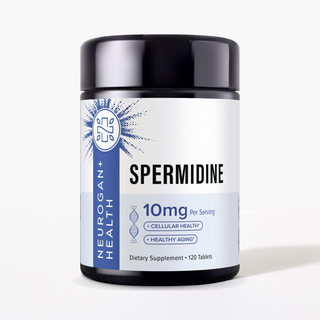
A small 2025 proof-of-concept pilot studied 1.5 mg and 3.3 mg of spermidine from rice-germ extract in 12 adults and measured circulating markers related to autophagy. The study was very small and does not establish a clinically validated autophagy dose. [5]
For a broader review of doses actually tested in humans, see our spermidine dosage guide.
Can You Increase Spermidine Without Fasting?
Yes. Fasting is not the only source of spermidine.
Your body synthesizes it, and spermidine is also present in the diet.
Common dietary sources include:
- wheat germ;
- soybeans and soy foods;
- legumes;
- mushrooms;
- whole grains;
- nuts and seeds; and
- some aged cheeses.
For detailed food amounts and comparisons, see our guide to foods highest in spermidine.
Supplements provide another route, but the fact that fasting raises endogenous spermidine does not prove that supplementation reproduces the same physiological state.
Does More Spermidine Mean More Autophagy?
Not necessarily.
Biological pathways rarely follow a simple “more is always better” relationship.
The body tightly regulates polyamine synthesis, conversion, transport, and breakdown.
Experimental evidence that spermidine participates in autophagy does not mean progressively higher supplement doses produce progressively greater or more beneficial autophagy in humans.
No validated human dose-response curve currently demonstrates that relationship.
Fasting Safety: Longer Is Not Automatically Better
The fasting research discussed here should not be interpreted as a recommendation to undertake prolonged fasting to increase spermidine.
Longer fasting periods are not automatically more beneficial and may create risks for some people.
Intermittent or prolonged fasting may be inappropriate without medical guidance for people who are pregnant or breastfeeding, younger than 18, have a history of eating disorders, use insulin or other glucose-lowering medication, experience hypoglycemia, or have medical conditions affected by changes in food intake.
Anyone considering prolonged fasting or major changes to an existing medical nutrition plan should discuss it with an appropriate healthcare professional.
Frequently Asked Questions
Does fasting increase spermidine?
Yes. A 2024 study found that fasting or caloric restriction increased spermidine under multiple experimental conditions, including in human participants. The study also found that endogenous spermidine metabolism played an important role in fasting-induced autophagy. [1]
How long do you need to fast to increase spermidine?
There is no established optimal fasting duration for increasing spermidine in humans. Spermidine increases have been observed under different fasting protocols, but researchers have not shown that 16, 18, 24, or another specific number of hours is ideal.
Does spermidine trigger autophagy?
Spermidine promotes autophagy in experimental research through pathways involving EP300 and eIF5A hypusination. However, no clinically established supplement dose has been proven to trigger whole-body autophagy in humans.
Can spermidine mimic fasting?
Spermidine can mimic some cellular pathways associated with fasting or caloric restriction, particularly autophagy-related pathways. It does not reproduce all of the metabolic and hormonal effects of fasting.
Is spermidine a caloric restriction mimetic?
Yes, spermidine is commonly classified in research literature as a caloric restriction mimetic because it can reproduce selected cellular effects associated with caloric restriction without requiring the same reduction in calories. This does not mean it is equivalent to caloric restriction.
Can you take spermidine while fasting?
There is no established need to take spermidine during a fasting window, and human research has not shown that taking supplemental spermidine while fasting increases autophagy beyond fasting alone.
Does spermidine break a fast?
It depends on how the fast is defined and what else is contained in the supplement. More importantly, there is no clinical evidence establishing that taking spermidine during a fast preserves or enhances fasting-induced autophagy. For strict fasting protocols, follow the rules of that specific protocol.
How much spermidine is needed for autophagy?
There is no clinically established spermidine dose for triggering autophagy in humans. Human studies have examined different doses and biomarkers, but the evidence is not sufficient to define an “autophagy dose.”
The Bottom Line
The connection between fasting and spermidine is stronger than a simple association.
Human studies show that spermidine can rise during fasting, while laboratory experiments indicate that endogenous spermidine and eIF5A hypusination are important components of the fasting-induced autophagy response. [1]
That makes spermidine a compelling part of the biology of fasting.
But several popular conclusions go beyond the evidence.
Research has not established:
- an optimal number of fasting hours for maximizing spermidine;
- that a 16-, 18-, or 24-hour fast represents a universal autophagy threshold;
- a spermidine supplement dose that reliably triggers autophagy in humans;
- that taking spermidine during a fast increases fasting-induced autophagy; or
- that supplementation reproduces all the metabolic effects of fasting.
The most accurate interpretation is that fasting increases endogenous spermidine and that spermidine participates in cellular pathways involved in the fasting response — particularly autophagy — while supplementation and fasting remain biologically distinct interventions.
For related topics, see our guides to spermidine and autophagy, spermidine dosage, when to take spermidine, and spermidine benefits.
Resources
- Hofer SJ, Daskalaki I, Bergmann M, et al. Spermidine is essential for fasting-mediated autophagy and longevity. Nature Cell Biology. 2024;26(9):1571-1584. doi:10.1038/s41556-024-01468-x. PMID: 39117797.
- Hofer SJ, Daskalaki I, Abdellatif M, et al. A surge in endogenous spermidine is essential for rapamycin-induced autophagy and longevity. Autophagy. 2024;20(12):2824-2826. PMID: 39212197.
- Pietrocola F, Lachkar S, Enot DP, et al. Spermidine induces autophagy by inhibiting the acetyltransferase EP300. Cell Death & Differentiation. 2015;22(3):509-516. doi:10.1038/cdd.2014.215. PMID: 25526088.
- Madeo F, Carmona-Gutierrez D, Hofer SJ, Kroemer G. Caloric Restriction Mimetics against Age-Associated Disease: Targets, Mechanisms, and Therapeutic Potential. Cell Metabolism. 2019;29(3):592-610. doi:10.1016/j.cmet.2019.01.018. PMID: 30840912.
- Bruno G, La Monica M, Ziegenfuss TN. Effects of Spermidine-Rich Rice Germ Extract Supplement on Biomarkers of Healthy Aging and Autophagy—Proof-of-Concept Pilot Study. Alternative Therapies in Health and Medicine. 2025;31(6):9-13. PMID: 40862848.
Medical disclaimer: This article is for educational purposes only and is not a substitute for medical advice. Fasting and dietary supplements may not be appropriate for everyone. Speak with an appropriate healthcare professional before undertaking prolonged fasting, particularly if you have a medical condition, take medications affected by food intake, are pregnant or breastfeeding, or have a history of disordered eating.