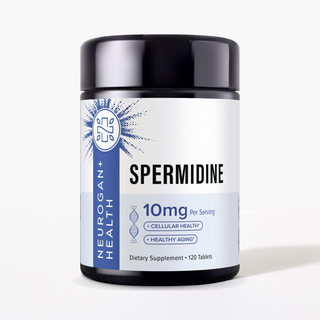

Spermidine has generally been well tolerated in the human studies conducted so far, but its safety evidence has important limits. Lower-dose spermidine-rich wheat germ extracts have been studied for up to 12 months, while a newer trial tested 40 mg per day of high-purity spermidine trihydrochloride for 28 days in healthy older men.
These studies did not identify a clear pattern of serious supplement-related adverse effects. However, they were relatively small, and the higher-dose research was short-term. That means we cannot assume that every spermidine dose, formulation, population, or duration has the same safety profile.

People who are pregnant or breastfeeding, have active cancer, are receiving cancer treatment, have significant medical conditions, or take medications that affect polyamine metabolism should discuss spermidine supplementation with a qualified healthcare professional before using it.
Spermidine Safety at a Glance
| Question | What the Evidence Currently Shows |
|---|---|
| Is spermidine generally well tolerated? | Yes, in the relatively small human trials conducted so far |
| Are serious side effects established? | No clear supplement-related serious adverse-event pattern has been established |
| Has higher-dose spermidine been studied? | 40 mg/day of high-purity spermidine trihydrochloride was studied for 28 days in 37 healthy men aged 50–70 |
| Is long-term high-dose safety established? | No |
| Is there a universal safe upper limit? | No universal human upper intake level has been established for all spermidine forms |
| Pregnancy and breastfeeding? | Supplement safety has not been adequately established |
| Active cancer? | Human supplement safety data are insufficient; discuss with an oncology team |
What Are the Side Effects of Spermidine?
Human clinical trials have not established a consistent set of common spermidine side effects.
In a three-month randomized trial involving 30 adults aged 60–80, participants received a spermidine-rich wheat germ extract supplying 1.2 mg of spermidine per day. Researchers found no significant differences from placebo in vital signs, body weight, clinical chemistry, hematology, or self-reported health. [1]
A larger 12-month randomized trial involving 100 older adults used approximately 0.9 mg of spermidine per day. Adverse events and serious adverse events were broadly balanced between the spermidine and placebo groups. [2]
More recently, researchers tested 40 mg per day of high-purity spermidine trihydrochloride in 37 healthy men aged 50–70 for up to 28 days. The study reported no study-product-related adverse events and no significant changes in clinical chemistry, lipid, or hematological measurements compared with placebo. [3]
These findings are reassuring, but they should not be interpreted as proof that spermidine can never cause side effects. The trials were relatively small, and the higher-dose study lasted only four weeks.
Is Spermidine Safe to Take Every Day?
Daily spermidine supplementation has been used in human trials ranging from several weeks to 12 months.

The strongest longer-term human data come from the 12-month SmartAge trial using 0.9 mg per day from spermidine-rich wheat germ extract. Adverse events were not significantly increased compared with placebo. [2]
However, that evidence cannot automatically be applied to much higher doses. The 40 mg/day trihydrochloride trial provides useful evidence for short-term use, but it lasted only 28 days. [3]
So the most accurate answer is that daily use has been tolerated at the doses and durations studied, but long-term safety at higher supplemental doses has not yet been established.
How Much Spermidine Is Too Much?
There is currently no universally established human toxicity threshold or tolerable upper intake level that applies to every form of supplemental spermidine.
This is an important distinction because different products may contain spermidine-rich wheat germ extract, isolated spermidine, or spermidine trihydrochloride.
The European Union authorizes one specific novel food—spermidine-rich wheat germ extract—for adult supplements at an amount equivalent to a maximum of 6 mg of spermidine per day. That regulatory authorization should not be interpreted as a universal biological safety ceiling for all forms of spermidine. [4]
Separately, 40 mg/day of high-purity spermidine trihydrochloride has been studied for 28 days in healthy older men without identifying a safety signal. [3] That does not establish that 40 mg or more is safe for years, nor does it establish an optimal dose.
For a fuller discussion of doses used in research, see our Spermidine dosage guide.
Who Should Not Take Spermidine?
There is not a clinically validated list of absolute spermidine contraindications, but several groups require substantially more caution because they were not adequately represented in supplementation trials.
Pregnant or Breastfeeding People
Human safety data for supplemental spermidine during pregnancy and breastfeeding are insufficient.
The European authorization for spermidine-rich wheat germ extract specifically applies to adults while excluding pregnant and lactating women. [4]
This does not mean normal spermidine-containing foods are unsafe during pregnancy. It means concentrated supplementation has not been established as safe for this population.
People With Active Cancer or Receiving Cancer Treatment
Spermidine's relationship with cancer is complex.
Polyamines are necessary for normal cell growth, but polyamine metabolism is also altered in many cancers. Experimental research has found both tumor-supporting and antitumor effects depending on the cancer model, concentration, immune response, and metabolic context. [5,6]
There is currently no good human evidence showing that ordinary spermidine supplementation causes cancer. At the same time, there are not adequate clinical trials demonstrating that supplementation is safe during active cancer or cancer treatment.
For that reason, people with active malignancy or those receiving chemotherapy, immunotherapy, targeted therapy, or other cancer treatment should discuss spermidine with their oncology team rather than self-supplementing.
People Taking Drugs That Target Polyamine Metabolism
Some medications deliberately interfere with polyamine production or metabolism.
For example, eflornithine, also known as DFMO, inhibits ornithine decarboxylase, an enzyme involved in polyamine synthesis. Adding a polyamine supplement while taking a treatment designed to alter the same pathway creates a plausible pharmacologic conflict.
There are not adequate clinical studies testing this combination. Anyone taking DFMO or another therapy targeting polyamine metabolism should use spermidine only with their prescribing clinician's guidance.
People With Significant Kidney or Liver Disease
Human spermidine trials have generally enrolled relatively healthy participants. They do not provide enough evidence to establish safety in people with significant kidney or liver disease.
Clinical chemistry measurements remained stable in the published short-term and longer-term trials, including the 40 mg/day study, but this should not be interpreted as evidence that spermidine is proven safe in people who already have impaired organ function. [1-3]
If you have kidney disease, liver disease, or another significant chronic condition, discuss supplementation with your healthcare professional first.
Children and Adolescents
Supplemental spermidine has not been adequately studied in children. Concentrated spermidine supplements should not be treated as routine pediatric nutrition without guidance from a pediatric healthcare professional.
Does Spermidine Interact With Medications?
There is not currently a well-established list of common drug interactions for spermidine supplements.
That is different from saying that interactions are impossible. Formal drug-interaction studies are limited.
The clearest reason for caution is with medications or treatments that deliberately affect polyamine metabolism, including DFMO. People receiving cancer treatment should also have any supplement reviewed by their oncology team because polyamine and autophagy pathways can interact with cancer biology in complex ways.
If you regularly take prescription medications, especially for a serious or chronic condition, review spermidine with a pharmacist or healthcare professional before adding it to your regimen.
Is Spermidine Hard on the Liver?
Current human trials have not identified a clear liver-safety signal from spermidine supplementation in the populations studied.
The 40 mg/day spermidine trihydrochloride trial found no significant changes in clinical chemistry compared with placebo during 28 days of supplementation. [3]
However, this study involved healthy men rather than people with liver disease. We therefore cannot conclude that high-dose spermidine is safe for someone with existing liver impairment.
Can Spermidine Cause Cancer?
There is no human clinical evidence showing that spermidine supplements cause cancer.
In the 12-month SmartAge trial, malignant and neoplastic serious adverse events were not increased in the spermidine group compared with placebo. However, the trial used a relatively low dose, involved only 100 participants, and was not designed to determine long-term cancer risk. [2]
Observational studies of dietary spermidine also do not show a simple cancer-promoting relationship. A recent large analysis of more than 54,000 men found no association between dietary spermidine intake and prostate cancer incidence or prostate-cancer-specific mortality. Dietary intake, however, is not the same exposure as concentrated supplementation.
At the cellular level, the picture is considerably more complicated. Polyamines can support cell proliferation, while spermidine can also influence immune surveillance, autophagy, and other pathways with potential antitumor effects. Recent reviews therefore describe spermidine as having context-dependent or even opposing roles in cancer biology. [5,6]
This is why the appropriate conclusion is neither “spermidine causes cancer” nor “spermidine prevents cancer.” People with active cancer should discuss supplementation with their oncology team.
Does Spermidine Increase Stroke Risk?
An observational study found that people with higher serum spermidine concentrations had a higher subsequent risk of stroke. [7]
That finding does not demonstrate that taking a spermidine supplement causes stroke. Serum concentrations reflect endogenous metabolism, diet, gut-microbial activity, disease processes, and other factors.
Later research examining plasma metabolites did not find an association between circulating spermidine and incident ischemic stroke.
The older version of this article treated the first association too directly. The evidence currently supports describing it as an observational biomarker finding rather than a demonstrated supplement side effect.
What About Wheat Allergy, Gluten, or Celiac Disease?
This depends on the source of the supplement rather than spermidine itself.
Some spermidine products use wheat germ extract. Anyone with celiac disease or a wheat allergy should therefore check the ingredient list and allergen information carefully.
Other products use isolated spermidine or spermidine trihydrochloride and may not contain wheat. Do not assume that every product labeled “spermidine” has the same allergen profile.
What Should You Do If You Experience a Side Effect?
If you develop a new symptom after starting a spermidine supplement, stop using the product and review the timing, dose, full ingredient list, and any other supplements or medications you take.
Seek medical attention promptly for severe symptoms such as difficulty breathing, facial or throat swelling, fainting, chest pain, or another potentially serious reaction.
For mild but persistent symptoms, discuss the supplement with a healthcare professional before restarting it.
Frequently Asked Questions
Does spermidine have side effects?
Human trials have not identified a consistent pattern of common spermidine-specific side effects, and supplementation has generally been well tolerated at the doses studied. The evidence base is still relatively small, especially for high-dose and long-term use.
Who should not take spermidine?
Pregnant or breastfeeding people, children, people with active cancer, people undergoing cancer treatment, and those taking medications that affect polyamine metabolism should not start concentrated spermidine supplementation without appropriate medical guidance. People with significant kidney or liver disease should also discuss it with their clinician first.
Is 10 mg of spermidine too much?
There is no universal human toxicity threshold showing that 10 mg is inherently too much. Human research has tested 15 mg/day short-term and 40 mg/day for 28 days, while lower doses have been studied for longer periods. Dose, form, duration, and individual health status all matter. See our dosage guide for more detail.
Can you take spermidine every day?
Daily dosing has been used in clinical studies, including a 12-month trial at 0.9 mg/day. Higher-dose long-term daily use has not been studied as thoroughly.
Does spermidine interact with medications?
No broad set of clinically established interactions has been defined. Particular caution is warranted with medications that target polyamine metabolism and during cancer treatment. People taking prescription medication should review the combination with a pharmacist or healthcare professional.
Is spermidine bad for the liver?
Published trials have not identified a clear liver-toxicity signal in the healthy or older adults studied. That does not establish safety in people with existing liver disease.
Can spermidine cause cancer?
No human evidence currently shows that spermidine supplementation causes cancer. However, polyamine biology in cancer is complex, and supplement use during active malignancy has not been adequately studied. People with cancer should discuss spermidine with their oncology team.
Is spermidine safe during pregnancy?
Supplement safety during pregnancy has not been adequately established. The EU authorization for spermidine-rich wheat germ extract excludes pregnant and lactating women. Normal dietary sources of spermidine are a separate issue from concentrated supplementation.
The Bottom Line
Spermidine appears to be well tolerated in the human studies conducted so far, but the evidence does not justify calling it risk-free.

Lower-dose wheat germ extracts have been studied for as long as 12 months, and a high-purity spermidine trihydrochloride supplement has been tested at 40 mg/day for 28 days without a significant safety signal. What remains uncertain is long-term higher-dose use and safety in populations such as pregnant people, cancer patients, children, and people with significant chronic disease.
The most evidence-based approach is to follow the product label, avoid assuming that more is better, and involve a healthcare professional when medical conditions or prescription medications are part of the picture.
References
1. Schwarz C, Stekovic S, Wirth M, et al. Safety and tolerability of spermidine supplementation in mice and older adults with subjective cognitive decline. Aging (Albany NY). 2018;10(1):19-33. doi:10.18632/aging.101354.
2. Schwarz C, Benson GS, Horn N, et al. Effects of Spermidine Supplementation on Cognition and Biomarkers in Older Adults With Subjective Cognitive Decline: A Randomized Clinical Trial. JAMA Network Open. 2022;5(5):e2213875. doi:10.1001/jamanetworkopen.2022.13875.
3. Keohane P, Everett JR, Pereira R, Cook CM, Blonquist TM, Mah E. Supplementation of spermidine at 40 mg/day has minimal effects on circulating polyamines: An exploratory double-blind randomized controlled trial in older men. Nutrition Research. 2024. doi:10.1016/j.nutres.2024.09.012.
4. European Commission. Commission Implementing Regulation (EU) 2017/2470: Union list of authorised novel foods. Entry for spermidine-rich wheat germ extract (Triticum aestivum).
5. Zimmermann A, Hofer SJ, Madeo F. Molecular targets of spermidine: implications for cancer suppression. Cell Stress. 2023;7(7):50.
6. Agostinelli E, et al. Spermidine in colorectal cancer: friend or foe? 2026.
7. Zheng L, Xie Y, Sun Z, et al. Serum Spermidine in Relation to Risk of Stroke: A Multilevel Study. Frontiers in Nutrition. 2022;9:843616.