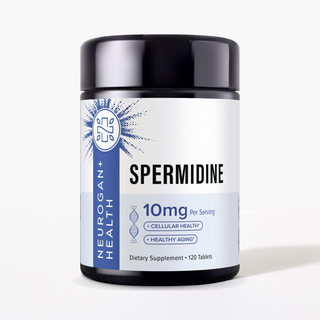
Spermidine may influence the human hair-growth cycle, but the evidence is still preliminary.
Laboratory research using isolated human scalp follicles found that spermidine prolonged the active growth phase of hair and increased hair-shaft elongation. A later randomized trial involving 100 healthy adults found that a spermidine-based nutritional supplement increased the number of follicles in advanced anagen stages compared with placebo. [1,2]

Those findings are interesting, but they do not prove that spermidine can regrow lost hair or treat common hair-loss conditions such as androgenetic alopecia or telogen effluvium.
The human trial studied people with normal hair cycling — not people diagnosed with a specific hair-loss disorder — and the supplement was described as spermidine-based rather than isolated spermidine alone. [2]
So the current evidence supports a possible effect on hair-cycle biology, not a proven hair-loss treatment.
Spermidine and Hair Growth at a Glance
| Question | What the evidence shows |
|---|---|
| Can spermidine affect human hair follicles? | Yes. Human follicle organ-culture research found increased hair-shaft elongation and prolonged anagen. |
| Has oral spermidine been studied in humans? | Yes. One randomized 100-person study tested a spermidine-based nutritional supplement for 90 days. |
| Did the human trial show more hairs in anagen? | Yes. More advanced anagen-stage follicles were observed in the supplement group than in the placebo group. |
| Was the trial performed in people with hair loss? | No. Participants were healthy adults with normal hair cycling, and people showing androgenetic alopecia were excluded. |
| Does spermidine regrow lost hair? | Not established. |
| Does it treat telogen effluvium? | Direct evidence for oral spermidine as a treatment is insufficient. |
| Does it treat androgenetic alopecia? | No clinical evidence currently establishes that it does. |
| Is there a proven hair-growth dose? | No clinically established spermidine dose exists for hair growth or hair loss. |
What Is Spermidine?
Spermidine is a naturally occurring polyamine found throughout the human body and in many foods.
Cells use polyamines in processes related to growth, protein synthesis, gene regulation, and cellular maintenance.
Spermidine is also found in foods including wheat germ, soy foods, legumes, mushrooms, whole grains, nuts, and some aged cheeses.
Much of the broader interest in spermidine comes from research into autophagy and healthy aging, but hair follicles are interesting for a different reason: they are among the body's most actively regenerating mini-organs.
Hair follicles repeatedly switch between growth, regression, rest, and shedding. Polyamine metabolism appears to participate in that cycle.
For a broader overview, see our complete guide to spermidine.
How Does the Hair-Growth Cycle Work?
Each scalp hair grows from an individual follicle that moves through several phases.
Anagen
Anagen is the active growth phase. Cells at the base of the follicle divide rapidly and produce the growing hair shaft.
Most healthy scalp hairs are normally in anagen at any given time.
Catagen
Catagen is a short transitional period in which active growth stops and the follicle begins to regress.
Telogen
Telogen is the resting phase. The follicle is no longer actively producing a longer hair shaft.
Exogen
The old hair is eventually released and shed while a new cycle can begin.
Many hair-growth treatments and research compounds are therefore evaluated partly by asking whether they can keep more follicles in anagen or reduce premature transition into resting or shedding phases.
Does Spermidine Help Hair Growth?
There is preliminary evidence that spermidine can influence the human hair-growth cycle, but there is not enough evidence to call it a proven hair-growth treatment.
Two studies provide most of the evidence behind current claims.
- A 2011 laboratory study exposed isolated human scalp follicles directly to spermidine. [1]
- A 2017 randomized placebo-controlled study tested a spermidine-based nutritional supplement in 100 healthy adults. [2]
The first provides useful biological evidence.
The second provides preliminary human supplementation evidence.
Neither establishes that isolated spermidine treats a diagnosed form of hair loss.
What Did the Human Hair-Follicle Study Find?
In 2011, researchers studied normal human scalp hair follicles that had been removed from surgical samples and maintained in organ culture. [1]
The follicles were exposed to different concentrations of spermidine for several days.
Researchers reported that spermidine:
- increased hair-shaft elongation;
- prolonged the anagen growth phase;
- affected proliferation of hair-follicle cells; and
- increased expression of the stem-cell-associated keratins K15 and K19. [1]
At the concentration producing the strongest effect, hair-shaft production increased by more than 20% after six days in culture compared with untreated follicles. [1]
This is meaningful mechanistic evidence because the experiment used actual human hair follicles rather than an unrelated cell line.
But it still occurred outside the human body.
The isolated follicles did not experience normal circulation, hormones, immune activity, nutrient metabolism, or the many other biological influences present on a living scalp.
The study therefore shows that spermidine can directly affect human follicle biology under laboratory conditions. It does not tell us how much oral spermidine a person should take or whether supplementation reverses a particular hair-loss condition.
What Did the Human Spermidine Hair-Growth Trial Find?
A 2017 randomized, double-blind, placebo-controlled trial moved the research into living human participants. [2]
The study included 100 healthy men and women, divided evenly between the supplement and placebo groups.
Participants took either:
- one spermidine-based nutritional supplement tablet per day; or
- a placebo.
The intervention lasted 90 days.
Researchers plucked and microscopically examined hair follicles before and after treatment and assessed markers associated with follicle growth.
After three months, the supplement group had significantly more follicles classified in advanced anagen stages than the placebo group. [2]
The researchers also reported:
- increased Ki-67, a marker associated with cellular proliferation;
- lower c-Kit measurements used in the study as an apoptosis-related marker; and
- differences in hair pull-test results during follow-up. [2]
The authors concluded that the findings provided preliminary evidence that the spermidine-based supplement could prolong anagen.
But they also stated that further studies were needed in specific clinical hair-loss conditions.
A Key Correction: The Trial Was Not a Telogen Effluvium Study
This distinction is important.
The 2017 randomized trial did not enroll 100 people diagnosed with telogen effluvium.
It enrolled healthy adults with normal hair cycling. [2]
In fact, participants were excluded if researchers identified signs of androgenetic alopecia, and several medical conditions and recent hair-loss treatments were also exclusion criteria.
The paper discussed earlier preliminary research involving telogen effluvium, which can lead to confusion when the study is summarized online.
But the randomized trial itself was designed primarily to test whether the nutritional supplement affected the anagen phase in healthy people.
How Strong Is the Human Evidence?
The randomized trial is useful, but there are several limitations to keep in mind.
There is only a small clinical evidence base
One 100-person randomized trial is not enough to establish spermidine as a standard hair-loss treatment.
The participants did not have a diagnosed hair-loss disorder
That makes it difficult to extrapolate the findings directly to androgenetic alopecia, telogen effluvium, alopecia areata, or other conditions.
The intervention was a spermidine-based nutritional supplement
The study should not automatically be interpreted as proving that any isolated spermidine product at any dose will produce the same result.
The study had industry involvement
The trial was funded by Giuliani S.p.A. Two authors were employees of the company, one author served as a consultant, and another reported company-supported travel. [2]
Industry funding does not by itself invalidate a study, but it is relevant when weighing preliminary evidence and reinforces the need for independent replication.
The earlier follicle research also had industry ties
The 2011 laboratory study was supported in part by a research grant from Giuliani, and some investigators reported academic grants or consultancy relationships with the company. [1]
The findings therefore deserve further independent confirmation.
Can Spermidine Regrow Lost Hair?
Current clinical evidence does not show that spermidine can reliably regrow hair that has been lost because of androgenetic alopecia or another established alopecia.
Increasing the proportion of follicles in anagen is biologically interesting, but “more follicles in anagen” is not automatically the same outcome as clinically meaningful restoration of lost hair.
Hair regrowth depends heavily on why hair is being lost in the first place.
For example:
- androgenetic alopecia involves progressive follicle miniaturization;
- telogen effluvium involves an increased number of follicles entering the resting and shedding phase;
- alopecia areata involves an autoimmune attack on follicles; and
- scarring alopecias can permanently damage the follicle.
A compound that influences anagen does not necessarily correct each of these underlying causes.
Does Spermidine Help Hair Shedding?
There is some preliminary evidence relevant to shedding, but it should not be overstated.
In the 2017 randomized trial, researchers performed pull tests in addition to examining the follicle cycle, and the results favored the spermidine-based supplement during follow-up. [2]
That suggests the intervention may have influenced hair retention or cycling in the healthy participants studied.
However, the trial did not establish that spermidine treats persistent excessive shedding from a diagnosed medical condition.
If someone develops sudden or substantial shedding, identifying the cause is more important than immediately choosing a supplement.
Does Spermidine Help Telogen Effluvium?
There is not currently strong evidence that oral spermidine alone treats telogen effluvium.
Telogen effluvium is excessive shedding that can occur after physiological or psychological stressors such as illness, surgery, major weight change, childbirth, medication changes, or other disruptions.
The main randomized oral spermidine study involved healthy adults rather than patients diagnosed with telogen effluvium. [2]
A separate clinical study has evaluated a topical formulation containing N1-methylspermidine, a spermidine analogue, together with another active ingredient in people with chronic telogen effluvium. That combination study reported improvements in several hair measurements. [3]
But because it used a modified spermidine molecule together with another ingredient, it cannot establish that ordinary oral spermidine by itself treats telogen effluvium.
For people with telogen effluvium, addressing the trigger remains an important part of management.
Does Spermidine Help Androgenetic Alopecia?
There is no good clinical evidence showing that spermidine treats androgenetic alopecia.
Androgenetic alopecia — also called male or female pattern hair loss — involves genetically influenced progressive miniaturization of susceptible hair follicles.
The 2017 spermidine trial specifically excluded people showing signs of androgenetic alopecia. [2]
So that study should not be cited as evidence that spermidine treats pattern hair loss.
Evidence-based treatment options for androgenetic alopecia have a much larger clinical research base. Depending on the person and diagnosis, these can include topical minoxidil and other dermatologist-directed therapies.
Spermidine should therefore not be presented as a replacement for established treatment of pattern hair loss.
What About Alopecia Areata or Scarring Alopecia?
There is currently insufficient clinical evidence to recommend spermidine as a treatment for alopecia areata or scarring alopecia.
Alopecia areata is an immune-mediated form of hair loss, while scarring alopecias involve inflammatory damage that can destroy follicles.
Those conditions require different approaches from simply prolonging the normal anagen phase.
Persistent patches of hair loss, scalp inflammation, pain, scaling, or signs of scarring are reasons to seek appropriate medical evaluation rather than relying on a hair-growth supplement.
Does Spermidine Extend the Anagen Phase?
This is the hair-related effect with the strongest direct evidence.
The 2011 human follicle experiment found that spermidine prolonged anagen under organ-culture conditions. [1]
The 2017 human trial then found that the spermidine-based supplement increased the number of follicles classified in advanced anagen stages after three months compared with placebo. [2]
So the evidence supports the statement:
Spermidine has been associated with anagen prolongation in laboratory human follicles and in one preliminary human supplementation trial.
That is much more defensible than saying that spermidine has been proven to regrow hair.
Is Autophagy Responsible for Spermidine's Hair Effects?
Spermidine is well known in other areas of research for its relationship with autophagy, a cellular recycling and quality-control pathway.
Experimental research has shown that spermidine can promote autophagy through mechanisms including inhibition of the acetyltransferase EP300. [4]
However, the key human hair studies did not demonstrate that autophagy was the specific reason spermidine affected hair follicles.
The hair research focused more directly on:
- anagen duration;
- hair-shaft elongation;
- cell proliferation;
- apoptosis-related markers; and
- hair-follicle stem-cell-associated keratins. [1,2]
Autophagy may eventually turn out to be part of the mechanism, and spermidine analogues have been investigated from that perspective, but it should currently be described as a plausible research pathway rather than a proven explanation for oral spermidine's effect on human hair.
For a detailed look at the broader mechanism, see our guide to spermidine and autophagy.
How Much Spermidine Should You Take for Hair Growth?
There is no clinically established spermidine dose for hair growth or hair-loss treatment.
This is important because search results often turn the existence of a hair study into a specific supplement recommendation.
The human trial tested a particular spermidine-based nutritional supplement rather than establishing a dose-response relationship for isolated spermidine. [2]
The study therefore does not tell us that:
- more spermidine produces more hair growth;
- a specific number of milligrams treats hair loss;
- higher-dose spermidine works faster; or
- the same result applies to every spermidine formulation.
If you're comparing doses used in broader human spermidine research, see our spermidine dosage guide.
How Long Does Spermidine Take to Work for Hair?
There is no validated treatment timeline for spermidine and hair growth.
The randomized study measured significant changes in hair-cycle parameters after approximately 90 days of supplementation. [2]
That means three months is a period that has been studied.
It does not mean everyone who takes spermidine should expect visible hair regrowth in three months.
The study primarily measured follicle-cycle stages and biological markers rather than establishing a predictable cosmetic regrowth timeline for people with hair loss.
Hair also grows slowly, and visible changes in density can lag behind biological changes occurring inside the follicle.
Can You Get Spermidine From Food?
Yes. Spermidine occurs naturally in many foods.
Common dietary sources include:
- wheat germ;
- soybeans and fermented soy foods;
- legumes;
- mushrooms;
- whole grains;
- nuts and seeds; and
- some aged cheeses.
There is currently no evidence showing that eating a specific amount of a spermidine-rich food treats hair loss.
For detailed food comparisons, see our guide to foods highest in spermidine.
Are Spermidine Supplements Proven Hair-Loss Treatments?
No.
A randomized human study provides preliminary evidence that a spermidine-based nutritional supplement can influence the normal hair-growth cycle. [2]
That is different from regulatory or clinical evidence establishing spermidine as a treatment for:
- male pattern hair loss;
- female pattern hair loss;
- telogen effluvium;
- alopecia areata; or
- scarring alopecia.
Supplement format also should not be assumed to determine hair efficacy. Capsules, tablets, liquids, and other forms have not been compared in clinical hair-growth trials.
For general supplement safety and precautions, see our spermidine side effects guide.
When Should Hair Loss Be Evaluated?
Hair thinning and shedding have many possible causes, and treatment depends on the diagnosis.
Consider medical or dermatologic evaluation if you notice:
- rapid or unexplained hair loss;
- persistent excessive shedding;
- receding or progressively widening areas of thinning;
- round or sharply defined bald patches;
- itching, redness, pain, scaling, or inflammation of the scalp;
- signs of scarring;
- loss of eyebrows or other body hair; or
- hair loss accompanied by other unexplained symptoms.
Identifying whether the problem is excessive shedding, hereditary pattern loss, autoimmune hair loss, a nutritional issue, medication-related loss, or another condition is more useful than treating every form of hair loss as the same problem.
Frequently Asked Questions
Does spermidine help hair growth?
Possibly, but the evidence is preliminary. Human follicle experiments found that spermidine increased hair-shaft elongation and prolonged anagen, while one randomized human study found that a spermidine-based supplement increased the number of follicles in advanced anagen stages. [1,2] More clinical trials are needed.
Can spermidine regrow hair?
Spermidine has not been proven to regrow lost hair. Current evidence mainly shows effects on hair-cycle biology rather than demonstrated restoration of hair lost from a diagnosed alopecia.
Does spermidine stop hair shedding?
A preliminary human study reported favorable hair pull-test findings with a spermidine-based supplement, but there is not enough evidence to say that spermidine reliably stops excessive hair shedding caused by a medical condition.
Does spermidine help telogen effluvium?
The main randomized oral spermidine study involved healthy participants rather than people diagnosed with telogen effluvium. Related research exists, including a combination topical study using a spermidine analogue, but evidence for oral spermidine itself as a telogen-effluvium treatment remains insufficient.
Does spermidine help androgenetic alopecia?
There is no established clinical evidence that spermidine treats male or female pattern hair loss. Participants with signs of androgenetic alopecia were excluded from the main 2017 spermidine supplementation trial.
Does spermidine prolong the anagen phase?
Human follicle laboratory research and one randomized supplementation trial both reported findings consistent with prolonged or increased anagen activity. [1,2] This is currently the best-supported hair-related effect of spermidine.
How much spermidine should I take for hair growth?
There is no clinically established spermidine dose for hair growth or hair-loss treatment. The available study does not establish a milligram dose-response relationship for isolated spermidine.
How long does spermidine take to work for hair?
The main randomized study measured changes after 90 days, but this does not establish a three-month regrowth timeline. More research is needed to determine whether supplementation produces visible hair-growth benefits and how long those effects would take.
The Bottom Line
Spermidine has a legitimate but still limited research connection to hair biology.
In isolated human scalp follicles, spermidine increased hair-shaft elongation, prolonged anagen, and altered markers associated with follicle stem-cell activity. [1]
In a randomized study of 100 healthy adults, a spermidine-based nutritional supplement increased the number of follicles in advanced anagen stages and influenced several hair-bulb markers compared with placebo. [2]
But the clinical evidence stops short of showing that spermidine treats established hair-loss disorders.
The main trial:
- involved healthy participants;
- excluded people showing androgenetic alopecia;
- tested a spermidine-based supplement rather than establishing a dose of isolated spermidine;
- was preliminary;
- had substantial industry involvement; and
- has not yet been followed by a large independent clinical trial demonstrating meaningful hair regrowth.
The most accurate conclusion is that spermidine may influence the human hair-growth cycle — particularly the anagen phase — but it has not been proven to regrow lost hair or treat androgenetic alopecia, telogen effluvium, or other forms of alopecia.
For related research, see our guides to spermidine benefits, spermidine and autophagy, spermidine dosage, and spermidine side effects.
Resources
- Ramot Y, Tiede S, Bíró T, et al. Spermidine promotes human hair growth and is a novel modulator of human epithelial stem cell functions. PLoS One. 2011;6(7):e22564. PMID: 21818338.
- Rinaldi F, Marzani B, Pinto D, Ramot Y. A spermidine-based nutritional supplement prolongs the anagen phase of hair follicles in humans: a randomized, placebo-controlled, double-blind study. Dermatology Practical & Conceptual. 2017;7(4):17-21. PMID: 29214104.
- New multi-targeting strategy in hair growth promotion: in vitro and in vivo studies. Study evaluating N1-methylspermidine-related autophagy research and a combination topical formulation in chronic telogen effluvium. PMID: 29766701.
- Pietrocola F, Lachkar S, Enot DP, et al. Spermidine induces autophagy by inhibiting the acetyltransferase EP300. Cell Death & Differentiation. 2015;22(3):509-516.
Medical disclaimer: This article is for educational purposes only and is not a substitute for professional medical advice, diagnosis, or treatment. Hair loss has many possible causes, and persistent, sudden, patchy, or progressive hair loss should be evaluated by an appropriate healthcare professional.