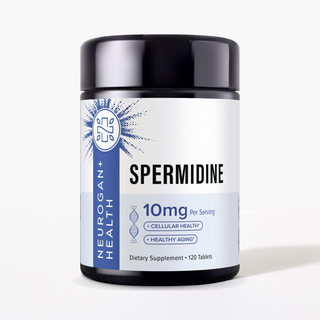
Spermidine is a naturally occurring polyamine involved in normal cellular processes such as protein translation and polyamine metabolism. It has attracted attention because laboratory and animal research connects spermidine with autophagy, mitochondrial biology, immune function, cardiovascular aging, and longevity.
Human evidence is much more limited.
Some clinical studies have produced promising signals in areas such as immune response and hair-follicle biology, while other larger trials have failed to confirm expected benefits. Observational studies on longevity are also inconsistent.
So the most accurate answer to “What are the benefits of spermidine?” is:
Spermidine has strong biological rationale and extensive preclinical research, but only a limited number of health benefits have been tested rigorously in humans, and many popular anti-aging claims remain unproven.
If you first want to understand the molecule itself, see our guide to what spermidine is.
Spermidine Benefits: Evidence at a Glance
| Proposed benefit | What human evidence currently shows |
|---|---|
| Autophagy | Strong mechanistic and preclinical evidence; a predictable supplementation effect has not been established in humans [1,2] |
| Memory and cognition | A larger 12-month randomized trial did not improve its primary memory outcome [3] |
| Immune function | Promising findings from a small 2026 pilot study in older adults, especially vaccine non-responders [4] |
| Human longevity | Conflicting observational evidence; supplementation has not been shown to extend lifespan [5,6] |
| Cardiovascular health | Mainly preclinical and observational evidence; definitive supplementation benefits are not yet established |
| Mitochondrial function | Strong preclinical rationale; clinical benefit in humans remains uncertain |
| Weight loss | Not established |
| Visible skin rejuvenation | Not established |
| Hair follicle growth phase | One small randomized study of a spermidine-based supplement reported favorable hair-cycle effects [7] |
| Short-term tolerability | Generally favorable in limited clinical trials [8] |
| Long-term safety | Still uncertain |
Does Spermidine Actually Work?
It depends on what “work” means.
Spermidine unquestionably has important biological functions in the body. It is required for processes such as eIF5A hypusination and normal protein translation, and experimental research shows that it can influence autophagy-related pathways [1,2].
That does not mean every biological effect translates into a measurable health benefit from taking a supplement.
Human spermidine trials are still relatively few, use different formulations and doses, and study very different outcomes.
For some proposed benefits, such as lifespan extension, weight loss, or visible anti-aging effects, there is currently no convincing clinical evidence.
For others, such as immune response or hair-follicle biology, there are promising early results that still require replication.
A useful distinction is:
Established biological role ≠ proven supplement benefit.
1. Spermidine and Autophagy
Autophagy is one of the main reasons spermidine has become associated with healthy aging.
Autophagy is a cellular recycling process that helps cells degrade and reuse selected proteins, organelles, and other cellular components.
Experimental studies have shown that spermidine can influence autophagy-related pathways. One frequently cited mechanism involves inhibition of the acetyltransferase EP300, changes in protein acetylation, and increased markers of autophagic flux [2].
Other work links spermidine biology to eIF5A hypusination, protein translation, and cellular stress responses.
However, most of the mechanistic evidence comes from:
- cell culture;
- animal models; and
- biochemical experiments.
There is currently no validated human dose at which an oral spermidine supplement has been shown to produce a predictable amount of autophagy.
So it is more accurate to say:
Spermidine influences autophagy-related biology in experimental research, but the magnitude and clinical significance of that effect after oral supplementation in humans remain uncertain.
For the mechanism in more detail, see our guide to spermidine and autophagy.
2. Spermidine and Brain Health
Spermidine has been extensively studied in animal models of brain aging.
Preclinical research has linked spermidine with:
- autophagy;
- mitochondrial function;
- synaptic biology;
- inflammatory signaling; and
- memory-related processes.
Early human pilot research also generated optimism.
But the larger follow-up trial produced a much more cautious result.
What Did the 12-Month SmartAge Trial Find?
The SmartAge randomized clinical trial included 100 adults aged 60 to 90 years with subjective cognitive decline [3].
Participants received either a spermidine-rich wheat-germ supplement providing 0.9 mg of spermidine per day or placebo for 12 months.
The trial found no significant improvement in its primary memory outcome compared with placebo.
Secondary outcomes were also not significantly different overall.
Exploratory analyses suggested possible signals involving verbal memory and inflammation, but the researchers stated that these findings require confirmation [3].
This means spermidine should not currently be described as a proven memory enhancer or dementia-prevention supplement.
For the broader neuroscience evidence, see our dedicated guide to spermidine and brain health.
3. Spermidine and Immune Function
A newer area of human research is immune aging, also called immunosenescence.
In 2026, researchers published a double-blind randomized pilot study involving 40 adults over age 65 following SARS-CoV-2 vaccination [4].
Participants received 6 mg of spermidine per day or placebo for 13 weeks.
Among participants who initially had poor vaccine responses, spermidine supplementation was associated with improvements in several measures, including:
- spike-specific IgG secretion;
- memory B-cell recall responses;
- neutralizing antibody activity; and
- some markers associated with immune-cell senescence.
These results are promising, but the study was:
- small;
- conducted in adults over 65;
- focused on vaccination; and
- particularly notable in a subgroup of vaccine non-responders.
It therefore would be inappropriate to convert the findings into the broad claim that “spermidine boosts immunity” in everyone.
A better conclusion is:
Early human research suggests spermidine may influence aspects of immune aging in specific older populations, but larger trials are needed.
4. Does Spermidine Slow Aging?
Spermidine is strongly associated with aging research, but the phrase “anti-aging” can mean many different things.
In laboratory and animal studies, spermidine has been linked to:
- autophagy;
- mitochondrial maintenance;
- protein homeostasis;
- immune aging;
- cardiovascular aging; and
- lifespan in several model organisms.
Those findings make spermidine biologically interesting.
But no human randomized trial has established that spermidine reverses aging or makes people biologically younger.
There is also no established clinical evidence that taking spermidine:
- reverses biological age;
- slows aging by a measured number of years;
- prevents age-related disease; or
- reproduces all of the physiological effects of fasting or caloric restriction.
5. Does Spermidine Help You Live Longer?
No clinical trial has shown that spermidine supplementation extends human lifespan.
The human longevity evidence comes mainly from observational dietary studies.
2018 European Cohort
A prospective study involving 829 adults found that higher estimated dietary spermidine intake was associated with lower all-cause mortality over long-term follow-up [5].
The association remained after adjustment for several lifestyle and dietary factors.
That study generated substantial interest in spermidine and human longevity.
Larger Japanese Cohort
A later Japanese study included 29,079 adults and examined dietary intake of spermidine, spermine, and putrescine over approximately 16 years of follow-up [6].
After adjustment for relevant factors, spermidine intake was not significantly associated with lower all-cause or cause-specific mortality.
The researchers concluded that their data did not support a beneficial effect of dietary spermidine on mortality [6].
These conflicting results illustrate an important point:
Observational associations do not prove that spermidine itself extends life.
People who eat spermidine-rich diets may also differ in overall diet quality, physical activity, socioeconomic status, smoking, alcohol use, healthcare access, and many other factors.
6. Spermidine and Cardiovascular Health
Cardiovascular health is one of the most promising areas in the preclinical spermidine literature.
Animal studies have connected spermidine with:
- cardiac autophagy;
- mitochondrial function;
- vascular biology;
- blood-pressure regulation; and
- age-related cardiac changes.
But direct human supplementation evidence remains limited.
Observational studies can show associations between dietary spermidine intake and cardiovascular outcomes, but those studies cannot establish that a spermidine supplement prevents heart disease.
A large randomized trial called POLYCAD has been designed specifically to test 24 mg/day of spermidine in 187 adults aged 65 or older with coronary artery disease. Its outcomes include cardiac remodeling, exercise capacity, inflammation, blood pressure, arterial stiffness, and other cardiovascular measures [9].
Until peer-reviewed outcome results from such trials are available, claims that spermidine supplementation protects the heart or reduces cardiovascular-disease risk remain unproven.
7. Spermidine and Mitochondrial Health
Mitochondrial function is another common reason spermidine appears in longevity research.
In animal and cellular models, spermidine has been linked to improved mitochondrial quality control and other aspects of cellular metabolism.
Part of this interest comes from the interaction between autophagy and the removal of dysfunctional cellular components.
But there is an important gap between:
“spermidine affects mitochondrial biology in experimental models”
and:
“taking spermidine improves mitochondrial function or energy in humans.”
The second statement has not been established broadly in human clinical trials.
Does Spermidine Increase Energy?
There is currently no strong evidence that spermidine reliably increases subjective energy, stamina, or reduces fatigue in healthy adults.
Some people may report feeling different while taking a supplement, but subjective experiences cannot establish efficacy because sleep, exercise, diet, placebo effects, stress, medications, and other factors can all affect energy levels.
Spermidine should therefore not be presented as a proven energy supplement.
8. Does Spermidine Help With Weight Loss?
There is no convincing human evidence that spermidine supplements cause weight loss.
Interest in weight and metabolism comes largely from experimental research involving:
- autophagy;
- mitochondrial metabolism;
- caloric restriction biology; and
- animal models of metabolic disease.
Those mechanisms should not be translated into the claim that taking spermidine burns fat or produces clinically meaningful weight loss in humans.
There is also no established spermidine “weight-loss dose.”
9. Spermidine and Skin Aging
The PAA data shows substantial interest in spermidine for skin and visible aging.
Spermidine participates in cellular processes relevant to tissue maintenance, and preclinical research into polyamines and aging has generated interest in skin biology.
However, oral spermidine supplementation has not been established as a treatment for wrinkles, sagging skin, loss of collagen, or visible facial aging.
At present, there is insufficient clinical evidence to say that taking spermidine:
- tightens skin;
- increases facial collagen;
- removes wrinkles;
- reverses skin aging; or
- makes someone look younger.
Mechanistic relevance to aging should not be confused with a demonstrated cosmetic result.
10. Spermidine and Hair Growth
Hair is one area where there is at least some direct human clinical evidence.
A randomized, double-blind, placebo-controlled study involving 100 healthy adults tested a spermidine-based nutritional supplement for 90 days [7].
The study reported an increase in the proportion of hair follicles in the anagen, or active-growth, phase compared with placebo.
The findings are interesting, but the trial had important limitations:
- it evaluated a spermidine-based multi-component nutritional product rather than isolated spermidine;
- it was relatively small;
- some authors had relationships with the product manufacturer; and
- the findings do not establish efficacy for every type of hair loss.
For the full evidence review, see our article on spermidine and hair growth.
11. Spermidine Benefits for Women
There is currently no distinct, clinically established set of spermidine benefits that applies specifically to women.
Women have participated in spermidine studies, including the SmartAge cognition trial, but the evidence does not establish that spermidine uniquely improves:
- female hormone levels;
- menopause symptoms;
- fertility;
- weight loss;
- skin aging; or
- other female-specific outcomes.
A 2026 cross-sectional analysis in older adults with coronary artery disease found sex differences in dietary spermidine intake and skeletal-muscle spermidine concentrations, but cross-sectional differences do not demonstrate sex-specific supplementation benefits [10].
12. Spermidine Benefits for Men
Likewise, spermidine has not been shown to provide a unique set of benefits specifically for men.
A 2024 randomized safety study involved 37 healthy men aged 50 to 70 who received 40 mg/day of high-purity spermidine trihydrochloride for up to 28 days [8].
The study found no significant changes in routine safety measures compared with placebo and no product-related adverse events.
But the trial was primarily designed to study safety and polyamine metabolism—not testosterone, libido, muscle growth, or male fertility.
There is currently insufficient evidence to claim that spermidine reliably increases testosterone or provides a specific male-performance benefit.
What Happens After You Take Spermidine?
One reason supplement effects can be difficult to predict is that the body appears to regulate circulating polyamines tightly.
In a randomized pharmacokinetic study, 12 healthy adults received 15 mg/day of spermidine for five days [11].
Researchers did not observe a significant increase in plasma spermidine compared with placebo. Plasma spermine increased instead.
The investigators proposed that some ingested spermidine may be converted before it reaches systemic circulation [11].
This finding means the biology is more complicated than:
“Take more spermidine → blood spermidine rises proportionally → greater benefits.”
Supplement dose, circulating levels, tissue exposure, and clinical outcomes should not be treated as interchangeable.
What Has Spermidine Not Been Proven to Do?
Current human evidence does not establish that spermidine supplementation:
- extends human lifespan;
- reverses aging;
- prevents Alzheimer's disease or dementia;
- treats cardiovascular disease;
- causes weight loss;
- increases testosterone;
- improves fertility;
- reliably increases energy;
- removes wrinkles or reverses skin aging;
- produces a predictable level of autophagy; or
- acts as a replacement for fasting, exercise, or established medical treatment.
How Long Does It Take for Spermidine to Work?
There is no clinically established point at which everyone should expect to “feel” spermidine working.
This was one of the most frequently recurring questions in the PAA data, but many online answers give precise timelines that are not supported by clinical evidence.
Human trials have measured different outcomes over very different periods:
- polyamine pharmacokinetics over several days [11];
- immune outcomes over 13 weeks [4];
- hair-follicle outcomes over several months [7]; and
- cognition over 12 months [3].
There is no validated sequence such as “energy after two weeks, skin after one month, memory after three months.”
If you are looking specifically for timing guidance, see our article on when to take spermidine.
Is Spermidine Worth Taking?
Whether a supplement is “worth taking” depends on the goal and the strength of evidence for that goal.
Spermidine is biologically important and scientifically interesting, but many supplement claims are substantially stronger than the current human evidence.
For someone considering spermidine specifically to:
- reverse aging;
- live longer;
- lose weight;
- prevent dementia;
- improve heart disease; or
- look visibly younger,
the clinical evidence is currently insufficient to promise those outcomes.
That does not mean future trials cannot identify meaningful benefits. It means the current evidence should be described accurately.
Is Spermidine Safe?
Short-term human studies have generally reported favorable tolerability at the doses and durations tested.
For example, the 2024 high-dose study found that 40 mg/day for up to 28 days was well tolerated in healthy men aged 50 to 70 [8].
However, that does not establish long-term safety or mean that higher doses provide greater benefits.
The PAA data contains very strong interest in:
- liver safety;
- drug interactions;
- daily use;
- excessive intake;
- cancer-related concerns; and
- who should avoid spermidine.
Those questions require more detail than belongs in a Benefits article. See our dedicated guide to spermidine side effects and safety.
Spermidine Benefits FAQ
What are the main benefits of spermidine?
Spermidine has well-established biological roles and strong preclinical evidence involving autophagy, protein translation, mitochondrial biology, immune function, and aging pathways. In humans, however, clinical benefits are much less certain. The strongest current evidence consists of specific early findings rather than broad proof of anti-aging or longevity effects.
Do spermidine supplements work?
Spermidine supplements clearly provide a biologically active polyamine, but whether supplementation produces a meaningful clinical benefit depends on the outcome being studied. Some trials show promising results in selected areas, while others, including the larger 12-month cognition trial, have been negative for their primary outcome [3].
Does spermidine slow aging?
Spermidine affects biological pathways related to aging in experimental models, but no human trial has established that supplementation slows or reverses aging.
Does spermidine help you live longer?
No randomized human trial has shown that spermidine supplementation extends lifespan. Observational dietary studies have produced conflicting results [5,6].
Does spermidine help with weight loss?
There is currently no convincing clinical evidence that spermidine supplementation produces meaningful weight loss in humans.
Does spermidine increase energy?
Spermidine is involved in cellular processes connected to metabolism and mitochondrial biology, but there is no strong evidence that supplementation reliably improves subjective energy or fatigue in healthy adults.
Is spermidine good for skin?
There is insufficient human clinical evidence to say that oral spermidine reduces wrinkles, increases collagen, tightens skin, or visibly reverses skin aging.
Does spermidine improve memory?
The largest longer-term randomized trial in older adults with subjective cognitive decline did not find a significant improvement in its primary memory outcome compared with placebo [3].
Does spermidine support heart health?
Preclinical and observational research makes cardiovascular health an important area of study, but direct clinical evidence that spermidine supplementation reduces cardiovascular risk is not yet established.
How long does spermidine take to work?
There is no validated timeline for “feeling” spermidine work. Different studies assess different outcomes over periods ranging from days to months, and subjective sensations are not a reliable measure of biological efficacy.
Key Takeaway
Spermidine is scientifically promising, but the human evidence does not yet support many of the broad benefits commonly associated with it online.
The strongest case for spermidine is its established role in normal cellular biology and the substantial body of mechanistic and animal research involving autophagy, protein translation, immune aging, mitochondria, and longevity.
Human evidence is more mixed:
- a larger cognition trial did not improve its primary outcome;
- a small immune pilot produced promising results in older vaccine non-responders;
- mortality studies are inconsistent;
- hair-follicle research shows an early positive signal;
- weight-loss and visible skin-rejuvenation claims are not established; and
- no human trial has shown that spermidine supplements extend lifespan.
For deeper topic-specific information, see:
- what spermidine is;
- spermidine and autophagy;
- spermidine and brain health;
- spermidine and hair growth;
- spermidine supplements and dosage; and
- spermidine side effects and safety.
Resources:
- Madeo F, Eisenberg T, Pietrocola F, Kroemer G. Spermidine in health and disease. Science. 2018;359(6374):eaan2788. doi:10.1126/science.aan2788.
- Pietrocola F, Lachkar S, Enot DP, et al. Spermidine induces autophagy by inhibiting the acetyltransferase EP300. Cell Death & Differentiation. 2015;22(3):509-516. doi:10.1038/cdd.2014.215.
- Schwarz C, Benson GS, Horn N, et al. Effects of Spermidine Supplementation on Cognition and Biomarkers in Older Adults With Subjective Cognitive Decline: A Randomized Clinical Trial. JAMA Network Open. 2022;5(5):e2213875. doi:10.1001/jamanetworkopen.2022.13875.
- Spermidine Mitigates Immune Cell Senescence and Boosts Vaccine Responses in Healthy Older Adults—A Pilot Study. 2026. PMID: 42169618.
- Kiechl S, Pechlaner R, Willeit P, et al. Higher spermidine intake is linked to lower mortality: a prospective population-based study. American Journal of Clinical Nutrition. 2018;108(2):371-380. doi:10.1093/ajcn/nqy102.
- Nagata C, Wada K, Yamakawa M, et al. Dietary polyamine intake and all-cause and cause-specific mortality in Japanese adults in the Takayama study. British Journal of Nutrition. 2024;131(2):343-350. doi:10.1017/S0007114523002465.
- Rinaldi F, Marzani B, Pinto D, Ramot Y. A spermidine-based nutritional supplement prolongs the anagen phase of hair follicles in humans: a randomized, placebo-controlled, double-blind study. Dermatology Practical & Conceptual. 2017;7(4):17-21. doi:10.5826/dpc.0704a05.
- Keohane P, Everett JR, Pereira R, et al. Supplementation of spermidine at 40 mg/day has minimal effects on circulating polyamines: An exploratory double-blind randomized controlled trial in older men. Nutrition Research. 2024;132:1-14. doi:10.1016/j.nutres.2024.09.012.
- Thorup CV, Jeppesen CNA, Jensen TH, et al. POLYamine treatment in elderly patients with Coronary Artery Disease (POLYCAD): study protocol for a Danish randomised, double-blind, placebo-controlled trial of spermidine treatment versus placebo. Trials. 2025;26(1):452. doi:10.1186/s13063-025-09176-z.
- Thorup CV, et al. Spermidine and spermine in elderly patients with coronary artery disease: a cross-sectional study of dietary intake and plasma and skeletal muscle concentrations. Clinical Nutrition. 2026;61:106651.
- Senekowitsch S, et al. High-Dose Spermidine Supplementation Does Not Increase Spermidine Levels in Blood Plasma and Saliva of Healthy Adults: A Randomized Placebo-Controlled Pharmacokinetic and Metabolomic Study. Nutrients. 2023;15(8):1852. doi:10.3390/nu15081852.
Disclaimer:
The Food and Drug Administration has not evaluated the statements made regarding these products. These products are not intended to diagnose, treat, cure, or prevent any disease. The information in this article is for educational purposes and is not a substitute for advice from a qualified healthcare professional. Speak with your healthcare professional before using a dietary supplement, particularly if you have a medical condition, take medication, are pregnant or breastfeeding, or are considering combining multiple supplements.