


Vitamin C supplements have come a long way since they were first introduced in the 70s as a household staple for “fighting colds”.
If you’ve been shopping for vitamin C supplements lately, you’ve probably noticed a newer option on the shelf: liposomal vitamin C. It sounds fancy, it usually costs more, and the labels make some bold claims about absorption.
So, is it worth it? When it comes to liposomal vitamin C versus standard vitamin C, the differences run deeper than marketing. They come down to how your body actually takes in and uses the vitamin, and that is backed by science.
What Is Vitamin C?
Vitamin C is one of the most well-known nutrients. It’s a vitamin that your body can’t make on its own, which means you need to get it from foods (citrus, berries, broccoli, peppers) or dietary supplements.
Your body relies on vitamin C for a long list of jobs — like supporting collagen (for skin, joints, and blood vessels), supporting the immune system, and acting as an antioxidant [1].
Standard vitamin C supplements typically come as ascorbic acid, sodium ascorbate, or calcium ascorbate. They’re affordable, widely available, and they work.
But there’s a catch: your body can only absorb so much at once.
When you take a large dose of regular vitamin C, your gut has a limited number of transporters to move it into your bloodstream. Whatever doesn’t get absorbed passes through your digestive system, which is why high doses of standard vitamin C can sometimes cause stomach discomfort or loose stools.
What is Liposomal Vitamin C?
Liposomal vitamin C is the same ascorbic acid you know, but it’s wrapped in a protective layer called a liposome. A liposome is a tiny, sphere-shaped bubble made from phospholipids — the same type of fat that makes up your cell membranes. It’s a technology that acts like a microscopic delivery vehicle, shielding the vitamin C as it travels through your digestive system.
Because the outer shell of a liposome is structurally similar to your own cells, it can merge directly with cell membranes in your gut.
The idea here is that the vitamin C inside is delivered more efficiently into your bloodstream without relying entirely on the limited gut transporters that standard vitamin C relies on.
The technology behind liposomal delivery isn’t brand new. Pharmaceutical companies have used liposomes for decades to improve drug delivery. Only in recent years has this approach been applied to nutritional supplements like vitamin C, making bioavailable vitamin C more accessible.
Key Differences Between Liposomal and Regular Vitamin C
Besides the price point — where liposomal vitamin C is a more premium offering — there are key differences in how each form behaves once it enters the body.
Understanding the difference between liposomal and regular vitamin C starts with how each form behaves once it enters your body. Here are the main areas where they diverge.
Absorption Rate & Bioavailability
This is where the gap between the two forms is most significant. In plain terms, more of the vitamin C you swallow actually makes it into your blood and cells when it’s delivered in liposomal form.
Standard oral vitamin C has dose-dependent absorption, meaning your body absorbs a high percentage of small doses (around 70–90% of doses under 200 mg), but absorption efficiency drops off sharply as the dose increases. At a 1,000 mg dose, absorption can fall to roughly 50% or lower [2]. The excess is simply excreted.
Liposomal vitamin C absorption tells a different story.
A 2025 scoping review published in Basic & Clinical Pharmacology & Toxicology analyzed 10 clinical studies and found that liposomal formulations consistently achieved 1.2 to 5.4 times higher peak plasma concentrations and 1.3 to 7.2 times higher overall exposure compared to non-liposomal vitamin C [3].
Delivery Mechanism
Regular vitamin C dissolves in water and relies on sodium-dependent vitamin C transporters (SVCTs) in your small intestine to cross into your bloodstream. These transporters become saturated at moderate doses, creating a bottleneck. This means your body can only absorb so much at one time. This is fine in lower doses (200-500 mg), but anything higher just goes to waste.
Liposomal vitamin C uses a fundamentally different approach. The phospholipid shell allows it to be absorbed through direct fusion with intestinal cell membranes, partially bypassing those saturable transporters. This lipid-based delivery mechanism is why liposomal forms can achieve higher blood levels at the same oral dose and work even better for those seeking doses of 1000 mg or more for specific wellness goals.
Cellular Uptake
Getting vitamin C into your bloodstream is only half the battle — it also needs to get inside your cells to do its work, especially in the immune system.
The 2024 Purpura et al. study found that liposomal vitamin C increased leukocyte (white blood cell) vitamin C levels by 20% compared to standard vitamin C [4]. This is important because immune cells are among the biggest consumers of vitamin C in your body, especially during times of stress or illness.
The liposomal structure could make this process smoother because the phospholipid shell interacts naturally with cell membranes, making it easier for the vitamin C to pass through.
Dosage Efficiency
Because liposomal vitamin C is absorbed more efficiently, you may be able to achieve your desired blood levels with a lower dose.
For instance, if standard vitamin C has roughly 50% absorption at a 1,000 mg dose, and liposomal delivery improves on that by 30–77% depending on the formulation, you’re getting significantly more usable vitamin C per milligram.
This also means less unabsorbed vitamin C in your gut, which translates to better digestive comfort, especially for people sensitive to high-dose ascorbic acid.
Is Liposomal Vitamin C Better Than Regular Vitamin C?
Based on current research, the answer is yes: liposomal vitamin C is better than regular vitamin C, specifically regarding absorption and bioavailability.
That said, “better absorption” doesn’t always mean everyone needs it.
If you eat a balanced diet rich in fruits and vegetables and you’re taking a moderate-dose vitamin C supplement as a daily baseline, standard vitamin C may work perfectly well. Your body absorbs small, regular doses of conventional vitamin C quite efficiently.
Why is liposomal vitamin C better for certain people?
It comes down to those who need higher circulating levels of vitamin C — whether for intensive immune support during cold and flu season, recovery from physical stress or heavy training loads, or for those who experience GI discomfort with regular high-dose vitamin C. Liposomal delivery delivers more of the nutrient where it needs to go without the digestive trade-offs.
Benefits of Liposomal Vitamin C Over Traditional Forms
Here’s a summary of the advantages that set liposomal vitamin C apart from conventional supplements:
-
Higher bioavailability: Clinical studies consistently show 20–77% greater absorption compared to standard vitamin C at the same dose, with some advanced formulations achieving even higher levels [3,4].
-
Enhanced immune cell delivery: Liposomal vitamin C increases vitamin C concentrations inside immune cells like leukocytes, directly supporting immune function where it counts [4].
-
Gentler on the stomach: By bypassing the gut’s saturable transport system, liposomal forms cause significantly less GI discomfort than high-dose standard vitamin C.
-
Longer-lasting blood levels: Research shows that liposomal vitamin C maintains elevated plasma concentrations for a longer period. One study found a significantly longer half-life than conventional vitamin C, meaning your body has access to the nutrient for longer after each dose [3].
-
More efficient dosing: Because more of each dose reaches your bloodstream, you may not need to take as much or as frequently to maintain optimal levels.
-
Superior antioxidant protection: With more vitamin C circulating in your blood and inside your cells, your body has a greater capacity to neutralize free radicals and protect against oxidative stress.
When to Choose Liposomal vs. Regular Vitamin C
Choose regular vitamin C if you’re on a tight budget and looking for basic vitamin C coverage, you only need a low daily maintenance dose (200 mg or under, where standard absorption is already high), or you’re simply adding to an already vitamin C–rich diet.
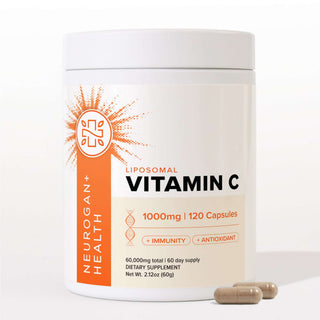
If you’re after maximum absorption from each dose, you need high-dose vitamin C without stomach issues, you’re looking to support your immune system during periods of high stress or illness, or you want a premium supplement backed by clinical absorption data. A high-quality option like Neurogan Health’s Liposomal Vitamin C is specifically formulated for optimal bioavailability.
Side-by-Side Comparison Table: Liposomal Vitamin C vs. Standard Ascorbic Acid
Here’s a quick reference to see how vitamin C vs liposomal vitamin C stack up across the factors that matter most:
|
Feature |
Regular Vitamin C |
Liposomal Vitamin C |
|
Bioavailability |
Moderate (drops at high doses) |
High (up to 1.2–5.4x greater Cmax) |
|
Absorption Mechanism |
SVCT transporters (saturable, creating a bottle neck) |
Lipid membrane fusion + transporters |
|
Cellular Uptake |
Standard |
Enhanced (up to 20% higher in leukocytes) |
|
GI Tolerance |
May cause discomfort at high doses |
Gentle, even at higher doses |
|
Duration in Blood |
Shorter half-life |
Longer-lasting plasma levels |
|
Dosing Efficiency |
May need higher/more frequent doses |
More vitamin C delivered per mg |
|
Cost |
Lower |
Higher (but more efficient per dose) |
|
Best For |
Daily maintenance, budget-friendly |
Maximum absorption, immune support |
How to Choose a Quality Liposomal Vitamin C
When shopping for a liposomal vitamin C supplement, look for products that use high-quality phospholipids (sunflower lecithin is a popular, soy-free option), have verified small and uniform liposome particle sizes, and ideally provide third-party testing data. The liposomal supplements collection at Neurogan Health is formulated with these quality standards in mind.
FAQs
Is liposomal vitamin C better than normal vitamin C?
For absorption, yes. Liposomal vitamin C uses a lipid layer to protect the ascorbic acid through digestion, so more reaches your bloodstream compared to standard vitamin C. Regular vitamin C works well for normal doses under 200 mg. Liposomal forms are most beneficial at higher doses, where standard forms may cause stomach discomfort.
Who shouldn't take liposomal vitamin C?
People with a history of kidney stones should be cautious with high-dose vitamin C, including liposomal forms, because excess intake can increase oxalate levels. Individuals on blood thinners or undergoing chemotherapy should consult their doctor. Pregnant or breastfeeding women should follow recommended daily amounts unless advised otherwise.
Is it okay to take liposomal vitamin C every day?
Daily use is generally safe for most people. Vitamin C is water-soluble, so the body flushes out what it doesn’t need. Liposomal forms are often easier on digestion compared to standard ascorbic acid. Typical supplemental doses range from 500 to 1000 mg per day.
Does liposomal vitamin C really work?
Research suggests liposomal delivery can increase vitamin C bioavailability compared to standard oral supplements. While it is not equivalent to IV vitamin C, it may provide higher absorption than traditional forms.
Resources:
-
Office of Dietary Supplements. (2025). Vitamin C: Fact sheet for health professionals. National Institutes of Health. Retrieved February 17, 2026, from https://ods.od.nih.gov/factsheets/VitaminC-HealthProfessional/
-
Levine, M., Conry-Cantilena, C., Wang, Y., Welch, R. W., Washko, P. W., Dhariwal, K. R., ... & Cantilena, L. R. (1996). Vitamin C pharmacokinetics in healthy volunteers: evidence for a recommended dietary allowance. Proceedings of the National Academy of Sciences, 93(8), 3704-3709.
-
Carr, A. C. (2025). Do liposomal vitamin C formulations have improved bioavailability? A scoping review identifying future research directions. Basic & Clinical Pharmacology & Toxicology. Advance online publication. https://pubmed.ncbi.nlm.nih.gov/40506693/
-
Purpura, M., Jäger, R., Godavarthi, A., Bhaskarachar, D., & Tinsley, G. M. (2024). Liposomal delivery enhances absorption of vitamin C into plasma and leukocytes: a double-blind, placebo-controlled, randomized trial. European journal of nutrition, 63(8), 3037-3046.

