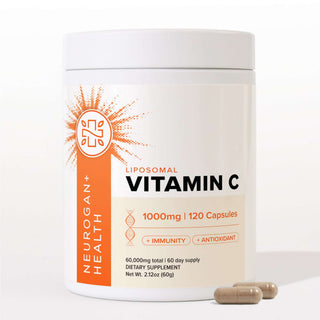
Liposomal vitamin C is designed to be more absorbable than your average ascorbic acid vitamin C supplement, which means you could need less.
The typical doses for liposomal vitamin C products are around 500-1000 mg, compared with 800-2000 mg for ascorbic acid if you’re looking to go beyond the regular dietary intake and support things like immune health, collagen production, and recovery.
Even within these numbers, you'll see a wide range, which is why we’ll guide you on how much to take and how to adjust your doses based on your health goals.
Recommended Daily Dose of Liposomal Vitamin C
Standard dose: 1000 mg daily (often split into two capsules)
Maintenance dose: 500 mg daily (1 capsule)
Most people fall comfortably within the 500-1000 mg per day range for general health, with a maximum dosage of 2000 mg.
Because liposomal formulations are designed to enhance bioavailability by protecting the active compound in tiny lipid layers that help it move through the digestive system, you don’t need to push the doses as high as regular vitamin C or other forms of it.

How Much Liposomal Vitamin C Per Day?
Your ideal dietary vitamin C dose depends on why you’re taking it.
For General Health (500-1000 mg)
Vitamin C is a water-soluble antioxidant, which means it helps neutralize unstable molecules called reactive oxygen species (ROS), or free radicals. Free radicals are byproducts of normal metabolism, exercise, stress, pollution, UV exposure, and inflammation.
They aren’t necessarily bad — in fact, we need them for signaling and immune defense — but the problem is when there are too many free radicals, causing an imbalance called “oxidative stress.”
Vitamin C is also excellent at supporting the body's regeneration of vitamin E and glutathione, which are key components of the antioxidant network.
For Immune Support (1,000–2,000 mg)
During periods of higher stress — such as travel, seasonal changes, or when you feel rundown — experts recommend increasing your vitamin C intake to 1000-2000 mg daily, ideally divided into two doses.
Splitting the dose (morning and afternoon) may help maintain steadier levels of dietary vitamin C in the blood.
Vitamin C can safely donate an electron to a free radical, stabilizing it without becoming unstable itself, kind of like a molecular shock absorber.
Because it’s a water-soluble antioxidant, vitamin C primarily works in blood plasma, cellular fluid, and immune cells. Interestingly, our white blood cells actively accumulate vitamin C 10-100x more than plasma, indicating that our immune cells require vitamin C for pathogen defence and cellular signalling [1].
For Antioxidant Protection (1,000–1,500 mg)
When we talk about vitamin C supporting antioxidant activity, what we’re really talking about is helping the body manage cumulative stress load. Not just emotional stress, but the stress you get from hard training sessions, travel, poor sleep, or intense workloads.
All of these increase metabolic demand, and as metabolism increases, so does reactive oxygen species production.
Vitamin C can help buffer all that exhaust.
For Skin Health & Collagen Support (1,000–2,000 mg)
When people take vitamin C supplements for skin health, tendons, and ligaments, clinicians often recommend 1000-2000 mg daily, split into two doses.
These higher doses support collagen synthesis, which relies on vitamin C for two key enzymes: prolyl hydroxylase and lysyl hydroxylase.
These enzymes stabilize collagen molecules; without sufficient vitamin C, collagen fibers are weaker, and structural integrity decreases. We see this in severe cases of scurvy (vitamin C deficiency) — weak connective tissue, poor wound healing, and fragile skin.
Topical vitamin C is another way to support skin health, but it works locally on the skin, bypassing systemic regulation and delivering higher concentrations. Vitamin C also interacts with other supplements and trace elements involved in skin health, including copper peptides.
Maximum Liposomal Vitamin C Dosage ( 3000mg daily limit)
While the commonly referenced upper limit for vitamin C from all sources is 2,000 mg per day, some individuals tolerate slightly higher amounts.
The upper limit (UL) for vitamin C is 3000 mg, based on gastrointestinal tolerance rather than toxicity. When in doubt, stay at or below 2,000 mg unless supervised by a healthcare professional.
How to Take Liposomal Vitamin C
Liposomal vitamin C is pretty flexible when it comes to timing. Because it’s water-soluble and used quickly by the body, small adjustments in timing and dose splitting can help you get the most out of it, especially if you’re taking higher amounts.
Best Time to Take (Morning Recommended)
Taking your dietary supplements in the morning is helpful because it’s easier to remember. The good thing about liposomal vitamin C is that it pairs well with other daily supplements like your omega-3s, B-complex, magnesium, and zinc.
With or Without Food?
Liposomal Vitamin C can be taken with or without food. Because vitamin C is encapsulated in tiny liposomes, it protects the compound and makes it easier for your stomach to digest, even for those who are prone to sensitivities.
If you’re particularly sensitive to taking capsules in general, it could help to take your vitamin C supplement with water and food.
How Many Capsules Per Day?
If we’re using the Neurogan Health Liposomal Vitamin C as an example, you could take 1 capsule (500 mg) for regular maintenance or take 2 for the 1000 mg dose (split in the day, if you prefer).
Split Dosing vs. Single Dose
Vitamin C is water-soluble and not stored extensively in the body. If you’re taking 1,000 mg or less, once daily is typically fine. If you’re taking more than 1,000 mg, splitting into two doses may help with tolerance and help to reduce stomach discomfort.
Factors That Affect Your Dosage Needs
There’s no universal optimal dose for liposomal vitamin C supplementation, and dosage can vary based on age (for instance, older adults may benefit from higher vitamin C intake), stress levels, immune status, diet, and training load.
Think of dosage as adjustable.
Official Daily Recommended Intake (RDA)
In North America, health authorities set vitamin C guidelines to prevent deficiency, but this is different from dietary vitamin C supplements based on performance, immune, or skin goals.
According to the National Institute of Health (NIH):
Adult Women: 75 mg per day
Adult men: 90 mg per day
Smokers: +35 mg per day [2].
The European Food Safety Authority (EFSA) sets similar ranges of around 80-110 mg per day [3].
Signs You May Need to Adjust Your Dosage
Vitamin C is one of the more forgiving supplements. Because it’s water-soluble, your body won’t store large amounts and gets rid of anything it won’t use in urine.
That said, there is a natural limit to how much your body can comfortably handle at one time — often called “bowel tolerance.”
As vitamin C intake increases, absorption efficiency decreases. Once you exceed what your body can absorb and utilize, the unabsorbed portion pulls water into the intestines.
That’s when you might notice signs you’ve overdone your vitamin C supplementation:
-
Diahrrea
-
Mild nausea
-
Abdominal cramping
The solution to this is pretty straightforward. Reduce your daily intake (for example, from 1,500 mg to 1000 mg) or split your doses into smaller servings. Symptoms of too much vitamin C should go away within a day.
On the other hand, you might need to bump up your liposomal vitamin C if you’re under a lot of stress. During stress states, vitamin C turnover increases. Immune cells and adrenal tissue use it rapidly. Plasma levels can drop faster than usual.
In these cases, modestly increasing intake can help maintain stable antioxidant capacity.
Dosage Comparison: Liposomal vs Regular Vitamin C
Not all vitamin C supplements behave the same in the body. For example, traditional vitamin C supplements (pure ascorbic acid) are absorbed through active transport in the small intestine, but absorption decreases as the dose increases.
-
At lower intakes (under ~200 mg), absorption is high.
-
As you increase the dose (500–1,000 mg+), absorption percentage drops.
-
Excess that isn’t absorbed contributes to bowel tolerance effects.
Liposomal vitamin C is designed differently, where the vitamin C is inside phospholipid spheres (liposomes). These lipid particles help protect the active ingredient during digestion and may improve delivery into circulation.
Because liposomal formulations are designed for enhanced bioavailability:
-
You often need lower doses compared to standard ascorbic acid to achieve similar plasma levels.
-
GI side effects may occur at higher thresholds.
-
Mega-dosing is generally unnecessary.
Liposomal vs Regular Vitamin C Dosage Chart
|
Goal |
Regular Vitamin C |
Liposomal Vitamin C |
|
Maintenance |
800-1000 mg |
500-1000 mg |
|
Immune support |
1000-2000 mg |
1000-2000 mg |
|
High oxidative stress |
1500 -2000 mg |
1000-1500 mg |
|
Upper limit (daily) |
2,000 mg (UL) |
2000 mg (practical ceiling) |
The Main Takeaway: Liposomal Vitamin C Dosage
For most adults, 500–1,000 mg of liposomal vitamin C daily is a good baseline for maintenance, with 1,000–2,000 mg used short-term during higher stress or immune demand.
Liposomal forms are designed to provide effective support at lower doses than regular vitamin C. More isn’t always better — consistency and adjusting to your lifestyle matter most.
Resources:
-
Carr, A. C., & Maggini, S. (2017). Vitamin C and immune function. Nutrients, 9(11), 1211.
-
Office of Dietary Supplements. (2024). Vitamin C fact sheet for health professionals. National Institutes of Health. https://ods.od.nih.gov/factsheets/VitaminC-HealthProfessional/
-
European Food Safety Authority (EFSA) Panel on Dietetic Products, Nutrition and Allergies (NDA). Scientific opinion on Dietary Reference Values for vitamin C. EFSA Journal. 2013;11(11):3418.