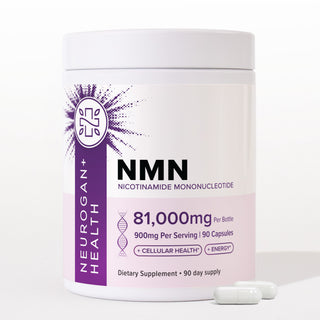
If you've been following the NMN space for a while, as we have, you already know it's been a bit of a rollercoaster.
In late 2022, the FDA tried to pull all NMN products from the U.S. supplement market. Brands scrambled. Amazon delisted. Customers panicked.
But the good news is that in 2026, NMN is back and more widely available than ever, with a cleaner regulatory path and a growing body of clinical research.
What is NMN (A Quick Recap)
NMN stands for nicotinamide mononucleotide. Even though it's a mouthful, the concept behind this molecule is fairly straightforward.
NMN is a molecule the body already uses to make NAD+ (nicotinamide adenine dinucleotide), and it's essentially a cellular fuel.
Every cell in the body needs it to produce energy, repair DNA, and maintain metabolism. However, NAD+ levels naturally decline with age, so by the time you're in your 50s, your body produces half the amount of NAD+ you had in your 20s. Researchers are linking this drop to a major driving factor of fatigue, slower recovery, and metabolic sluggishness that we associate with aging.
And while we've still yet to find the fountain of youth, NMN supplements might give your body enough raw material to support NAD+ production to support a healthier aging process — but not stop or reverse it.
NMN FDA Status Update 2026
If you've seen anything in the news about NMN being "banned" or suddenly "legal again," here's the full story:
Is NMN Banned?
No, but it's had a very rocky few years.
NMN products first entered the market in late 2017, but in November 2022, the Food and Drug Administration declared NMN was excluded from the definition of a dietary supplement. Not because it was inherently dangerous, though.
The reason came down to something called the "drug exclusion clause."
Under U.S. law, if an ingredient has been the subject of substantial clinical investigations, like a drug, and those investigations were published before the ingredient was marketed as a supplement, the FDA can block it from being sold as a supplement.
In NMN's case, a company called MetroBiotech had filed an Investigational New Drug (IND) application, essentially claiming NMN as a pharmaceutical candidate. The FDA used this as grounds to say: "If it's being studied as a drug, it can't also be a supplement [1]."
Current Regulatory Landscape
Fast forward to September 29, 2025: the FDA reversed its earlier position.
The agency officially confirmed that NMN isn't excluded from the definition of a dietary supplement, acknowledging that it had been on the market as a supplement before the drug investigations became public.
This means you can now buy your favorite NMN products again in the United States without any issues.
In Europe, NMN is still being evaluated as a novel food, so it's not yet authorized as a regular food supplement ingredient across the EU.
Japan and South Korea are ahead of everyone, with well-established consumer markets for NMN longevity products. China has approved NMN specifically as a cosmetic ingredient, though not yet as an oral supplement.
Latest NMN Clinical Research
The science on NMN is moving fast. A few years ago, most of the impressive data was from mouse studies. Now we have a growing bank of human clinical trials with more on the way— and the results are getting interesting.

Increasing NAD+ Levels in Blood Compared to Placebo
A 2022 trial looked at 66 healthy adults (ages 40-65) and tested 300 mg/day of NMN for 60 days. They found that NMN significantly increased blood NAD+ levels compared with placebo, improved walking distance in a 6-minute walking test, and that participants reported better overall health scores [2].
Metabolic Support in Postmenopausal Women
A 2023 trial in overweight postmenopausal women with prediabetes found that 250 mg/ day of NMN for 10 weeks improved muscle and insulin sensitivity without major side effects. This one is a pretty big deal, showing that NMN may have real metabolic benefits and not just energy-adjacent ones [3].
Safety Profile at Higher Doses
Across at least seven human clinical trials conducted in 2023-2024, oral NMN at 900-1250 mg/day for 4-10 weeks was described as "safe and well tolerated," with no severe adverse reactions [4].
NMN and Longevity
I want to be practical about what the science does and doesn't say here.
In human studies, NMN consistently raises NAD+ levels and shows good short-term safety. There are early signs of better physical and metabolic health, but no human trials have proven that NMN extends lifespan. That's a claim that would take decades and massive studies to make.
The most compelling longevity data we have on NMN still comes from animal studies. A 2024 study in mice with a premature aging condition found that NMN increased median lifespan by about 20% and improved frailty scores [5].
What's more realistic to expect with NMN supplements in humans is better energy, less fatigue, and potential metabolic support.
NMN and Metabolism/Energy
If you're taking NMN for energy and metabolic health, you're in the zone supported by current science. Just don't expect it to work like a stimulant — it's more like raising the floor on your cellular energy capacity over time.
In 2024, a narrative review of human randomized controlled trials found that NMN doses of 100-1250 mg/day increased circulating NAD+, improving some glucose and lipid markers [6].
What's Being Studied Now?
The NMN research pipeline is active. Here's what's currently underway that could shape NMN's story over the next few years:
NMN Protecting Liver Health from Binge Drinking
A double-blind crossover study (NCT05882214) is examining NMN's effects on liver health after binge drinking in otherwise healthy subjects.
The premise is this: Participants undergo a controlled acute binge drink challenge during each period.
They'll receive NMN or a placebo around that challenge. The exact dose/timing of NMN isn’t fully detailed in the public brief, but the stated goal is to see whether NMN shifts liver and lipid responses to the same alcohol load.
NMN and Mild Ulcerative Colitis
NCT06214078 is testing whether NMN can reduce inflammation and improve symptoms in people with mild ulcerative colitis, using a randomized, double‑blind design.
Most human NMN data so far have been collected in metabolic health or short‑term stress models. Ulcerative colitis is a chronic, immune‑mediated condition, which means that showing benefit here would strongly support NAD+ boosting as a real immunometabolic strategy.
NMN Industry News & Trends
The regulatory reversal isn't the only thing shaking up the NMN world. The market itself has exploded — and with that comes both opportunity and noise.
NMN and NAD+ have become the stars of "healthy aging" ingredients across supplements and cosmetics. Japan and South Korea are leading early adoption, with strong consumer demand for anti-aging beauty and wellness products.
A 2025 nutricosmetics report estimates the NMN beauty and anti-aging segment is already in the hundreds of millions of dollars, with high double-digit growth projected into the 2030s [7]. K-beauty trend pieces explicitly list NMN as a breakthrough anti-aging ingredient in 2025 formulations, often paired with retinoids and Centella for skin barrier support and anti-inflammatory routines.
New Forms of NMN: Liposomal, Sublingual, and Nasal
Standard oral NMN is quickly metabolized in the gut and liver, with much of it converted to other molecules before reaching your bloodstream. This has encouraged researchers and brands to explore alternative delivery methods that might bypass first-pass metabolism and get more NMN (or NAD+) where it needs to go.
Liposomal NMN
A 2025 Japanese intervention study compared liposomal NMN with standard oral NMN in healthy adults and found that the liposomal group achieved significantly higher blood NAD+ levels by week 4. Both groups' NAD+ levels fell after stopping supplementation, suggesting consistent use is needed to maintain results [8].
Sublingual NMN
You'll see marketing claims like "80% bioavailability vs. 20–30% for standard capsules."
But the truth is that those numbers are marketing estimates, not peer-reviewed data. There haven't been any clinical studies looking at sublingual vs. oral NMN on blood NAD+ levels.
Sublingual delivery theoretically bypasses some first-pass metabolism, but standard oral NMN already reliably raises NAD+ in humans, and gut bacterial conversion of NMN actually contributes to NAD+ production, so bypassing the gut may not always be an advantage.
Intranasal NMN
Nasal sprays are mostly being explored for NAD+ spray itself (not NMN specifically) in animal models of brain injury. In rats and mice, intranasal NAD+ has been shown to increase brain NAD+ levels and reduce stroke damage via the olfactory route [9]. Interesting science — but nasal NMN sprays are way ahead of the human evidence base right now.
NMN vs. NR: The Ongoing Debate
The honest answer, based on current science, is that NMN and NR (nicotinamide riboside) are more similar than different.
A trial found that NAD precursors, such as both NR and NMN, roughly doubled whole-blood NAD+ over 14 days, while plain nicotinamide didn't. Interestingly, both appear to be partially metabolized by gut bacteria into nicotinic acid, which then drives much of the increase in NAD+ [10].
NR has more published clinical history and quality-controlled, branded ingredients (such as Niagen). NMN may have more supportive preclinical aging and healthspan data, and more human trials now showing functional endpoints like walking speed and insulin sensitivity.
Some experts believe that NMN is "superior" systemically and more likely to reach muscle and brain than NR — but these are usually based on selective interpretation of preclinical studies.
Where things get interesting is in real-world user reports.
On Reddit communities dedicated to NMN and NR. Many users report stronger, more noticeable effects from NMN, particularly around afternoon energy and physical output, while others prefer NR for what they describe as smoother, more "head-focused" benefits. These are anecdotes, not data, but they're worth mentioning.
What This Means for NMN Supplement Users
Let's pull all of this together into plain English for the person who just wants to know: is NMN worth taking, and is it safe?
-
On safety: Yes. Across multiple human clinical trials, NMN at doses up to 1,250 mg/day for 4–10 weeks has been consistently reported as safe. No severe adverse events.
-
On effectiveness: NMN reliably raises blood NAD+ levels in humans. Beyond that, there are early but real signals for better physical function, improved insulin sensitivity, and metabolic support. Longevity claims — such as "extend your lifespan" — are not yet proven in humans and shouldn't appear on any supplement label.
-
On legality: The FDA's 2025 reversal cleared the air. NMN is available as a dietary supplement in the United States.
-
On timing: Most trials run 8–12 weeks. Give it at least that long before deciding whether it's working for you. NAD+ replenishment isn't a bolt of lightning. Its effects are much more subtle, like a slow, steady rise.
How to Choose a Quality NMN Supplement in 2026
With the market flooded and prices all over the map — we've seen NMN supplements ranging from $20 to $150+ for similar doses — knowing what to look for in NMN supplements matters more than ever.
Here's what we actually look at (and what we hold ourselves to at Neurogan Health):
-
Purity and third-party testing: Look for a Certificate of Analysis (COA) showing ≥99% NMN purity, low levels of heavy metals, and clean microbiological results. Ideally, this testing is conducted by an accredited third-party lab.
-
Realistic claims: Look for brands making structure/function claims like "supports energy," "promotes healthy aging," or "supports NAD+ levels." Red flags include anything that promises to "reverse your age" or "extend your lifespan," or claims FDA approval (supplements don't get FDA approval — that's a drug thing).
-
Delivery form: Standard capsules and powders have the most human data. Liposomal NMN formulations are promising if you want potentially better absorption.
-
Price reality check: High-purity NMN is not cheap to manufacture. But you also don't need to pay $150 a bottle for a quality product. At Neurogan Health, our NMN products sit in the $35–$50 range — and that reflects what a well-tested, USA-made, lab-verified NMN product actually should cost. If you're paying a lot more, you're likely paying for marketing. If you're paying a lot less, ask questions.
-
Manufacturer transparency: Clear company identity (not just a marketing shell), batch numbers on products. The more transparent a brand is, the more seriously the NMN manufacturer take quality.
We'll update this article quarterly as new research drops and the regulatory space evolves. Bookmark it and check back — because in the NMN world, things move fast.
Resources:
-
Natural Products Association, & Alliance for Natural Health USA. (2023, March 7). Citizen petition regarding regulatory status of β-nicotinamide mononucleotide (NMN) [Citizen petition]. U.S. Food and Drug Administration. https://www.npanational.org/wp-content/uploads/2023/03/NMN-CP.pdf
-
Huang, H. (2022). A multicentre, randomised, double blind, parallel design, placebo controlled study to evaluate the efficacy and safety of uthever (NMN supplement), an orally administered supplementation in middle aged and older adults. Frontiers in aging, 3, 851698.
-
Yi, L., Maier, A. B., Tao, R., Lin, Z., Vaidya, A., Pendse, S., ... & Kumbhar, V. (2023). The efficacy and safety of β-nicotinamide mononucleotide (NMN) supplementation in healthy middle-aged adults: a randomized, multicenter, double-blind, placebo-controlled, parallel-group, dose-dependent clinical trial. Geroscience, 45(1), 29-43.
-
Huang, H. (2022). A multicentre, randomised, double blind, parallel design, placebo controlled study to evaluate the efficacy and safety of uthever (NMN supplement), an orally administered supplementation in middle aged and older adults. Frontiers in aging, 3, 851698.
-
Gu, Y., Gao, L., He, J., Luo, M., Hu, M., Lin, Y., ... & Yu, Y. (2024). β-Nicotinamide mononucleotide supplementation prolongs the lifespan of prematurely aged mice and protects colon function in ageing mice. Food & Function, 15(6), 3199-3213.
-
Chen, F., Zhou, D., Kong, A. P. S., Yim, N. T., Dai, S., Chen, Y. N., & Hui, L. L. (2025). Effects of nicotinamide mononucleotide on glucose and lipid metabolism in adults: a systematic review and meta-analysis of randomised controlled trials. Current diabetes reports, 25(1), 4.
-
Future Market Insights. (2025). NAD precursor supplements market. Future Market Insights. https://www.futuremarketinsights.com/reports/nad-precursor-supplements-market
-
Kawakami, S., MAEDA, Y., & FUKUZAWA, Y. (2025). Intervention Study Comparing Blood NAD+ Concentrations with Liposomal and Non-Liposomal Nicotinamide Mononucleotide. Ann Clin Med Case Rep, 14(11), 1-12.
-
Ying, W., Wei, G., Wang, D., Wang, Q., Tang, X., Shi, J., ... & Lu, H. (2007). Intranasal administration with NAD+ profoundly decreases brain injury in a rat model of transient focal ischemia. Front Biosci, 12(1), 2728-2734.
-
Christen, S., Redeuil, K., Goulet, L., Giner, M. P., Breton, I., Rota, R., ... & Cuenoud, B. (2026). The differential impact of three different NAD+ boosters on circulatory NAD and microbial metabolism in humans. Nature Metabolism, 1-12.