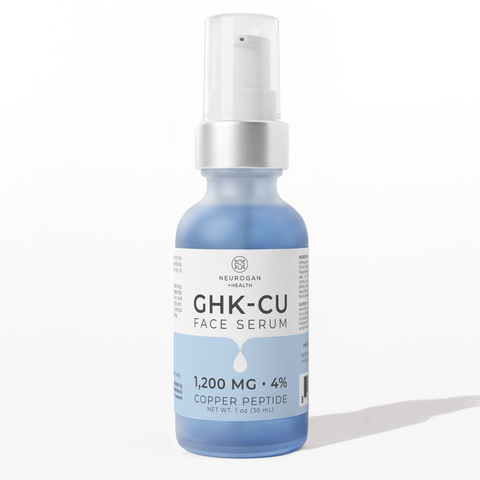
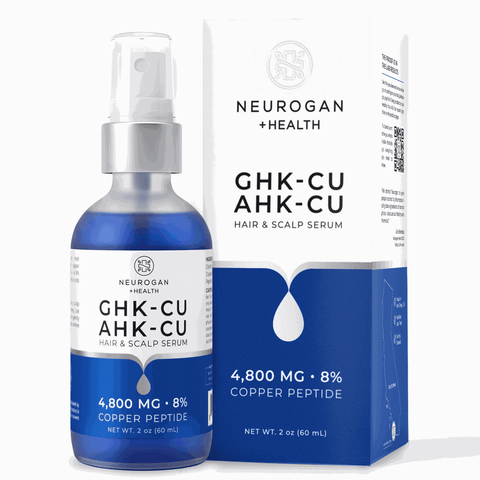

GHK and GHK-Cu are closely related, but they are not the same chemical form. GHK is the tripeptide glycyl-L-histidyl-L-lysine by itself. GHK-Cu is that same three-amino-acid peptide coordinated with a copper ion.
That difference changes the composition and chemistry of the molecule, but it does not automatically mean that GHK-Cu is clinically “better,” more bioavailable, or more effective for every use.
The distinction is especially important because terms such as GHK basic, GHK without copper, Tripeptide-1, GHK-Cu, and Copper Tripeptide-1 are often used interchangeably online even though they do not all describe the same form.
This guide explains what each name means, what changes when GHK binds copper, and what the research can — and cannot — tell us about the difference. For a broader introduction to the copper-bound peptide itself, see our guide to what GHK-Cu is.
GHK vs. GHK-Cu at a Glance
| Property | GHK | GHK-Cu |
|---|---|---|
| Full name | Glycyl-L-histidyl-L-lysine | GHK coordinated with copper |
| Peptide sequence | Gly-His-Lys | Gly-His-Lys |
| Bound copper | No | Yes |
| Common cosmetic name | Tripeptide-1 | Copper Tripeptide-1 |
| Naturally associated with the body | GHK occurs naturally in human biological fluids | GHK can bind Cu2+ to form the copper complex |
| Research focus | Free-peptide biology and signaling | Copper-peptide, tissue and cosmetic research |
| Same molecule? | No. They share the same peptide sequence but differ in copper coordination. | |
| Is GHK-Cu clinically proven superior? | No broad head-to-head clinical evidence establishes universal superiority. | |
What Does GHK Stand For?
GHK stands for glycyl-L-histidyl-L-lysine, a tripeptide made from three amino acids:
- G — Glycine
- H — Histidine
- K — Lysine
GHK occurs naturally in the human body and has been identified in biological fluids including plasma, saliva, and urine.1
It is a small metal-binding peptide with a particularly strong affinity for copper ions. That copper-binding property is what leads to GHK-Cu.

What Is “GHK Basic”?
“GHK basic” is not a separate amino-acid sequence.
The phrase is commonly used online and by some peptide suppliers to distinguish free GHK without bound copper from GHK-Cu.
In other words:
GHK basic = GHK without copper
GHK-Cu = GHK with coordinated copper
The more scientifically precise name for the copper-free form is simply GHK or glycyl-L-histidyl-L-lysine.
What Is GHK-Cu?
GHK-Cu is the copper complex formed when GHK coordinates a copper ion, commonly Cu2+.
The GHK peptide sequence remains Gly-His-Lys, but copper becomes part of the coordination complex. This changes the chemical state of the molecule and influences how researchers describe and study it.
In cosmetic ingredient terminology, the copper complex is commonly listed as Copper Tripeptide-1.2
GHK-Cu has been studied in relation to extracellular-matrix remodeling, collagen-related processes, inflammatory signaling, wound repair, skin biology, and other biological pathways.3
However, mechanistic activity should not be confused with proof that every GHK-Cu product produces a particular clinical result.
What Happens When GHK Binds Copper?
Copper binding changes GHK from a free peptide into a metal-peptide coordination complex.
Studies of GHK-copper complex formation have shown that GHK can form copper complexes with different stoichiometries and stabilities depending on chemical conditions.4 Structural work has also demonstrated direct coordination of copper through atoms within the GHK peptide.5
This matters because copper is involved in many biological systems, and much of the scientific literature focuses specifically on the copper-bound GHK complex.
But there is an important limitation:
Different chemistry does not automatically prove better clinical performance.
A laboratory finding showing that GHK-Cu behaves differently from GHK in a specific system does not establish that GHK-Cu is universally:
- more effective;
- more bioavailable;
- more stable in every formulation;
- better for hair;
- better for skin; or
- clinically superior across every route of use.
Those questions require direct comparisons using the relevant formulation and clinical outcome.
Is GHK the Same as GHK-Cu?
No.
They share the same GHK peptide backbone, but GHK-Cu contains coordinated copper while free GHK does not.
An easy way to think about it is:
- GHK = the peptide
- GHK-Cu = the peptide-copper complex
They are closely related chemical forms, not interchangeable names for exactly the same molecule.
Is GHK the Same as Tripeptide-1?
In cosmetic ingredient terminology, Tripeptide-1 refers to the GHK peptide sequence.2
That means an ingredient list containing Tripeptide-1 generally refers to the GHK peptide rather than Copper Tripeptide-1.
The distinction matters because the word “tripeptide” by itself only means a peptide containing three amino acids. There are many different tripeptides.
Tripeptide-1 identifies this specific GHK sequence.
Is Copper Tripeptide-1 the Same as GHK-Cu?
In cosmetic ingredient terminology, Copper Tripeptide-1 is the name commonly used for the copper complex of Tripeptide-1, the GHK sequence.2
So in skincare discussions:
- GHK corresponds to the Gly-His-Lys peptide commonly identified as Tripeptide-1.
- GHK-Cu corresponds to the copper-bound form commonly identified as Copper Tripeptide-1.
“Copper peptide,” however, is a broader category and does not always mean GHK-Cu. Other peptide sequences can also bind copper.
Can GHK Exist Without Copper?
Yes.
GHK does not need to be pre-bound to copper in order to exist.
The free peptide occurs naturally and can also be synthesized independently. Its affinity for copper means it can form a copper complex when suitable copper ions are available, but GHK and GHK-Cu remain distinguishable chemical forms.
This is why it is possible to encounter:
- GHK;
- Tripeptide-1;
- GHK-Cu; and
- Copper Tripeptide-1
as different ingredient or research descriptions.
Does GHK Bind Copper Naturally?
Yes. GHK can bind Cu2+ and form copper-peptide complexes.4
That does not mean every molecule of free GHK in the body is always bound to copper, or that applying free GHK guarantees a predictable amount will convert into GHK-Cu.
The actual chemical form present depends on factors such as:
- available copper;
- other competing ligands;
- pH;
- formulation conditions; and
- the surrounding biological environment.
Research on GHK-copper interactions in human serum also shows why the biological environment matters: GHK can participate in more complex copper-binding equilibria involving other proteins rather than existing in one fixed state.6
Is GHK-Cu More Active Than GHK?
The most accurate answer is: it depends on what biological activity is being measured.
GHK and GHK-Cu are both biologically interesting, and copper coordination can alter the chemical and biological behavior of the peptide.
Experimental work on GHK and related peptides has shown that copper-complex formation can be relevant to biological activity in particular laboratory systems.4
But that is not the same as proving that GHK-Cu is universally more effective than free GHK in people.
There is not a broad body of head-to-head human clinical research showing that GHK-Cu consistently outperforms GHK for:
- wrinkles;
- skin firmness;
- hair growth;
- wound healing;
- systemic outcomes; or
- every other effect attributed to the peptide.
So terms such as “upgraded GHK,” “significantly stronger GHK,” or “the superior form” go beyond what the evidence can establish as a general rule.
Is GHK-Cu More Stable Than GHK?
There is no useful universal answer that applies to every formulation.
Peptide stability depends on factors such as:
- pH;
- temperature;
- light;
- water activity;
- other ingredients;
- metal availability; and
- the specific salt or chemical form used.
GHK-Cu itself can exist in different formulation and coordination states, so it should not always be treated as one chemically identical material regardless of preparation.7
That makes blanket claims such as “GHK-Cu is always more stable than GHK” too broad.
The same principle applies to labels such as acetate. If you are comparing those chemical forms specifically, see our GHK-Cu acetate guide.
Why Is GHK-Cu More Common in Skincare?
GHK-Cu has become more recognizable in skincare largely because Copper Tripeptide-1 is an established cosmetic ingredient and because a substantial portion of the skin-related peptide literature focuses on the copper complex.2

GHK-Cu has been investigated in relation to:
- collagen and extracellular-matrix biology;
- fibroblast activity;
- glycosaminoglycans;
- tissue remodeling;
- skin repair; and
- visible signs of skin aging.
That research history helps explain its popularity in cosmetic formulations.
It does not mean every Copper Tripeptide-1 serum or cream has been independently clinically proven to produce those outcomes.
GHK vs. GHK-Cu for Skin
For skin-related applications, the copper-bound form has the larger recognizable cosmetic research history.
Reviews of GHK-Cu discuss laboratory research as well as human topical evidence involving skin appearance, photoaging, density, firmness, and related outcomes.3
However, this evidence is not equivalent to a direct clinical comparison of free GHK against GHK-Cu.
So it is more accurate to say:
GHK-Cu is more extensively represented in the cosmetic skin literature.
It is less accurate to say:
GHK-Cu has been clinically proven to be better than GHK for skin.
For the evidence behind individual proposed effects rather than the GHK-versus-GHK-Cu distinction, see our GHK-Cu benefits research review.
GHK vs. GHK-Cu for Hair
Hair evidence is more limited than many online comparisons suggest.
A small human study evaluated a topical combination containing GHK peptide together with 5-aminolevulinic acid in men with pattern hair loss.8
Because that study used a combination formula, it does not isolate the effect of GHK or GHK-Cu alone.
Another frequently cited copper-peptide hair study involved AHK-Cu, a different copper-binding tripeptide, rather than GHK-Cu.9
As a result, there is not strong head-to-head human evidence showing that either free GHK or GHK-Cu is clinically superior for hair growth.
Is AHK-Cu the Same as GHK-Cu?
No.
AHK-Cu is a different copper-binding tripeptide with an alanine-histidine-lysine sequence, while GHK-Cu contains glycine-histidine-lysine.
Research on AHK-Cu should not automatically be credited to GHK-Cu, and vice versa.
If you are comparing those two copper peptides specifically, see our dedicated AHK-Cu vs. GHK-Cu comparison.
Can You Buy GHK Without Copper?
Yes. Free GHK exists independently of the copper complex.
Depending on the context, it may be described as:
- GHK;
- glycyl-L-histidyl-L-lysine; or
- Tripeptide-1 in cosmetic ingredient terminology.
If the goal is to distinguish copper-free GHK from GHK-Cu, the ingredient identity matters more than marketing terms such as “basic peptide.”
A label saying Copper Tripeptide-1 refers to the copper-bound form rather than free GHK.
Which Is Better: GHK or GHK-Cu?
There is no evidence-based universal answer.
The more useful question is: better for what outcome, in what formulation, and based on what type of evidence?
GHK-Cu has a larger research footprint in cosmetic and regenerative contexts, particularly around skin and tissue biology. Free GHK is also biologically active and has been studied independently.
But a larger literature does not equal proof of universal superiority.
Choosing between them should therefore be based on:
- the specific formulation;
- the intended use;
- the route of application;
- the evidence for that particular outcome; and
- whether the finished product itself has been studied.

GHK vs. GHK-Cu FAQ
What does GHK stand for?
GHK stands for glycyl-L-histidyl-L-lysine, a tripeptide made from glycine, histidine, and lysine.
What does GHK-Cu stand for?
GHK-Cu refers to the GHK tripeptide coordinated with copper. The “Cu” is the chemical symbol for copper.
What is GHK basic?
“GHK basic” is an informal term commonly used to describe free GHK without bound copper. It is not a different peptide sequence.
Is GHK basic the same as GHK?
Usually, yes. In marketplace usage, “GHK basic” generally refers to the copper-free GHK peptide.
Is GHK the same as GHK-Cu?
No. GHK is the free Gly-His-Lys peptide. GHK-Cu is the copper-bound complex.
What is the difference between GHK and GHK-Cu?
The difference is copper coordination. GHK is the Gly-His-Lys tripeptide without coordinated copper, while GHK-Cu is the copper complex formed from that same peptide.
Can GHK exist without copper?
Yes. Free GHK exists independently and can bind copper when suitable copper ions are available.
Is Tripeptide-1 GHK?
In cosmetic ingredient terminology, Tripeptide-1 refers to the GHK peptide sequence.2
Is Copper Tripeptide-1 the same as GHK-Cu?
In cosmetic terminology, Copper Tripeptide-1 is the name commonly used for the copper complex of Tripeptide-1, the GHK peptide sequence.2
Does GHK naturally bind copper?
Yes. GHK can bind Cu2+ and form copper-peptide coordination complexes.4
Does all GHK turn into GHK-Cu in the body?
No fixed conversion rate has been established. Copper binding depends on the surrounding chemical and biological environment, including copper availability, pH, other proteins, and competing molecules.
Is GHK-Cu more bioavailable than GHK?
There is not enough general human evidence to make a universal statement that GHK-Cu is more bioavailable than free GHK across every route and formulation.
Is GHK-Cu more effective than GHK?
That has not been established as a universal clinical rule. The copper complex has a larger research footprint in several skin and tissue contexts, but broad head-to-head human evidence is lacking.
Is GHK-Cu better for skin?
GHK-Cu is more extensively represented in cosmetic skin research, but that is not the same as a clinical trial proving it is universally superior to free GHK.
Is GHK-Cu better for hair?
There is not strong head-to-head human evidence showing that GHK-Cu is clinically superior to free GHK for hair growth.
GHK vs. GHK-Cu: The Bottom Line
The simplest distinction is also the most important:
GHK is the Gly-His-Lys tripeptide without bound copper.
GHK-Cu is that peptide coordinated with copper.
The two forms are closely related, but they are not chemically identical.
Copper coordination changes the molecule's chemical state and is relevant to much of the research surrounding GHK-Cu. But that does not justify treating GHK-Cu as an automatically “upgraded,” “more bioavailable,” or universally superior version of GHK.
The current evidence supports a more careful conclusion:
- GHK occurs naturally and can exist without copper.
- GHK can bind copper and form GHK-Cu.
- Tripeptide-1 generally refers to GHK in cosmetic nomenclature.
- Copper Tripeptide-1 generally refers to the copper complex of the GHK sequence.
- GHK-Cu has a larger recognizable cosmetic and regenerative research history.
- There is not a broad head-to-head clinical evidence base proving GHK-Cu is superior to GHK for every outcome.
When comparing the two, focus on the exact molecule, formulation, route, and evidence rather than assuming that adding copper automatically makes one version clinically better.
References
- Pickart L, Margolina A. GHK Peptide as a Natural Modulator of Multiple Cellular Pathways in Skin Regeneration. BioMed Research International. 2015;2015:648108. doi:10.1155/2015/648108. PMID: 26236730.
- Johnson W Jr, Bergfeld WF, Belsito DV, et al. Safety Assessment of Tripeptide-1, Hexapeptide-12, Their Metal Salts and Fatty Acyl Derivatives, and Palmitoyl Tetrapeptide-7 as Used in Cosmetics. International Journal of Toxicology. 2018;37(3 Suppl):90S-102S. doi:10.1177/1091581818807863.
- Pickart L, Margolina A. Regenerative and Protective Actions of the GHK-Cu Peptide in the Light of the New Gene Data. International Journal of Molecular Sciences. 2018;19(7):1987. doi:10.3390/ijms19071987. PMID: 29986520.
- Conato C, Gavioli R, Guerrini R, Kozlowski H, Mlynarz P, Pasti C, Pulidori F, Remelli M. Copper complexes of glycyl-histidyl-lysine and two of its synthetic analogues: chemical behaviour and biological activity. Biochimica et Biophysica Acta. 2001;1526(2):199-210. doi:10.1016/S0304-4165(01)00127-1. PMID: 11325542.
- The structure of a copper complex of the growth factor glycyl-L-histidyl-L-lysine at 1.1 Å resolution. Inorganica Chimica Acta. 1984;82(1):93-99. doi:10.1016/S0020-1693(00)82544-X.
- Ternary Cu2+ Complexes of Human Serum Albumin and Glycyl-L-histidyl-L-lysine. Inorganic Chemistry. 2021. doi:10.1021/acs.inorgchem.1c03084. PMID: 34730942.
- GHK-Cu as a Bioactive Metallopeptide and Drug-Delivery Cargo: Coordination Chemistry, Formulation Science, Therapeutic Evidence, and a Translational Roadmap. Review published 2026. PMID: 42797253.
- Lee WJ, Sim HB, Jang YH, Lee SJ, Kim DW, Yim SH. Efficacy of a Complex of 5-Aminolevulinic Acid and Glycyl-Histidyl-Lysine Peptide on Hair Growth. Annals of Dermatology. 2016;28(4):438-443. doi:10.5021/ad.2016.28.4.438. PMID: 27489425.
- Pyo HK, Yoo HG, Won CH, et al. The effect of tripeptide-copper complex on human hair growth in vitro. Archives of Pharmacal Research. 2007;30(7):834-839. doi:10.1007/BF02978833. PMID: 17703734.