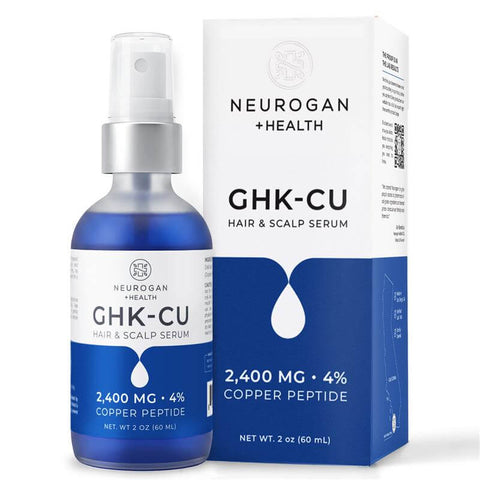

GHK-Cu acetate is a copper-GHK complex supplied in an acetate-associated chemical form. The core peptide is still GHK — glycyl-L-histidyl-L-lysine — coordinated with copper, while “acetate” describes an additional component of the isolated compound or salt form.12
That distinction is useful for chemistry and formulation, but it does not automatically mean that GHK-Cu acetate is more effective, more absorbable, more stable, or clinically superior to every other form of GHK-Cu.
It is also important to distinguish research-supplier terminology from cosmetic ingredient nomenclature. “GHK-Cu acetate,” “Copper Tripeptide-1,” and “Bis(Tripeptide-1) Copper Acetate” are related terms, but they should not automatically be treated as chemically identical labels.3
If you need the broader peptide definition first, see what GHK-Cu is. For the distinction between free GHK and copper-bound GHK-Cu, see our GHK vs. GHK-Cu guide.
GHK-Cu Acetate at a Glance
| Property | GHK-Cu Acetate |
|---|---|
| Core peptide | GHK — Gly-His-Lys |
| Metal | Copper |
| Additional component | Acetate / acetic-acid-derived component |
| Common research-supplier description | GHK-Cu acetate or GHK-Cu monoacetate |
| Example CAS number | 300801-03-0 for a commonly supplied GHK-Cu acetate material |
| Same as free GHK? | No |
| Same as every material called Copper Tripeptide-1? | Not necessarily; exact chemical form and formulation matter |
| Clinically proven superior to other GHK-Cu forms? | No |
What Is GHK-Cu Acetate?
GHK-Cu acetate is a chemical form of the copper-bound GHK peptide.
GHK itself is the tripeptide glycyl-L-histidyl-L-lysine. When it coordinates copper, the resulting metal-peptide complex is commonly called GHK-Cu.
In a GHK-Cu acetate material, acetate is present as part of the isolated chemical form.
For example, one commercially available research material is described as a tripeptide-copper(II) complex, monoacetate.2
That makes GHK-Cu acetate chemically more specific than simply saying “GHK-Cu.”
What Does “Acetate” Mean in GHK-Cu Acetate?
Acetate is derived from acetic acid.
In peptide and coordination chemistry, an acetate designation can identify an associated salt or counterion form of an isolated material.

The key point is that the acetate does not replace GHK or copper.
The material still contains:
- the GHK tripeptide;
- copper; and
- an acetate-associated component.
However, the exact coordination state, stoichiometry, and formulation can vary between named materials.4
So “acetate” should not be reduced to a marketing claim such as “the stabilized version” unless a specific stability comparison has actually been demonstrated for the formulation being discussed.
GHK-Cu Acetate vs. GHK-Cu: What's the Difference?
GHK-Cu is a broad way of describing the copper complex of the GHK peptide.
GHK-Cu acetate specifies an acetate-associated form of that copper-peptide material.
| Feature | GHK-Cu | GHK-Cu Acetate |
|---|---|---|
| GHK peptide | Yes | Yes |
| Copper | Yes | Yes |
| Acetate explicitly specified | Not necessarily | Yes |
| Exact molecular representation | Can depend on the defined chemical form | Includes an acetate-associated component |
| Proven clinically superior? | No head-to-head clinical evidence establishes one form as universally superior. | |
The difference therefore matters chemically, but it should not automatically be converted into an efficacy claim.
For the broader distinction between the copper-free and copper-bound peptide, see GHK vs. GHK-Cu.
Is GHK-Cu Acetate the Same as Copper Tripeptide-1?
Not as a universal naming rule.
Copper Tripeptide-1 is the cosmetic ingredient name commonly used for a complex formed by copper and Tripeptide-1, the GHK peptide sequence.3
That name describes the copper-peptide ingredient category used in cosmetics.
GHK-Cu acetate is a more chemically specific description because it also identifies an acetate-associated form.
So while both involve the same GHK-copper system, it is safer to verify the actual ingredient identity rather than assuming every Copper Tripeptide-1 material is specifically the same monoacetate form.
What Is Bis(Tripeptide-1) Copper Acetate?
Cosmetic ingredient nomenclature also includes Bis(Tripeptide-1) Copper Acetate.3
This is defined as an acetate salt formed from the reaction of Tripeptide-1 with copper.
The name itself indicates a particular stoichiometric form involving more than one Tripeptide-1 unit.
That is one reason chemical names need to be read carefully.
The terms:
- GHK-Cu;
- GHK-Cu acetate;
- Copper Tripeptide-1; and
- Bis(Tripeptide-1) Copper Acetate
all relate to GHK and copper chemistry, but they are not necessarily interchangeable descriptions of one single molecular form.
Does the Acetate Form Change How GHK-Cu Works?
There is not enough head-to-head human evidence to say that the acetate form produces a clinically meaningful difference in skin, hair, or tissue outcomes compared with other defined GHK-Cu forms.
Modern reviews of GHK-Cu chemistry emphasize that coordination state, speciation, formulation, stability, pharmacokinetics, and toxicity can vary across GHK-Cu preparations.4
That means formulation chemistry matters.
But it does not mean that every chemical difference has been shown to produce a better clinical result.
For the evidence behind GHK-Cu itself — rather than the acetate form specifically — see our GHK-Cu benefits research review.
Is GHK-Cu Acetate More Stable?
There is no universal evidence-based answer.
Stability depends on more than the name of the counterion or associated salt.
Relevant factors can include:
- pH;
- temperature;
- light exposure;
- water content;
- buffer composition;
- other ingredients;
- metal speciation;
- storage conditions; and
- the exact peptide material used.
A supplier may choose an acetate form because it performs appropriately in that supplier's manufacturing or analytical system.
That should not be generalized into the claim that GHK-Cu acetate is always more stable than every other GHK-Cu preparation.4
Is GHK-Cu Acetate More Soluble?
Solubility is also formulation-dependent.
Research suppliers may report solubility data for a specific GHK-Cu acetate material in a defined solvent or buffer.2
Those measurements apply to that material under those conditions.
They do not establish that acetate is universally more soluble than every other GHK-Cu form in:
- water;
- serum bases;
- creams;
- foams;
- biological fluids; or
- other formulations.
So claims such as “acetate dissolves better” or “HCl is more soluble” require direct formulation-specific evidence.
GHK-Cu Acetate vs. GHK-Cu HCl
You may see suppliers or product manufacturers describe GHK-Cu materials using different associated salts or chemical forms, including acetate or hydrochloride-related terminology.
The important question is not simply which suffix appears after the peptide name.
What matters is the exact material being used, including:
- identity;
- purity;
- stoichiometry;
- coordination state;
- solubility;
- stability in the finished formulation; and
- evidence for that formulation.
There is no broad clinical evidence showing that GHK-Cu acetate or an HCl-associated form is universally more effective for skin or hair.
Can GHK-Cu Acetate Be Used Topically?
GHK-Cu-related materials can appear in topical research and formulation contexts, but the exact ingredient in a finished cosmetic matters.
Cosmetic safety evaluations have assessed Copper Tripeptide-1 and related peptide ingredients under defined cosmetic practices and concentrations.3
That type of assessment does not mean every research-grade GHK-Cu acetate powder has been evaluated as a finished topical product.
A finished topical formula also contains many other variables, including:
- vehicle;
- pH;
- preservatives;
- peptide concentration;
- other active ingredients; and
- packaging and storage conditions.
So the performance and safety of a finished topical product should be evaluated at the formulation level rather than inferred from the name of the raw peptide alone.
For practical application questions involving finished copper-peptide cosmetics, see how to use copper peptides.
What Is GHK-Cu Acetate Topical Foam?
Some searches for GHK-Cu acetate relate specifically to compounded or formulated topical foams.
A foam is simply a delivery format.
It does not establish a standard GHK-Cu acetate concentration or a clinically validated dosing protocol.
Different foam formulations can vary in:
- peptide concentration;
- vehicle composition;
- pH;
- preservatives;
- other active ingredients; and
- intended application area.
There is no universal evidence-based rule that GHK-Cu acetate foam should contain one specific percentage such as 0.05%.
A concentration used by one compounder or supplier should not be presented as a standard for the entire category.
Is GHK-Cu Acetate Better for Skin?
There is no controlled human evidence showing that the acetate form itself is clinically superior for skin.
GHK-Cu has broader research related to extracellular-matrix biology, collagen-related processes, fibroblast activity, skin appearance, tissue remodeling, and wound-repair research.
But most of that literature is about GHK-Cu broadly, not a head-to-head comparison of acetate against other defined GHK-Cu forms.
The benefits associated with GHK-Cu therefore should not be reclassified as “acetate benefits” unless the acetate form itself was actually studied.
See our GHK-Cu benefits guide for the broader evidence.
Is GHK-Cu Acetate Better for Hair?
That has not been established.
Hair-related copper-peptide research is already less direct than the skin literature, and much of what is repeated online mixes:
- GHK;
- GHK-Cu;
- AHK-Cu;
- combination formulas; and
- different product formats.
There is no controlled human evidence showing that GHK-Cu acetate is clinically superior to another GHK-Cu form for hair growth.
Is GHK-Cu Acetate Injectable?
Research suppliers may sell GHK-Cu acetate as a laboratory material, but that does not establish that the material is approved, sterile, appropriately formulated, or clinically validated for injection.
A research-grade peptide powder and a pharmaceutical injectable product are not the same thing.
Injectable use introduces separate requirements involving:
- sterility;
- endotoxin control;
- particle control;
- formulation compatibility;
- dose;
- route;
- quality systems; and
- human safety evidence.
The availability of a peptide from a chemical supplier therefore should not be interpreted as evidence that it is suitable for self-injection.
For the evidence and safety differences between injectable and topical use, see our GHK-Cu injections vs. topical use guide.
Does Research-Grade GHK-Cu Acetate Need to Be Reconstituted?
That depends on the laboratory material and the experiment being performed.
Research suppliers may provide GHK-Cu acetate as a solid that researchers dissolve in a specified laboratory solvent or buffer for experimental work.2
Those laboratory preparation instructions should not be converted into instructions for human injection or cosmetic formulation.
There is no reason for an ordinary consumer to use research-supplier handling instructions as a self-use protocol.
For evidence-based discussion of dosing by route, see our GHK-Cu dosage guide.
Can Research-Grade GHK-Cu Acetate Be Used as a Cosmetic?
Not simply because the molecule is related to a cosmetic ingredient.
A research material is supplied for laboratory work under the supplier's specifications. Cayman Chemical, for example, identifies its GHK-Cu acetate material for research use rather than human therapeutic use.2
A finished cosmetic requires its own:
- ingredient sourcing;
- formulation;
- manufacturing controls;
- preservation system;
- stability testing;
- packaging;
- labeling; and
- safety assessment.
The fact that Copper Tripeptide-1 is used in cosmetics does not convert every research-grade GHK-Cu acetate powder into a finished cosmetic ingredient or consumer product.
Is GHK-Cu Acetate Legal?
The answer depends on what material is being discussed, its intended use, and how it is marketed or supplied.
A research chemical, cosmetic ingredient, finished cosmetic, compounded preparation, and approved drug do not share the same regulatory status simply because they contain related GHK-Cu chemistry.
For the broader regulatory distinction, see Is GHK-Cu Legal?
What Should You Check When You See “GHK-Cu Acetate” on a Product or Supplier Page?
Look for the exact chemical identity rather than relying only on the shorthand name.
- Exact ingredient or compound name — is it GHK-Cu acetate, Copper Tripeptide-1, Bis(Tripeptide-1) Copper Acetate, or something else?
- CAS number — does the listed identifier match the actual material?
- Intended use — research reagent, cosmetic raw material, or finished consumer product?
- Purity or assay — what exactly was measured?
- Formulation context — is the material a powder, solution, cream, serum, foam, or another preparation?
- Finished-product evidence — was the actual formulation tested, or is the page borrowing evidence from GHK-Cu research generally?
GHK-Cu Acetate FAQ
What is GHK-Cu acetate?
GHK-Cu acetate is an acetate-associated chemical form of the copper-bound GHK peptide. One commonly supplied research material is described as a GHK-Cu monoacetate.2
What does the acetate do?
Acetate identifies part of the isolated chemical or salt form. It does not replace the GHK peptide or copper, and it should not automatically be interpreted as providing better clinical performance.
Is GHK acetate the same as GHK-Cu acetate?
The phrase “GHK acetate” can be ambiguous. GHK-Cu acetate specifically indicates a copper-containing GHK complex associated with acetate. Always check the full chemical identity.
Is GHK-Cu acetate the same as Copper Tripeptide-1?
They refer to closely related GHK-copper chemistry, but the names should not be treated as universally interchangeable. GHK-Cu acetate specifies an acetate-associated form, while Copper Tripeptide-1 is the broader cosmetic ingredient name for a copper complex of Tripeptide-1.3
What is Bis(Tripeptide-1) Copper Acetate?
It is a specifically defined cosmetic ingredient described as an acetate salt formed from Tripeptide-1 and copper.3
Is GHK-Cu acetate more stable than GHK-Cu?
That has not been established as a universal rule. Stability depends on the exact material and finished formulation, including pH, temperature, solvent, other ingredients, packaging, and storage.4
Is GHK-Cu acetate more soluble?
Solubility depends on the defined material and solvent system. Supplier data for one GHK-Cu acetate material should not be generalized to every GHK-Cu formulation.
Is GHK-Cu acetate better for skin?
There is no head-to-head clinical evidence showing that the acetate form itself is superior for skin outcomes.
Is GHK-Cu acetate better for hair?
No controlled human evidence establishes the acetate form as clinically superior for hair growth.
What is GHK-Cu acetate foam?
It is a topical foam formulation containing a GHK-Cu acetate-related ingredient. There is no universal standard concentration that applies to every foam product.
Is 0.05% the standard concentration for GHK-Cu acetate foam?
No universal clinically established 0.05% standard exists for the category. A concentration used by one formulation or compounder should not be generalized to every product.
Is GHK-Cu acetate injectable?
Research-grade GHK-Cu acetate may be sold as a laboratory material, but that does not establish that it is sterile, approved, or clinically appropriate for injection.
Do you reconstitute GHK-Cu acetate with bacteriostatic water?
Laboratory handling instructions depend on the specific research material and experiment. Research-supplier preparation instructions should not be converted into human injection instructions.
GHK-Cu Acetate: The Bottom Line
GHK-Cu acetate is best understood as a specific chemical form of the GHK-copper system, not as a separate peptide with an independently proven list of benefits.
The key distinctions are:
- GHK is the Gly-His-Lys tripeptide.
- GHK-Cu is the copper-bound GHK complex.
- GHK-Cu acetate specifies an acetate-associated form of that copper-peptide material.
- Copper Tripeptide-1 is the broader cosmetic ingredient name for a copper complex of Tripeptide-1.
- Bis(Tripeptide-1) Copper Acetate is a specifically defined acetate-containing cosmetic ingredient.
- The acetate designation does not by itself prove better stability, solubility, absorption, skin benefits, or hair benefits.
- Research-grade peptide material should not be treated as a finished cosmetic or injectable product.
When comparing GHK-Cu forms, the most useful information is the exact chemical identity, formulation, purity, intended use, and evidence for the finished product — not simply whether the word “acetate” appears in the name.
References
- PubChem. GHK-Cu acetate. CID 162343861. Molecular formula C16H26CuN6O6; listed components include glycyl-L-histidyl-L-lysine, copper, and acetic acid. View compound record.
- Cayman Chemical. GHK-Cu (acetate), Item No. 28259. Described as a tripeptide-copper(II) complex with the formal designation of a monoacetate form. View compound information.
- Johnson W Jr, Bergfeld WF, Belsito DV, et al. Safety Assessment of Tripeptide-1, Hexapeptide-12, Their Metal Salts and Fatty Acyl Derivatives, and Palmitoyl Tetrapeptide-7 as Used in Cosmetics. International Journal of Toxicology. 2018;37(3 Suppl):90S-102S. View safety assessment.
- GHK-Cu as a Bioactive Metallopeptide and Drug-Delivery Cargo: Coordination Chemistry, Formulation Science, Therapeutic Evidence, and a Translational Roadmap. Review published 2026. PMID: 42797253. View review.