


If you're weighing GHK-Cu against rosemary oil for hair growth, rosemary oil currently has the stronger direct evidence in actual people.
One randomized trial in people with pattern hair loss found that rosemary oil increased hair count after six months, and the results weren't much different from 2% minoxidil in that same study [1].
GHK-Cu brings something different to the table. It's a copper-binding peptide with a lot of lab research behind it, covering tissue remodeling (the scaffolding that holds skin together), skin repair, inflammation, and other pathways that could plausibly matter to scalp health [2]. But the direct proof that topical GHK-Cu regrows hair in real people is much thinner.
So this isn't really a case of one ingredient simply beating the other.
Rosemary oil has the better direct human hair-loss evidence. GHK-Cu has the broader peptide and tissue-remodeling research. Neither one comes close to the evidence base behind established hair-loss medications like minoxidil.
|
Feature |
GHK-Cu |
Rosemary Oil |
|
Ingredient type |
Copper-binding tripeptide |
Plant-derived essential oil |
|
Direct human hair-loss evidence |
Limited |
Limited, but includes a randomized comparative trial |
|
Lab and mechanism research |
Broad |
Moderate |
|
FDA-approved hair-loss treatment |
No |
No |
|
Typical format |
Lightweight serum or scalp spray |
Diluted essential oil or oil-based scalp product |
|
Biggest evidence-based strength |
Peptide and tissue-remodeling biology |
An actual randomized human hair-count study |
|
Common concern |
Thin hair-specific clinical evidence |
Irritation if used undiluted or poorly formulated |
|
Evidence-based timeline |
Not established |
Six months, based on the main study |
What Is GHK-Cu?
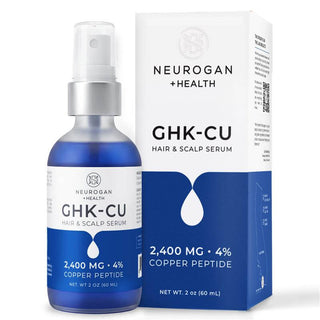
GHK-Cu is a small copper-binding peptide your body already makes. GHK stands for glycyl-L-histidyl-L-lysine, a short chain of three amino acids. Once it grabs onto a copper ion, it becomes GHK-Cu.
On skincare labels, you'll usually see it listed as Copper Tripeptide-1.

Researchers have studied GHK-Cu for decades, mostly in relation to how tissue rebuilds and repairs itself. The research connects it to fibroblast activity (fibroblasts build collagen), the scaffolding that holds skin together, inflammation, antioxidant activity, wound healing, collagen and elastin production, and blood vessel growth [2].
That makes it biologically relevant for the scalp, which is really just skin wrapped around a busy network of follicles, blood vessels, oil glands, immune cells, and connective tissue.
But there's still a gap between showing that a peptide affects those rebuilding pathways in a lab, and showing that a finished topical product actually regrows hair when real people use it.
That second question hasn't been studied nearly as much for GHK-Cu.
Another peptide often confused with GHK-Cu is AHK-Cu.
A frequently cited 2007 study looked at AHK-Cu, not GHK-Cu, using isolated human hair follicles and lab-grown dermal papilla cells (cells that help control follicle growth). Under lab conditions, the researchers saw the follicles grow longer, and the cells multiply more [3].
AHK-Cu and GHK-Cu are related, but they're different molecules. Evidence for one shouldn't be passed off as evidence for the other.
For a deeper look at the difference, check out our AHK-Cu vs GHK-Cu comparison.
What Is Rosemary Oil?
Rosemary essential oil comes from the rosemary plant, now officially named Salvia rosmarinus (you may still see the older name, Rosmarinus officinalis, floating around).
The oil contains a mix of aromatic compounds, including things like:
-
1,8-cineole
-
camphor
-
alpha-pinene
-
borneol
Here's something a lot of hair-care content glosses over: rosemary essential oil, rosemary extract, rosemary leaf powder, and isolated rosmarinic acid are not the same ingredient.
The most well-known human hair-loss study specifically tested rosemary oil. Research done on rosemary extract or rosmarinic acid for other health outcomes shouldn't be treated as proof that topical rosemary essential oil grows hair.

How Does GHK-Cu Work Compared With Rosemary Oil?
These two work through pretty different biological routes.
How GHK-Cu May Support the Scalp
GHK-Cu is mainly interesting as a signaling peptide, something that tells nearby cells what to do next.
Research connects the GHK-Cu system to:
-
rebuilding the scaffolding that holds tissue together
-
fibroblast activity
-
collagen and elastin production
-
antioxidant defenses
-
calming inflammatory signals
-
new blood vessel growth
-
general tissue repair [2]
Some of these pathways could help touch the environment around hair follicles.
But "may help follicle biology" is a much smaller claim than "clinically regrows hair." Proving the second one takes stronger, more direct human studies.
How Rosemary Oil May Support Hair
Rosemary oil has been studied for its anti-inflammatory, antioxidant, antimicrobial, and blood-flow effects. The randomized hair-loss study that made rosemary oil so popular pointed to improved microcapillary perfusion (basically, blood flow through tiny scalp vessels) as part of the reason it might help [1].
In simpler terms, one idea is that rosemary oil might improve blood flow and the overall environment around follicles.
You'll also see rosemary described online as a natural DHT blocker. That claim stands on much shakier ground.
DHT, short for dihydrotestosterone, plays a big role in pattern hair loss for people whose follicles are genetically sensitive to it. There isn't enough human evidence to treat rosemary oil as a proven DHT blocker on the level of drugs built specifically to target that pathway.
GHK-Cu vs Rosemary Oil: What Does the Human Evidence Actually Show?
This is really the heart of the comparison.
Rosemary Oil: An Actual Randomized Human Trial
The strongest direct evidence for rosemary oil comes from a 2015 randomized trial involving 100 people with pattern hair loss [1].
Participants were split into two groups:
-
50 used rosemary oil
-
50 used topical 2% minoxidil
Both groups were followed for six months.
At three months, neither group showed a significant increase in hair count.
By six months, both groups showed a statistically significant increase in hair count compared with baseline. There wasn't a huge difference between the two groups at either the three-month or six-month checkpoint [1].
Scalp itching showed up in both groups, though it happened more often in the minoxidil group.
That sounds pretty impressive, and it is worth paying attention to. But it needs some context.
This was:
-
a single trial
-
fairly small
-
six months long
-
compared against 2% minoxidil, not the more commonly recommended 5% strength
It doesn't prove that rosemary oil matches 5% minoxidil, oral minoxidil, finasteride, or other established drug treatments.
It also doesn't guarantee that every rosemary oil product on the market today will do the same thing. Essential-oil quality, concentration, freshness, and formulation can vary widely from one product to the next.
GHK-Cu: Stronger Lab Research, Weaker Direct Hair Evidence
GHK-Cu has a bigger overall body of research, but most of it isn't specifically about pattern hair loss.
A major review of GHK-Cu links it to tissue remodeling, inflammation, fibroblasts, collagen, elastin, blood vessel growth, and wound healing [2].
Those findings make GHK-Cu interesting for skin and scalp research. But this is where the type of evidence really matters:
|
Evidence Type |
GHK-Cu |
Rosemary Oil |
|
Lab and mechanism research |
Fairly broad |
Moderate |
|
Direct human hair-loss trial |
Very limited |
Yes |
|
Randomized comparison for pattern hair loss |
Not well established |
Yes, against 2% minoxidil |
|
Enough evidence to call it an established hair-loss drug |
No |
No |
That's why we wouldn't say GHK-Cu is clinically better than rosemary oil for hair growth. The evidence just doesn't support that yet.
So Which Is Better: GHK-Cu or Rosemary Oil?
There isn't one universal winner here. The better pick depends on what matters most to you.
If You Want the Stronger Direct Human Evidence
Rosemary oil has the edge. It's the only one with a randomized human trial behind it for pattern hair loss [1].
If You Want a Peptide-Focused Scalp Formula
GHK-Cu might be the better fit. Its appeal comes from copper-peptide biology and its use in lightweight cosmetic formulas built around scalp and skin support.
If You Want Something Lightweight and Non-Oily
GHK-Cu products are usually easier to formulate into water-based sprays and serums.
That might matter if you:
-
apply products before heading out the door
-
have fine hair that gets greasy easily
-
use styling products regularly
-
prefer a leave-on serum over an oil treatment
If You Prefer a Plant-Based Routine
Rosemary oil is the more obvious pick.
Just remember that "natural" doesn't automatically mean gentle. Essential oils are concentrated, and they need to be formulated properly for skin use.
If You Want the Strongest Overall Evidence for Pattern Hair Loss
Honestly, neither one is the clear first choice.
Established treatments like topical minoxidil have a much stronger clinical evidence base. The FDA also treats products marketed to restore hair growth differently from ordinary cosmetics, since that kind of claim can legally turn a cosmetic into a drug [4].
How Long Does Rosemary Oil Take to Work?
The clearest answer comes straight from the randomized trial.
At three months, researchers didn't see a meaningful improvement in hair count in either the rosemary oil or 2% minoxidil group.
At six months, hair counts had gone up significantly in both groups compared to baseline [1].
That makes six months a much more realistic checkpoint than promises like "new growth in two weeks" or "visible density in 30 days."

Hair follicles move slowly through their growth cycle. If you're testing out a new routine, taking progress photos in the same lighting and angle every four weeks tells you more than checking the mirror every morning.
How Long Does GHK-Cu Take to Work for Hair?
There's no equally solid human timeline for topical GHK-Cu.
Plenty of peptide products advertise very specific timelines despite not having strong clinical trials on the finished product to back that up. For a cosmetic scalp product, it's more useful to check progress in stages:
-
First few weeks: how your scalp tolerates it, and whether it feels comfortable
-
Following months: how your existing hair looks and feels
-
Longer term: whether you notice fuller-looking areas or a real cosmetic change
Claims about actual hair regrowth need a much higher bar of proof than claims about scalp comfort or fuller-looking hair.
Can You Use GHK-Cu and Rosemary Oil Together?
Potentially, yes.
These ingredients work differently, and we haven't found strong evidence that they cancel each other out.
That said, there's no high-quality clinical trial showing that GHK-Cu plus rosemary oil works better than either one on its own.
If you want to try both, keep it simple:
-
introduce one product at a time
-
watch for itching, redness, burning, or flaking
-
follow the directions on each product
-
avoid stacking several irritating scalp ingredients at once
-
let a lightweight serum dry before applying a heavier oil, if both are leave-on formulas
If you're already using a medicated hair-loss treatment, check with a dermatologist before adding several new topical products at once.
GHK-Cu vs Rosemary Oil Side Effects
Possible GHK-Cu Side Effects
A topical GHK-Cu product may cause:
-
redness
-
itching
-
dryness
-
stinging
-
localized irritation
The full formula matters here. A reaction could come from GHK-Cu itself, or from preservatives, fragrance, solvents, or other ingredients in the product.
Our GHK-Cu side effects guide covers this in more detail.
Possible Rosemary Oil Side Effects
Rosemary essential oil can irritate the scalp too. Watch for:
-
burning
-
redness
-
itching
-
allergic contact dermatitis
-
irritation from applying it too concentrated
Just because rosemary shows up in cooking doesn't mean concentrated rosemary essential oil is safe to apply straight to your scalp undiluted.
This article is specifically about applying rosemary to the scalp. Questions about swallowing rosemary essential oil or taking it as an oral supplement are a different topic entirely and shouldn't be treated the same way as applying it to your scalp.
GHK-Cu vs Rosemary Oil for Different Hair Concerns
Male or Female Pattern Hair Loss
Rosemary oil has stronger direct evidence here, since it's been tested in people with pattern hair loss [1]. That still doesn't make it the best-proven treatment overall.
Diffuse Thinning
Neither ingredient fixes every cause of thinning hair.
Shedding can be tied to things like:
-
illness
-
major stress
-
thyroid issues
-
iron deficiency
-
rapid weight loss
-
certain medications
-
hormonal shifts
If shedding is sudden, unexplained, patchy, painful, or comes with scalp problems, figuring out the cause matters a lot more than choosing between a peptide and an essential oil.
Receding Hairline
Neither rosemary oil nor GHK-Cu has strong evidence showing it can bring back a hairline where the follicles are no longer active. Early thinning is different from a long-established smooth bald patch.
Black or Textured Hair
There's no good evidence that either ingredient works better or worse based on race or hair texture.
The real differences are usually practical: how often you wash your hair, whether an oily product fits your styling routine, scalp sensitivity, and any tension from braids, extensions, or tight hairstyles.
If tight styling is causing thinning, easing up on that tension matters more than adding another topical product.
How to Choose a High-Quality GHK-Cu Product
GHK-Cu products vary widely in concentration, formula, and marketing. Look for:
-
Clear ingredient labeling: GHK-Cu or Copper Tripeptide-1 should be clearly listed, not hidden in a vague "peptide complex."
-
A stated amount: concentration or total peptide amount should be disclosed when possible.
-
Testing transparency: check whether documentation covers the raw ingredient, one batch, or the finished product.
-
Contaminant testing: especially useful for concentrated peptide formulas.
-
A full ingredient list: you should know everything going onto your scalp.
-
Realistic claims: avoid anything guaranteeing regrowth or presenting lab findings as proof in humans.
A Certificate of Analysis (COA) can be genuinely useful, but only if you understand what it's actually measuring. A raw-material purity report doesn't automatically mean the finished serum was tested for potency, microbes, or heavy metals.
You can compare topical options across our GHK-Cu peptide collection.

How to Choose High-Quality Rosemary Oil
Rosemary oil calls for a different checklist. Look for:
-
Clear botanical identity: the product should say rosemary, not vague "herbal fragrance."
-
Essential oil, not fragrance oil: these are not interchangeable.
-
GC-MS testing when available: this helps confirm the oil's actual chemical makeup.
-
Proper packaging: essential oils break down with too much light or air exposure.
-
Dilution guidance: especially important if you're buying pure essential oil rather than a ready-made scalp product.
-
Freshness and storage tips: oxidized essential oil can become more irritating over time.
A ready-to-use rosemary scalp product may be simpler to stick with consistently than buying pure oil and mixing your own dilution.
Can Rosemary Oil Replace Minoxidil?
Not with full confidence, based on just one study.
The 2015 trial is encouraging. Rosemary oil and 2% minoxidil both improved hair count after six months, without a significant difference between the two [1].
But that doesn't make rosemary oil equal to 5% minoxidil, every minoxidil formula, finasteride, dutasteride, or combined medical treatment plans.
One study is a great reason to keep paying attention to it, but it’s hardly enough to close the case.
Can GHK-Cu Replace Minoxidil?
The evidence supports that even less.
GHK-Cu has promising lab research, but there simply isn't enough direct human hair-loss evidence to call it an even swap for minoxidil.
The FDA angle is key here too. Cosmetic products marketed with claims to restore hair growth can fall under drug rules, since that kind of claim affects how the body functions [4].
GHK-Cu vs Rosemary Oil: Final Verdict
GHK-Cu and rosemary oil are both worth considering, but they offer different strengths.
Rosemary oil has the stronger direct human evidence for hair loss. A randomized study in people with pattern hair loss found a real increase in hair count after six months [1].
GHK-Cu has the broader lab research. Copper-peptide studies point to its role in tissue rebuilding, skin repair, and antioxidant activity [2].
Here's the practical way to think about it:
-
Choose rosemary oil if the direct human evidence matters most to you.
-
Consider GHK-Cu if you'd rather use a lightweight peptide serum and like the idea of copper-peptide biology for scalp support.
-
Consider both, carefully, if your scalp handles topicals well and you're okay with the fact that the combination hasn't been studied together.
-
Look beyond both if you're dealing with more significant pattern hair loss and want the option with the strongest track record.
Neither ingredient should be sold as a guaranteed fix. What actually matters is picking the one whose evidence, formulation, and realistic expectations line up with what you're hoping to get out of it.
Frequently Asked Questions
Is Rosemary Oil Better Than GHK-Cu for Hair Growth?
Rosemary oil currently has better direct human hair-loss evidence, since it's been tested in a randomized trial in people with pattern hair loss. GHK-Cu has broader lab research but thinner direct clinical proof for hair growth [1, 2].
Does GHK-Cu Really Regrow Hair?
There isn't enough direct human evidence to promise that GHK-Cu regrows hair. It's better described as a copper-peptide ingredient that may support scalp health and fuller-looking hair.
If your scalp problem is dryness and flaking rather than thinning, neither ingredient is the right starting point. A scalp serum for dry scalp is, and ours combines GHK-Cu with hyaluronic acid in a water-based formula for exactly that job.
Does Rosemary Oil Really Regrow Hair?
A randomized study found a significant increase in hair count after six months among people who used rosemary oil [1]. That's encouraging, but one relatively small trial isn't enough to guarantee results for everyone.
Can I Use GHK-Cu and Rosemary Oil Together?
Potentially. There's no known reason they'd clash, but there are also no high-quality trials showing the combination works better. Introduce them gradually and watch for irritation.
How Long Does Rosemary Oil Take to Work for Hair?
In the main study, there was no noteworthy improvement in hair count at three months, but a significant increase appeared by six months [1].
How Long Does GHK-Cu Take to Work for Hair?
There's no validated universal timeline for GHK-Cu. Strong human trials don't support specific promises of results in four, eight, or twelve weeks.
Is Rosemary Oil a DHT Blocker?
There isn't enough clinical evidence to call rosemary oil a proven DHT blocker in humans.
Which Has Fewer Side Effects?
Again, there isn't enough head-to-head safety data to name a clear winner. GHK-Cu products can cause irritation or sensitivity, and rosemary essential oil can cause irritation or allergic reactions, especially at the wrong concentration.
Can Peptides Regrow Lost Hair?
Some peptides have promising lab or early clinical research, but peptide ingredients vary a lot. They shouldn't all be lumped together as proven hair-regrowth treatments.
Which Peptide Is Best for Hair Growth?
No single peptide is clearly the best. GHK-Cu, AHK-Cu, acetyl tetrapeptide-3, biotinoyl tripeptide-1, and others each have different evidence and different mechanisms. For copper peptides specifically, see our AHK-Cu vs GHK-Cu guide.
Can Rosemary Oil or GHK-Cu Restore a Completely Bald Area?
Neither ingredient has strong evidence showing it can reliably bring back hair in areas where the follicles are no longer active.
Do I Need to Choose Between GHK-Cu and Rosemary Oil?
Not necessarily. You can potentially use them in the same scalp-care routine. The bigger question is whether using both keeps things tolerable, consistent, and actually matched to what's causing your hair loss in the first place.
References
-
Panahi, Y., Taghizadeh, M., Marzony, E. T., & Sahebkar, A. (2015). Rosemary oil vs minoxidil 2% for the treatment of androgenetic alopecia: A randomized comparative trial. Skinmed, 13(1), 15–21.
-
Pickart, L., & Margolina, A. (2018). Regenerative and protective actions of the GHK-Cu peptide in the light of the new gene data. International Journal of Molecular Sciences, 19(7), 1987.
-
Pyo, H. K., Yoo, H. G., Won, C. H., Lee, S. H., Kang, Y. J., Eun, H. C., Cho, K. H., & Kim, K. H. (2007). The effect of tripeptide-copper complex on human hair growth in vitro. Archives of Pharmacal Research, 30(7), 834–839.
-
U.S. Food and Drug Administration. (n.d.). Is it a cosmetic, a drug, or both? (Or is it soap?). https://www.fda.gov/cosmetics/cosmetics-laws-regulations/it-cosmetic-drug-or-both-or-it-soap


