


If your main goal is treating pattern hair loss, minoxidil is the one with the stronger track record.
Minoxidil has been tested in randomized human trials, used for decades, and cleared by the FDA as an over-the-counter hair regrowth product.
On the other hand, GHK-Cu is a copper peptide found in cosmetic scalp products, and while the lab research on it is interesting, there just isn't much direct clinical evidence tying it to hair regrowth in real people, but that doesn't mean GHK-Cu is a dud. It just means the two shouldn't be treated as equals simply because they both show up when you search "hair growth."
Let’s get things straight: Minoxidil is a drug. GHK-Cu, sometimes labeled Copper Tripeptide-1, is a cosmetic ingredient. They work in different ways, are judged by different evidence standards, and honestly might fit different goals depending on what you're after.
This guide walks through what the research actually says about GHK-Cu vs minoxidil: how well each works, what side effects to expect, how long each one takes, where the FDA stands, and whether it makes sense to use them together.
|
Feature |
GHK-Cu |
Minoxidil |
|
Type |
Copper peptide, cosmetic ingredient |
Hair regrowth drug |
|
FDA status for hair regrowth |
Not FDA-approved for this use |
FDA-regulated OTC drug label for hair regrowth |
|
Human hair-loss research |
Limited |
Extensive |
|
Best-known use |
Scalp conditioning, cosmetic support |
Androgenetic (pattern) hair loss |
|
Typical timeline |
Not well established |
Roughly 2 to 4 months for early results, per labeling |
|
Needs ongoing use |
Likely, for cosmetic upkeep |
Yes, to keep the hair it helped grow |
|
Common issues |
Redness, dryness, irritation in some users |
Scalp irritation, itching, early shedding, unwanted hair growth |
What Is GHK-Cu?
GHK-Cu is a small copper-binding molecule your body already makes on its own. It's built from three amino acids: glycine, histidine, and lysine. On skincare labels, it usually goes by Copper Tripeptide-1.
Scientists have studied GHK-Cu for years, mostly around how it interacts with skin cells and tissue repair [1]. Think of it less like a targeted drug and more like a signal that nudges cells toward rebuilding and maintenance.
A lot of that research happens on skin cells, fibroblasts (the cells that build collagen), or wound-healing models, rather than on people dealing with actual hair loss.
There's a real difference between saying:
-
"GHK-Cu affects biological pathways that could be relevant to hair follicles," and
-
"GHK-Cu is proven to regrow hair."
The second claim just doesn't have the same level of support as the first.
There's actually stronger follicle-specific evidence for a related copper peptide called AHK-Cu (Copper Tripeptide-3).
A small 2007 lab study found that AHK-Cu made isolated human hair follicles grow longer in a lab dish, and it also encouraged growth in dermal papilla cells (the cells that help control how follicles grow) [2]. AHK-Cu and GHK-Cu are cousins, not twins, so that study shouldn't be treated as direct proof for GHK-Cu.
Want the deeper breakdown of how these two peptides differ? Check out our AHK-Cu vs GHK-Cu comparison.
 What Is Minoxidil?
Minoxidil started out as a blood pressure medication. Doctors noticed it caused extra hair growth as a side effect, and it was eventually reformulated as a topical treatment for pattern hair loss.
Unlike GHK-Cu, minoxidil has been through repeated, large-scale human trials.
In a 48-week study of 393 men with pattern hair loss, 5% topical minoxidil beat both 2% minoxidil and a placebo on hair-count and scalp-coverage measures. The 5% group also started seeing results sooner than the 2% group [3].
A separate 48-week study of 381 women found that 5% topical minoxidil beat placebo on every main measure of hair growth, and the 2% version helped too, just to a smaller degree [4].
Current FDA-regulated labeling for 5% topical minoxidil describes it plainly as a hair regrowth treatment. That labeling also says some people notice results around the two-month mark with twice-daily use, while others may need at least four months before seeing anything.
This is the heart of the GHK-Cu vs minoxidil debate: minoxidil has real human data behind it for pattern hair loss. GHK-Cu simply doesn't have that same body of evidence yet.
How Does Minoxidil Work Compared With GHK-Cu?
These aren't just a strong version and a weak version of the same tool. They work in different ways.
How Minoxidil Works
Minoxidil is generally described as a potassium-channel opener, which is a fancy way of saying it changes how certain cells let ions pass through their membranes.
Scientists still don't have a complete picture of exactly how that translates into hair growth, but the leading idea is that it encourages follicles into their active growth phase and can help hairs grow thicker and denser over time.
Its effect works like a drug because, well, it is one. That's part of why it's regulated the way it is.
How GHK-Cu Works
GHK-Cu is better described as a signaling molecule that helps tissue rebuild and repair itself.
Lab research has connected GHK-Cu to several processes: rebuilding the scaffolding that holds skin tissue together, activating fibroblasts, supporting antioxidant activity, calming inflammatory signals, and interacting with growth-factor pathways [5].
Those mechanisms are genuinely interesting for scalp health. But there's a big difference between "biologically interesting" and "proven to treat pattern hair loss when applied as a topical serum."
That's why we describe topical GHK-Cu as something that may support a healthier-looking scalp and fuller-looking hair, not as a hair-loss treatment.
GHK-Cu vs Minoxidil: Which Has Better Clinical Evidence?
Minoxidil wins this one, clearly.
That's not about branding or popularity. It comes down to the kind of evidence each one has.
Minoxidil: Backed by Human Randomized Trials
Minoxidil has several placebo-controlled, head-to-head human studies behind it.
For men, randomized trials have shown real improvements in hair counts and visible scalp coverage with topical 5% minoxidil [3].
For women, randomized research has shown measurable benefits too [4].
Researchers still use topical 5% minoxidil as the benchmark treatment when testing newer options for pattern hair loss, which says a lot about how established it's become.
GHK-Cu: Mostly Lab-Based and Indirect Evidence
GHK-Cu has a fairly deep body of scientific literature, but most of it focuses on skin repair, tissue structure, fibroblasts, and wound healing rather than controlled trials for hair loss specifically [1].
The strongest hair-specific evidence in this space actually comes from AHK-Cu, the related peptide we mentioned earlier, not from GHK-Cu itself [2].
That's useful, mechanism-level evidence. It just shouldn't be stretched into "GHK-Cu outperforms minoxidil."
What About Claims That GHK-Cu Beat Minoxidil in a Trial?
You may run across pages claiming GHK-Cu boosted hair counts by some impressive percentage, or that it beat minoxidil head-to-head.
Those claims are worth a second look before you trust them.
Some online comparisons blur the lines between:
-
GHK-Cu and other copper peptides,
-
GHK-Cu and AHK-Cu,
-
multi-ingredient formulas and pure GHK-Cu, or
-
small, loosely documented studies and large randomized trials.
We didn't find a high-quality, randomized head-to-head comparison showing that topical GHK-Cu beats minoxidil. If you see that claim somewhere, it's worth asking what study it's actually pointing to.
Is GHK-Cu Better Than Minoxidil?
For treating pattern hair loss, no. Minoxidil has considerably stronger evidence behind it.
That said, GHK-Cu can still make sense if what you want is a cosmetic, peptide-based scalp routine rather than a drug treatment.
Here's a simple way to think about it:
|
Your Priority |
Better Fit |
|
Strongest evidence for pattern hair loss |
Minoxidil |
|
FDA-regulated hair regrowth drug |
Minoxidil |
|
Non-drug cosmetic scalp support |
GHK-Cu |
|
A copper-peptide routine |
GHK-Cu |
|
Trying to avoid minoxidil altogether |
GHK-Cu could be worth considering, with the understanding that the evidence is thinner |
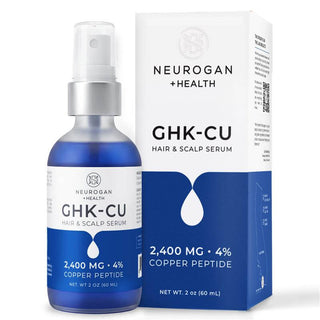
If you're curious about topical copper peptides, Neurogan Health carries a GHK-Cu Hair & Scalp Serum and a wider GHK-Cu peptide collection.
GHK-Cu vs Minoxidil Side Effects
Side effects are another big reason people weigh peptides against minoxidil.
Topical Minoxidil Side Effects
The most common complaints include:
-
scalp itching
-
dryness
-
redness
-
local irritation
-
unwanted hair growth on the face or body
-
a temporary uptick in shedding when you first start
In clinical trials, the higher-strength 5% formula caused more itching and irritation than the 2% version [3, 4]
Current FDA-regulated labeling also tells users to stop and check with a doctor if they notice chest pain, a racing heartbeat, faintness, dizziness, or sudden unexplained weight gain.
GHK-Cu Side Effects
Topical copper peptides are usually treated as cosmetic ingredients, but that doesn't mean irritation is off the table.
Possible reactions include:
-
redness
-
itching
-
dryness
-
stinging
-
general scalp sensitivity
The real limitation: the long-term safety data for GHK-Cu used specifically for hair loss is much thinner than what exists for minoxidil.
For more on this, see our guide to GHK-Cu side effects.
Which Is Better for Older Adults?
Age by itself doesn't determine whether minoxidil will work for someone.
What matters more is the cause and stage of the hair loss, whether the follicles are still active, general scalp health, and any other medications or conditions in the mix.
Minoxidil has solid regrowth evidence overall, but older adults are also more likely to be managing blood pressure medications or heart-related conditions, which makes it smart to loop in a doctor first.
GHK-Cu doesn't have enough direct clinical evidence to say it works better, or worse, for older adults specifically.
If hair loss shows up suddenly, in patches, or without an obvious explanation, it's worth figuring out the cause before assuming it's ordinary age-related thinning.
How Long Does Minoxidil Take to Work?
Current 5% topical minoxidil labeling says some people see results after about two months of twice-daily use, while others may need at least four months [3].
Clinical trials typically check progress at 16, 24, or 48 weeks [3, 4]
So four to six months is a more realistic window for judging results than a few weeks.
What Happens After Two Years of Minoxidil?
Longer studies suggest the results tend to peak early and then ease off a bit, while still staying above where things started for people who keep using it.
One five-year follow-up found that hair regrowth generally peaked around the one-year mark and then slowly declined, but men who stuck with treatment still had noticeably more hair than at their starting point after roughly five years [6].
What Happens If You Stop Minoxidil?
The benefit doesn't tend to stick around once you stop.
A discontinuation study found that most of the extra hair minoxidil had helped grow was lost again after treatment ended [7].
That's the tradeoff worth knowing upfront: minoxidil works best as something you stick with, not a short course you finish and move on from.
How Long Does GHK-Cu Take to Help Hair?
There's no well-established clinical timeline for GHK-Cu the way there is for minoxidil.
So a claim like "GHK-Cu regrows hair in 8 weeks" deserves some skepticism unless it's pointing to a specific finished product that was actually tested in a controlled human trial.
For a cosmetic scalp product, it makes more sense to judge progress in stages:
-
how your scalp tolerates it in the first few weeks
-
how your hair looks and feels over the following weeks
-
whether hair looks fuller only after a longer stretch of consistent use
Can You Use GHK-Cu and Minoxidil Together?
Potentially, but the evidence for this specific combination is thin.
The two work through different pathways, so there's no obvious reason to think one would cancel the other out. That said, we couldn't find high-quality randomized trials showing that adding GHK-Cu to minoxidil actually works better than minoxidil alone.
The more practical concern is how your scalp handles both at once.
Minoxidil can already cause dryness or irritation on its own. Layering in another topical product just adds more variables to track.
If you want to try both, a cautious approach looks like this:
-
introduce one product at a time
-
follow the minoxidil label exactly as written
-
let each product dry before applying the next
-
stop if irritation sticks around
-
talk to a dermatologist if you're treating diagnosed hair loss
We wouldn't treat GHK-Cu as a reason to cut back on prescribed hair-loss treatment without checking with a professional first.
Can GHK-Cu Replace Minoxidil?
Not based on what the research currently shows.
If minoxidil is working for your androgenetic alopecia and you switch to GHK-Cu instead, you're moving from something with solid human efficacy data to a cosmetic ingredient with a much smaller evidence base.
That might still be a reasonable personal choice if minoxidil doesn't agree with you, but it's a tradeoff, not a like-for-like swap.
Does GHK-Cu Block DHT?
There isn't strong clinical evidence that GHK-Cu meaningfully blocks DHT in people.
DHT, short for dihydrotestosterone, plays a big role in androgenetic alopecia for people whose follicles are genetically sensitive to it.
Finasteride and dutasteride target that hormone pathway much more directly. GHK-Cu shouldn't be treated as a stand-in for those medications based on DHT-blocking claims.
Do Copper Peptides Really Work for Hair Loss?
The science is interesting, but the direct clinical proof isn’t there.
What copper-peptide research actually includes:
-
lab effects on fibroblasts and the extracellular matrix (the scaffolding that holds tissue together)
-
hair-follicle research using the related peptide AHK-Cu
-
cosmetic use aimed at scalp and hair appearance
That's enough to justify continued research and cosmetic use. It's not enough to put copper peptides on the same evidence tier as minoxidil for treating pattern hair loss [1, 2].
Minoxidil vs Peptides for Men and Women
For Men
Men with androgenetic alopecia have strong randomized-trial support for topical 5% minoxidil [3].
GHK-Cu can still be worth considering as a cosmetic scalp-support product, especially if you're already into peptides, but it shouldn't be marketed as the stronger treatment.
For Women
Topical minoxidil also has randomized evidence for female pattern hair loss [4].
Women dealing with sudden shedding, postpartum hair loss, iron deficiency, thyroid issues, traction alopecia, or other causes of thinning may need a completely different approach. Not all hair loss in women is female pattern hair loss.
Again, GHK-Cu might fit into a cosmetic routine, but it shouldn't delay a proper evaluation of unexplained hair loss.
What About Beard Growth?
Minoxidil gets talked about a lot online for beard growth, but the FDA's hair-regrowth labeling covers scalp use, not facial hair.
GHK-Cu also lacks solid controlled research for beard growth.
So neither one should be casually rebranded as a proven beard-growth product outside its established use.
How to Choose a High-Quality GHK-Cu Product
Because GHK-Cu shows up across all kinds of cosmetic and peptide websites, transparency really matters here. Look for:
-
Clear ingredient labeling: the product should say GHK-Cu or Copper Tripeptide-1, not vague "peptide complex" wording.
-
A stated concentration: the amount used should be clearly listed when possible.
-
Certificate of Analysis access: check what was actually tested rather than assuming a COA confirms everything.
-
Contaminant testing: especially important for concentrated peptide products.
-
Finished-product transparency: raw-material purity isn't the same as testing the final product.
-
Realistic claims: steer clear of products promising guaranteed regrowth or presenting lab research as clinical proof.
You can compare formats and available testing across our GHK-Cu peptide collection.

How to Choose Minoxidil
Minoxidil is a bit different since it's regulated as an OTC drug. Look for:
-
clear Drug Facts labeling
-
the correct concentration for what you're trying to do
-
directions that match the FDA-regulated label
-
an identifiable manufacturer or distributor
-
no claims that stretch beyond the approved use
GHK-Cu vs Minoxidil: The Bottom Line
Judging purely by the quality of evidence for pattern hair loss, minoxidil is the stronger option.
It has randomized controlled trials, long-term data, FDA-regulated labeling, and decades of real-world use behind it.
GHK-Cu is more of an experimental player in the hair-loss conversation. The mechanisms are plausible, and the tissue-remodeling research is genuinely broad, but it hasn't built up anything close to the clinical evidence minoxidil has for androgenetic alopecia.
Here's the most practical way to sort it out:
-
Go with minoxidil if your priority is the best-established nonprescription option for pattern hair loss.
-
Consider GHK-Cu if you want a cosmetic peptide product for scalp care and fuller-looking hair, and you're comfortable with the evidence still being early.
-
Consider both, carefully, if your scalp tolerates topical products well and you understand that solid combination data just isn't there yet.
GHK-Cu shouldn't be marketed as a proven replacement for minoxidil. But it can still have a reasonable spot in a hair-care routine for people who go in with realistic expectations about what the science does, and doesn't, show.
Frequently Asked Questions
Which Is Better, Minoxidil or a Peptide?
Minoxidil has stronger clinical evidence for pattern hair loss. Copper peptides like GHK-Cu are better viewed as supportive cosmetic ingredients rather than equivalent hair-loss treatments.
Is GHK-Cu Better Than Minoxidil?
No high-quality evidence currently shows GHK-Cu outperforming minoxidil for androgenetic alopecia. Minoxidil simply has far more randomized human data behind it.
Can I Use Minoxidil and Peptides Together?
They can potentially coexist in a routine, but well-designed trials of the combination are limited. Follow the minoxidil label closely and introduce any additional topical slowly to reduce irritation.
Will GHK-Cu Regrow Hair?
There isn't enough direct clinical evidence to promise hair regrowth from topical GHK-Cu. It's better suited for scalp care and supporting the appearance of fuller-looking hair.
One practical note: the most common complaints with minoxidil are scalp dryness, itching, and flaking. A water-based step like our Hydrating Scalp Serum, with hyaluronic acid and GHK-Cu, can sit alongside either routine to keep the scalp comfortable.
How Long Does GHK-Cu Take to Work for Hair?
There's no validated universal timeline. Cosmetic scalp changes may show up within a few weeks, while judging fuller-looking hair usually takes a longer stretch of consistent use.
How Long Does Minoxidil Take to Work?
FDA-regulated labeling notes that some users see results after about two months, while others may need at least four.
What Happens After Four Months of Minoxidil?
Four months is a common point where people start checking for visible change. Clinical trials often run longer than that because hair density and coverage can keep shifting over six to twelve months.
What Happens After Two Years of Minoxidil?
Longer-term data suggest results can peak early and ease off gradually, while staying above the starting point for people who continue treatment.
What Happens If You Stop Minoxidil?
Most of the gains minoxidil helped create are typically lost after stopping.
Does GHK-Cu Block DHT?
There isn't strong clinical evidence that GHK-Cu works as an effective DHT blocker in humans.
Which Has Fewer Side Effects?
GHK-Cu may cause fewer drug-related effects simply because it's used cosmetically, but its hair-specific long-term safety data is also much thinner. Minoxidil's side-effect profile is better mapped out because it has been studied so extensively.
Is GHK-Cu FDA Approved for Hair Loss?
No. GHK-Cu is typically sold as a cosmetic ingredient. The FDA has made clear that a cosmetic marketed with claims to restore hair growth can legally cross the line into being classified as a drug.
Is Minoxidil FDA Approved for Hair Loss?
Topical minoxidil is marketed in the United States as an OTC hair-regrowth drug under FDA requirements, with current labeling covering both 2% and 5% concentrations.
References
-
Pickart, L. (2008). The human tri-peptide GHK and tissue remodeling. Journal of Biomaterials Science, Polymer Edition, 19(8), 969-988.
-
Pyo, H. K., Yoo, H. G., Won, C. H., Lee, S. H., Kang, Y. J., Eun, H. C., ... & Kim, K. H. (2007). The effect of tripeptide-copper complex on human hair growth in vitro. Archives of pharmacal research, 30(7), 834-839.
-
Olsen, E. A., Dunlap, F. E., Funicella, T., Koperski, J. A., Swinehart, J. M., Tschen, E. H., & Trancik, R. J. (2002). A randomized clinical trial of 5% topical minoxidil versus 2% topical minoxidil and placebo in the treatment of androgenetic alopecia in men. Journal of the American Academy of Dermatology, 47(3), 377-385.
-
Lucky, A. W., Piacquadio, D. J., Ditre, C. M., Dunlap, F., Kantor, I., Pandya, A. G., ... & Tharp, M. D. (2004). A randomized, placebo-controlled trial of 5% and 2% topical minoxidil solutions in the treatment of female pattern hair loss. Journal of the American Academy of Dermatology, 50(4), 541-553.
-
Pickart, L., & Margolina, A. (2018). Regenerative and protective actions of the GHK-Cu peptide in the light of the new gene data. International journal of molecular sciences, 19(7), 1987.
-
Olsen, E. A., Weiner, M. S., Amara, I. A., & DeLong, E. R. (1990). Five-year follow-up of men with androgenetic alopecia treated with topical minoxidil. Journal of the American Academy of Dermatology, 22(4), 643-646.
-
Olsen, E. A., & Weiner, M. S. (1987). Topical minoxidil in male pattern baldness: effects of discontinuation of treatment. Journal of the American Academy of Dermatology, 17(1), 97-101.


