
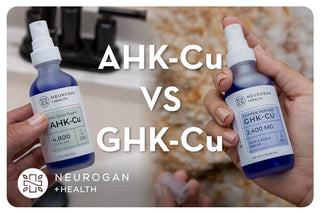
AHK-Cu and GHK-cu are copper peptides used as active ingredients in hair and skincare products. Copper peptides have an affinity to skin cells and have been used to support healthy collagen production, skin elasticity, and the natural wound healing process.
The main difference is that AHK-Cu is a synthetic copper peptide. At the same time, GHK-Cu is a naturally occurring copper peptide in the human body, but what you'll find in the ingredient list of your favorite products is also lab-made and made to resemble the real thing.
What is AHK-Cu?
AHK-Cu stands is a synthetic copper peptide modeled after bioactive peptides made up of the following short-chain amino acids:
Alanine, histidine, and lysine combined with copper.
Unlike GHK-Cu, which occurs naturally in the body, AHK-Cu is lab-made and specifically designed to target hair follicles. This version of copper peptide has a much more focused role in signaling around the hair root, making it more suitable to support scalp hair and healthier hair cycles [1].
AHK-Cu vs. GHK-Cu: What’s the Difference?
Let's first look at the basic definitions of AHK-Cu and GHK-Cu:
-
GHK-Cu (Glycyl-L-histidyl-L-lysine + Copper): A naturally occurring copper peptide found in human plasma and tissues. However, note that GHK-Cu used in skin and hair ingredients aren't harvested from plasma and tissues but are produced in the lab.
-
AHK-Cu (Ala-His-Lys + Copper): A synthetic copper peptide designed primarily to target hair growth and follicle health.

So, how do these compounds work for skin and hair care?
-
GHK-Cu: Has an affinity to skin cells and acts as a signaling molecule for tissue repair and natural anti-inflammatory responses. Studies also show it upregulates genes linked to healing and downregulates those associated with damaging inflammation [2].
-
AHK-Cu: This has been designed to work more locally at the hair follicles. Research suggests it may stimulate dermal papilla cells to regrow hair [1].
|
Feature |
GHK-Cu |
AHK-Cu |
|
Type |
Naturally occurring peptide + copper |
Synthetic peptide + copper |
|
Amino Acids |
Glycine - Histidine - Lysine |
Alanine - Histidine - Lysine |
|
Main Use |
Skin integrity and general cell support |
Hair and scalp care |
|
Focus Area |
Elastin and collagen production |
Hair follicle signaling |
|
Known For |
Supporting skin health for healthy aging and scalp health for hair growth |
Supporting stronger, fuller-looking hair |
Should I use AHK or GHK-Cu For Hair Growth?
Copper peptides don’t act like medications or hair regrowth treatments. Instead, they support the scalp's natural balance, which plays a role in healthy-looking hair over time.
If your main goal is to support thicker, fuller-looking hair or reduce the appearance of thinning, AHK-Cu is often the better choice. The benefit of AHK-Cu is that there's more research behind it for hair growth, as the AHK peptide combination has a higher affinity to hair follicles. This compound was designed specifically to help the scalp and follicles stay in the hair’s growth phase longer.
That said, GHK-Cu can still be helpful for overall scalp health, especially if you’re looking to calm dryness or maintain a well-balanced skin barrier, which does influence hair growth.
The advantages of using AHK-Cu and GHK-Cu for the hair are that it's gentle for most people to use and can be combined with other hair growth treatments, such as minoxidil (topical medication) and finasteride (oral medication), for more comprehensive scalp and hair support.
Who Shouldn't Use Copper Peptides?
Copper peptides are generally safe for most people when used topically, as they don't enter the body to produce systemic effects, but copper peptides might not be appropriate for people with a known allergy or sensitivity to copper.
If vitamin C, strong AHAs/BHAs, low-pH exfoliants, and retinols are part of your regular skincare routine, I wouldn't say you're not a candidate for copper peptides — rather, you need to be more strategic about timing.
Copper peptides are delicate, and using these active ingredients in the same step could cancel out the copper peptides, making them less effective or causing skin irritation.
The best thing to do is to space out their timing. For instance, waiting 15 minutes after applying your vitamin C serum before using copper peptides in the morning may work, but most people don't have an extra 15 minutes every day to do this consistently.
We suggest instead staggering their application, so using vitamin C in the morning, where it can help with UV protection and antioxidant support, and then using copper peptides at night, where it can work with the skin organ's natural circadian rhythm for repair.
Use Both GHK-Cu and AHK-Cu
Our Hair Elixer is made with pure GHK-Cu and AHK-Cu in distilled water — no other added ingredients, fragrances, or dyes that might dry, irritate, or weigh down the scalp and hair. This formulation is gentle, water-based, and designed for direct-to-scalp use to support a clean, calm, healthy scalp environment.
For a deeper look at the science behind AHK-Cu — including research, mechanisms of action, and real-world applications — explore our dedicated resource at ahk-cu.com.
FAQs
What is the difference between GHK-Cu and AHK-Cu?
GHK-Cu is a naturally occurring copper peptide best known for skin repair, collagen stimulation, and anti-inflammatory effects, so it’s widely used for anti‑aging and barrier support. AHK-Cu is a synthetic copper peptide designed primarily to signal around hair follicles, improving circulation and supporting thicker, fuller-looking hair and scalp health.
Which copper peptide is the best?
For overall skin anti‑aging, firmness, and repair, GHK-Cu is generally considered the “gold standard” because it’s better researched and consistently improves collagen, wound healing, and visible skin quality. For hair growth or reducing the look of thinning, AHK-Cu is often preferred because its signaling is more targeted to the hair follicle and hair growth cycle.
Which peptide is most effective?
“Most effective” depends on the goal: GHK-Cu tends to be most effective for global skin rejuvenation (texture, fine lines, recovery after procedures). AHK-Cu is often more effective when the main concern is scalp health and hair density, especially in anti‑thinning routines.
What cannot be paired with copper peptides?
Avoid mixing copper peptides with strong, low‑pH actives like high‑strength vitamin C (ascorbic acid), aggressive AHAs/BHAs (glycolic, lactic, salicylic acid), and potent retinoids in the same step, as they can destabilize peptides or increase irritation.
It's also a good idea to avoid mixing copper peptides with strong oxidizing acne treatments like benzoyl peroxide in the same step, as this can exacerbate skin irritation and compromise peptide stability.
Many experts recommend using these on alternate nights or in separate routines (for example, acids or strong vitamin C in the morning and copper peptides at night) to maintain efficacy and a strong skin barrier.
Resources:
-
Pyo, H. K., Yoo, H. G., Won, C. H., Lee, S. H., Kang, Y. J., Eun, H. C., ... & Kim, K. H. (2007). The effect of tripeptide-copper complex on human hair growth in vitro. Archives of pharmacal research, 30, 834-839.
-
Pickart, L., & Margolina, A. (2018). Regenerative and protective actions of the GHK-Cu peptide in the light of the new gene data. International journal of molecular sciences, 19(7), 1987.