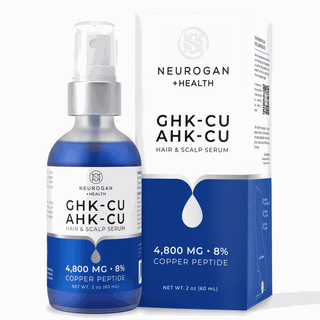
Search for an AHK-Cu dosage and you'll find everything from topical percentages to injection charts, syringe units, reconstitution instructions, and daily protocols.
The problem is that the research doesn't support most of that precision.
AHK-Cu has been studied for its effects on human hair follicles and dermal papilla cells, but the primary published research was conducted ex vivo and in vitro. It did not establish a human injection dose, a clinically proven topical percentage, or a daily treatment protocol.
So instead of presenting an unofficial protocol as established science, here's what we actually know about AHK-Cu dosage.
AHK-Cu Dosage at a Glance
| Question | What the Evidence Supports |
|---|---|
| AHK-Cu injection dosage | No clinically established human injection dose |
| AHK-Cu injection dosage per day | No validated daily human dose |
| AHK-Cu injection dosage chart | No peer-reviewed human dosing chart has been established |
| AHK-Cu reconstitution protocol | No validated human clinical protocol has been established |
| Topical AHK-Cu concentration | No clinically established optimal percentage |
| Published AHK-Cu hair research | 10⁻¹² to 10⁻⁹ M in ex vivo hair follicles and cultured dermal papilla cells [1] |
Is There an Established AHK-Cu Injection Dosage?
No clinically established human AHK-Cu injection dose has been identified in the peer-reviewed literature reviewed for this guide.
That distinction matters because many online AHK-Cu dosage pages provide specific microgram amounts, injection schedules, syringe units, cycle lengths, and reconstitution calculations. A calculation can tell you how much peptide is present in a given volume, but it cannot establish that the resulting dose is safe or effective in humans.
The primary published AHK-Cu hair study did not inject AHK-Cu into people. It studied isolated human hair follicles and cultured human dermal papilla cells in a laboratory setting. [1]
For that reason, Neurogan Health does not present an online injection schedule as a clinically validated AHK-Cu protocol.
Why Do AHK-Cu Injection Dosage Charts Exist Online?
Injection charts can look highly precise because they use numbers such as milligrams, micrograms, milliliters, and syringe units. But numerical precision is not the same thing as clinical validation.
Some charts are based on community practices, vendor protocols, mathematical concentration calculations, or assumptions borrowed from other copper peptides. Those sources may explain how a particular amount is calculated, but they do not establish an evidence-based human AHK-Cu dose.
This is particularly important with AHK-Cu because dosing information is sometimes extrapolated from GHK-Cu. The two are related copper-binding tripeptides, but evidence for one should not automatically be treated as dosing evidence for the other.
What Did the AHK-Cu Hair Study Actually Test?
The most directly relevant published study evaluated AHK-Cu — L-alanyl-L-histidyl-L-lysine bound to copper — using isolated human hair follicles and cultured dermal papilla cells.

Researchers tested AHK-Cu at concentrations ranging from 10⁻¹² to 10⁻⁹ M. In this laboratory setting, AHK-Cu increased hair-follicle elongation and dermal papilla cell proliferation. [1]
Those findings are interesting because dermal papilla cells play an important role in hair-follicle biology.
But the experiment does not tell us that a consumer should inject a particular number of micrograms, use a particular percentage serum, apply AHK-Cu twice per day, or follow a specific 8 or 12-week protocol.
Laboratory concentrations also should not be converted directly into a finished topical-product percentage. Those are different exposure conditions.
What Does “Topical AHK-Cu Dosage” Mean?
With a topical cosmetic, several different numbers can be described as a “dose,” even though they mean different things.
Concentration tells you what percentage of the finished formula consists of AHK-Cu.
Amount applied describes how much serum reaches the scalp during an application.
Frequency describes how often the product is used.
Total peptide per bottle tells you how much AHK-Cu is contained in the entire product.
No clinical study has established the optimal combination of these variables for topical AHK-Cu in humans.
If you're using a finished cosmetic AHK-Cu serum, follow that product's labeled directions rather than treating percentages or schedules found online as universal dosing standards.
How Much AHK-Cu Should You Use Per Day?
There is currently no evidence-based universal daily amount of AHK-Cu.
For a finished topical product, the appropriate amount is the amount specified in that product's directions. A higher concentration should not automatically be interpreted as a clinically superior dose.
For injectable AHK-Cu, the research reviewed for this guide does not provide a validated human daily dose. That is why we don't provide a microgram-per-day injection recommendation or convert an experimental vial into syringe units.
Is There a Maximum AHK-Cu Concentration?
No clinically validated maximum topical AHK-Cu percentage has been established.
Claims that a particular percentage is the universal “maximum,” “sweet spot,” or ideal starting concentration should therefore be distinguished from published human dosing evidence.
A product may be formulated at a particular concentration for cosmetic use, but that formulation choice is not the same thing as proving that concentration is optimal for hair growth.
How Long Does AHK-Cu Take to Work?
There is no established clinical timeline showing that topical or injected AHK-Cu produces a particular hair result after a specific number of weeks.
The published AHK-Cu research demonstrates biological activity in laboratory hair-follicle and dermal papilla models. It does not establish a consumer timeline such as four weeks, eight weeks, or three months.
If you're using a topical cosmetic product, consistency and standardized photos can make it easier to assess changes in hair appearance over time, but individual observations should not be confused with a clinically proven response timeline.
AHK-Cu vs. GHK-Cu Dosage
AHK-Cu and GHK-Cu are related copper peptides, but their research bases are not interchangeable.
AHK-Cu has specifically been studied in human hair follicles and dermal papilla cells. GHK-Cu has a much broader research history across skin and tissue biology.
That does not mean an injection dose, topical concentration, or frequency reported for GHK-Cu can simply be transferred to AHK-Cu.
If you're comparing the two peptides rather than their dosage, read our AHK-Cu vs. GHK-Cu guide.
Can AHK-Cu and GHK-Cu Be Used Together?
AHK-Cu and GHK-Cu can both appear in professionally formulated topical products, but that does not mean raw peptides should automatically be mixed together at home.
Formula concentration, pH, stability, other ingredients, packaging, and intended use can all matter. A finished combination product and a DIY peptide mixture are not equivalent.
If you're using commercial topical products, follow the manufacturer's directions for those specific formulas.
How Do You Reconstitute AHK-Cu?
Reconstitution is one of the recurring questions around AHK-Cu because powdered peptide products are widely discussed online.
However, a reconstitution calculation does not establish a safe or effective human injection protocol. Because published AHK-Cu research has not established a validated human injection dose, this guide does not provide bacteriostatic-water volumes or syringe-unit instructions for self-injection.
What Is the Most Evidence-Based Way to Think About AHK-Cu Dosage?
The simplest answer is to separate what has actually been studied from what has become common online practice.
AHK-Cu has laboratory evidence involving human hair follicles and dermal papilla cells. That supports continued interest in the peptide for hair and scalp research.
What it does not currently provide is a clinically validated injection dose, daily protocol, topical percentage, reconstitution schedule, or guaranteed timeline for results.
For topical consumer products, follow the labeled directions. For medical hair loss or questions about injectable peptides, speak with a qualified healthcare professional rather than relying on an online dosing chart.
Frequently Asked Questions
How much AHK-Cu should I use per day?
There is no clinically established universal daily AHK-Cu dose. For a finished topical product, follow its labeled directions. Published research does not establish a validated daily human injection dose.
Is there an AHK-Cu injection dosage chart?
Online charts exist, but a peer-reviewed human AHK-Cu injection dosage chart has not been established. Many charts represent vendor protocols, community practices, or concentration calculations rather than clinical dosing evidence.
Can AHK-Cu be injected?
AHK-Cu is discussed online as an injectable peptide, but the published research reviewed for this guide does not establish a human injection protocol, pharmacokinetic profile, or clinically validated injection dose.
How long does AHK-Cu take to work?
There is no clinically established timeline. The primary AHK-Cu hair study was conducted on isolated hair follicles and cultured cells rather than people using an AHK-Cu product over a defined treatment period.
Is AHK-Cu better than GHK-Cu for hair?
AHK-Cu has direct laboratory research involving human hair follicles and dermal papilla cells, while GHK-Cu has a broader overall research base. Current evidence is not sufficient to declare one universally superior for human hair growth.
Can AHK-Cu and GHK-Cu be mixed together?
Both peptides can be used in professionally formulated cosmetic products. That does not establish the stability or safety of DIY mixtures, so finished products should be used according to their formulation-specific directions.
References
1. Pyo HK, Yoo HG, Won CH, et al. The effect of tripeptide-copper complex on human hair growth in vitro. Archives of Pharmacal Research. 2007;30(7):834-839. doi:10.1007/BF02978833.