


How Old Do You Look?
Our AI Face Age Calculator analyzes your uploaded photo and estimates your apparent age based on visible facial features. Upload a clear, well-lit photo facing straight ahead, and the tool returns an estimated apparent age in seconds.
It reads factors like skin texture, the depth of expression lines, and the areas around the eyes that change most visibly over time. It is not a medical assessment and does not measure biological age in a clinical sense — it gives you a rough, honest benchmark for how your face reads to an AI trained on millions of images.
Drop your image here or use the buttons below
Results are an estimate, not a measurement. Lighting, expression, camera angle, and even how well you slept can shift the output by several years. For the most consistent reading, upload under similar conditions each time and watch the trend over months.
Step 1
Take a Photo
Take a photo in good lighting, with a neutral expression, facing directly ahead. Avoid heavy filters, sunglasses, or harsh shadows across the face.
Step 2
Upload & Analyze
Upload your photo and let the AI analyze your facial features. Results appear within a few seconds.
Step 3
Track Over Time
Upload new photos periodically under similar conditions. Consistency in lighting and expression makes comparison over time far more practical.


We created this Face Age Calculator because longevity isn’t just about how long you live—it’s about how well you age. With over 50 science-backed products, from sea kelp to NMN to skincare peptides, we’re building a one-stop ecom store for all daily supplements & ways to track your progress. As a compliant manufacturer for 10 years, we 3rd party test everything and make sure to test, store & trial all ingredients from all over the world to stay ahead of the curve. Family-operated with one goal—to help you stay sharp, strong & vibrant for years to come.
How Does Our AI Face Age Calculator Work?
The tool uses a deep learning model — a type of AI that learns patterns from large datasets — to estimate apparent age from a facial photograph. It was trained on a large dataset of labeled facial images and has learned which visual features tend to correlate with perceived age. The primary features it reads include:
- Skin texture: surface smoothness, pore visibility, and uniformity of tone
- Expression lines: depth and distribution of lines around the eyes, forehead, and mouth
- Eye area: changes in the skin around and under the eyes are among the most age-sensitive features
- Facial contours: soft tissue changes that occur gradually with age
Facial age estimation is an active area of computer vision research, and the underlying technology is genuinely useful and reasonably accurate under good conditions. That said, the result is an estimate, not a measurement. Lighting, expression, camera angle, and even how well you slept the night before can shift the output by several years. For the most consistent reading, use similar conditions each time you test.
Biological Age vs Chronological Age: What Your Face Reveals
Your chronological age is simply how many years you have been alive. Your biological age is different — it reflects how your cells and tissues are actually functioning relative to what would be expected at your calendar age. Facial appearance sits somewhere between the two.
How old your face looks is not a precise measure of either, but research suggests it is not meaningless either. An AI tool from Harvard and Mass General that estimates “biological age” from face photos was able to predict which cancer patients lived longer — suggesting that how old we look can carry real health information beyond our birthday.
That study was conducted in a clinical research context with specific populations, and it does not mean a consumer-facing age tool is a health assessment. But it does suggest that the visual signals of aging the AI reads — skin condition, tissue changes, structural shifts around the eyes — reflect something beyond pure aesthetics. How your face is aging may loosely track with how your body is aging.
What Affects Your Facial Age?
Some factors that influence how old your face appears are fixed. Genetics plays a significant role in how quickly skin loses collagen and elasticity. But a good part of apparent facial age reflects lifestyle and environment — meaning it changes over time.
Factors That Tend to Accelerate Apparent Aging
- UV exposure: chronic sun damage is one of the most consistent accelerators of visible skin aging, driving uneven pigmentation, texture changes, and collagen breakdown
- Poor sleep: skin repair happens largely during sleep, and consistently poor sleep shows up over time in texture and tone
- Smoking: a well-documented effect on skin vascularity, collagen production, and surface appearance
- High stress levels: chronic cortisol elevation has downstream effects on skin inflammation and repair
- Low hydration: dehydrated skin accentuates lines and reduces the plumpness of younger-looking skin
Factors That Tend to Slow It
- Consistent SPF use: the single highest-leverage habit for maintaining skin appearance over decades
- Adequate sleep quality: the skin does a meaningful amount of structural repair overnight
- Hydration and diet: collagen synthesis depends on adequate protein, vitamin C, and hydration
- Managing chronic inflammation: through diet, stress, and skin health
- Targeted skincare actives: retinoids, peptides, and antioxidants at concentrations that have published evidence behind them
Your Face Age Results—Now What?
These are in rough order of evidence-to-effort. The first three cost nothing and have the strongest evidence; the second group helps once the basics are in place.

Start Here (No Cost, High Impact)
Daily SPF. The research on sun protection and skin aging is about as consistent as it gets in dermatology. If you aren't already doing this, it's the single most impactful change you can make.
Seven to nine hours of sleep. Skin repair is heavily sleep-dependent, and chronic poor sleep accumulates visibly.
Hydration. Aim for consistent water intake throughout the day rather than large amounts at once — skin hydration reflects tissue water content over time, not just what you drank today.

If the Basics Are Covered
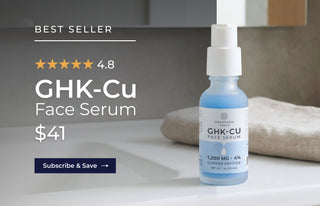
Topical actives with a real evidence base: retinoids for collagen stimulation and surface cell turnover, peptides like GHK-Cu (Copper Tripeptide-1) for collagen support, and vitamin C for antioxidant protection.
Targeted supplements: longevity-adjacent compounds for cellular health — spermidine to support autophagy, fisetin to support senescent cell function, and nicotinamide riboside as an NAD+ precursor.
Collagen support: vitamin C is required for collagen synthesis, and supplemental collagen peptides show some evidence for skin elasticity and hydration over several months.
How Accurate Is Face Age Detection?
It's reasonably accurate under good conditions, with real variation based on inputs. Research into facial age estimation models generally shows mean absolute errors in the range of three to six years under controlled conditions — meaning the estimate is typically within a few years of actual age, though individual results vary.
The tool performs better on clear, well-lit frontal photos with neutral expressions than on photos with unusual angles, heavy shadows, strong filters, or significant fatigue. A few things that reliably affect the estimate:
- Lighting: diffuse, even lighting produces the most consistent results; harsh directional light creates shadows that can add apparent age
- Expression: neutral or slightly relaxed reads better than strong smiles or frowns, which activate expression lines
- Photo quality: higher resolution gives the model more to work with
- Hydration and rest: a well-rested, hydrated face can read younger by several years than the same face after poor sleep
Use the tool as a periodic reference point rather than a precise measurement. Upload under similar conditions each time and look for directional trends over months rather than treating any single result as authoritative.
About This Tool
Neurogan Health built this Face Age Calculator as part of a broader interest in practical longevity tracking. If you're actively working on your health and skin over time, you should have some way to observe whether it's showing — and a periodic face age estimate, taken consistently, gives you one rough data point alongside others.
We make supplements and skincare products, some of which address factors that affect apparent facial age. We've kept the product conversation in its proper place: after the tool information, not ahead of it. If you just wanted the tool, that's the whole page.


Frequently Asked Questions
Is my photo stored or shared?
No. Photos uploaded to the Face Age Calculator are processed to generate a result and are not stored on our servers or shared with any third party. Your privacy is the default, not an opt-in.
What facial features does the AI actually analyze?
The model primarily reads skin texture, the depth and distribution of expression lines, the eye area, and facial contours. These are the features that vary most predictably with age in training datasets.
Why did I get a result that seems too high or too low?
Several factors can affect the estimate: lighting quality, facial expression, photo resolution, and current physical state (hydration, fatigue, recent illness). If the result seems off, try a different photo taken under good, even lighting with a neutral expression.
Can I use the tool to track changes over time?
Yes, and this is probably the most practical use. Upload photos every few months under similar conditions and compare the results. A single result is a rough estimate; a trend line over time is more meaningful.
How does AI face age estimation work technically?
The tool uses a deep learning model trained on labeled facial images. It has learned statistical associations between visual features and age, and applies those patterns to estimate the apparent age from a new image. The process is more pattern matching than analysis in any medical sense.
Does the result mean anything for my actual health?
Not directly. The tool estimates apparent facial age, which is correlated with but not equivalent to biological age. Research has found associations between AI-estimated facial age and health outcomes in specific populations, but this tool is not a health assessment. If your result concerns you, it's worth considering the lifestyle factors that influence skin aging rather than treating it as a diagnosis.
What devices and image formats work best?
The tool accepts standard image formats (JPEG, PNG) from any device. For best results, use a recent smartphone camera in good light. Front-facing cameras work well — the key variables are lighting and expression, not camera quality.
Does it work for all ages?
The model is trained on adult faces and performs best across the adult age range. Results for children or very elderly individuals may be less accurate due to limited representation in typical training datasets.