Resveratrol is a dietary supplement commonly taken to support cellular health, antioxidant defenses, and healthy aging — but when you take it matters less than how consistently you use it.
Resveratrol is usually taken once a day and is better absorbed when taken with a meal that includes some healthy fat—think olive oil, avocado, or eggs. Taking it with food rather than on an empty stomach can also help reduce the risk of stomach discomfort. Beyond that, daily intake matters far more than the exact time on the clock.
You might come across discussions about timing based on circadian rhythms.
Some researchers suggest younger adults could benefit from taking resveratrol in the evening to line up with overnight repair processes, while older adults may do better with a midday dose that matches age-related shifts in metabolism. That said, research in this area is limited, so these ideas are theoretical.
In real life, the best time to take resveratrol is simply when it fits smoothly into your day. How your body tolerates it, how it feels on your stomach, and how it lines up with your meals, supplements, or medications should all guide your timing.
What Is Resveratrol?
Resveratrol is a type of plant compound known as a polyphenol, more specifically a stilbenoid polyphenol (3,5,4′-trihydroxystilbene, if we’re getting technical).

You’ll find resveratrol in the skins of grapes, red wine, peanuts, berries, and Japanese knotweed (the most common source of supplements). Plants produce resveratrol as a protective response to stressors like injury, UV exposure, or infection. In plant biology, this makes it a phytoalexin, or a natural defense compound.
Humans have consumed resveratrol-containing plants for thousands of years through food and traditional medicine, but the compound itself wasn’t isolated and studied until the early mid-20th century [2].
Modern interest in resveratrol took off in the 1990s and early 2000s, largely due to research around grape polyphenols and cardiovascular health.
This is also where the “French paradox” gained attention. It’s the observation that populations with higher saturated fat intake but regular red wine consumption seemed to have lower rates of heart disease [2]. Red wine became the headline, but researchers were more interested in the compounds inside it, including resveratrol.
While we’re here, it’s worth clearing up the common misconception that red wine is good for you. Typical resveratrol supplements provide far more than you’d get realistically from wine or food alone.
Studies have shown that resveratrol can influence sirtuin pathways, particularly SIRT1, which are involved in cellular stress responses and metabolic regulation, which is why resveratrol has become associated with calorie restriction research and healthy aging [3].
How To Take Resveratrol (Different Product Types)
Resveratrol supplements most commonly come in capsule form, which is the easiest way to get a measured daily dose. Capsules are taken once daily with a meal containing some healthy fat to support absorption.
You may also see resveratrol listed as an ingredient in skincare products, where it’s used for its antioxidant and soothing properties. Topical resveratrol works at the skin level and is separate from oral supplementation — it doesn’t replace taking resveratrol by mouth if your goal is systemic or cellular support.
When it comes to supplement quality, not all resveratrol is the same.
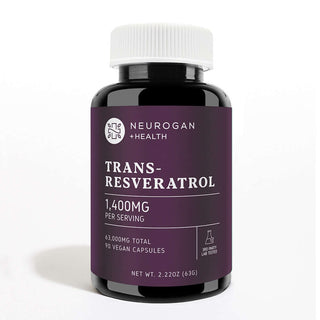
Resveratrol exists in two primary forms: cis-resveratrol and trans-resveratrol. Of the two, trans-resveratrol is the more stable and biologically active form, and it’s the version most often used in research. For that reason, trans-resveratrol has become the standard in dietary supplements and is the form you’ll typically want to see listed on the label.
Some formulas may also combine resveratrol with other polyphenols, NAD+ boosters, or compounds designed to support absorption, but the most important factor is ensuring you’re getting a clearly labeled trans-resveratrol source with third-party lab testing for quality assurance.
Best Time to Take Resveratrol: Morning vs. Night
If you’re looking for a single, universal answer to whether resveratrol is better in the morning or at night, the honest answer is: we don’t have one.
There are no large human clinical trials proving that one time of day is superior for everyone. That said, research into circadian biology and cellular timing gives us some useful clues, and that’s where the morning vs. night conversation comes from.

Morning Dosing (with a Fat-Containing Breakfast)
Morning resveratrol is often chosen when the goal is daytime metabolic support. It aligns with natural cortisol rhythms, daytime insulin sensitivity, and metabolic activity. This timing also pairs well if you take NMN or other NAD⁺ precursors in the morning, or if your focus is on blood sugar regulation, energy, or cognitive clarity. For those who also stack NMN with resveratrol, we have an NMN+Resveratrol all-in-one supplement, delivering 600 mg of each compound per serving for convenience.
The logic behind taking resveratrol in the AM is that it interacts with the body’s internal clock by activating SIRT1 and influencing core circadian genes like CLOCK, BMAL1, PER, and CRY [4].
These genes help regulate sleep–wake cycles, metabolism, and cellular repair. Lab, animal, and human-cell studies suggest resveratrol can strengthen or shift circadian gene expression, meaning that when you take it may influence how it works [4]. What’s missing so far are direct human trials comparing morning vs. evening dosing with real-world outcomes.
One of the most cited timing frameworks comes from circadian and metabolic modeling work out of the University of Waterloo [5]. Using age-specific liver metabolism models (based on animal data), researchers suggested that younger individuals may respond better to nighttime dosing, while older adults may benefit more from midday or afternoon dosing.
With that said, please keep in mind that these are modeling-based insights — not outcome trials — but they’ve become influential in longevity and anti-aging discussions.
Evening or Nighttime Dosing (with Dinner or a Small Amount of Fat)
Evening dosing is more commonly used when the focus is on recovery, sleep quality, or cellular repair, particularly in younger adults.
Resveratrol’s activation of SIRT1 and its influence on circadian clock genes like PER and CRY, which are more active during the night, has led some researchers to suggest that taking it later in the day may better align with the body’s natural self-maintenance window.
These pathways are involved in processes like DNA repair, mitochondrial maintenance, and oxidative stress management, all of which tend to ramp up during sleep.
Circadian and metabolic modeling work, including the University of Waterloo analysis, has further supported this idea for younger individuals, whose circadian rhythms are generally more tightly synchronized. In this context, evening dosing could “support the night shift” of cellular housekeeping rather than daytime energy or metabolism [5].
From a practical standpoint, evening dosing may also make sense for people who notice mild digestive discomfort when taking resveratrol earlier in the day, or for those who already take multiple supplements in the morning and prefer to spread their intake out. Resveratrol isn’t considered a stimulant, so most people can handle it well in the evening, especially when taken with dinner.
Taking Resveratrol Every Day vs. Cycling
Resveratrol is meant to be taken daily. Most clinical studies use resveratrol daily rather than in cycles, and there’s currently no strong evidence that cycling is necessary at typical supplement doses.
In human trials, resveratrol has commonly been used daily for 8–12 weeks at doses of 100-1,000 mg, with generally good tolerability [6]. Reviews often describe resveratrol as “safe and well tolerated” at doses up to about 1 gram per day in the short term.
When people do experience side effects, they’re usually digestive — things like nausea, diarrhea, or stomach discomfort. These effects tend to occur more often at higher doses (2.5–5 grams per day), especially in individuals with existing liver concerns [7].
What People Say Online: Morning vs Night (Reddit Anecdotes)
If you’re reading this article, you’re probably a supplement nerd like us and look into real-world anecdotes.
After reading enough resveratrol threads, you’ll notice a pattern: people are split between morning and nighttime dosing, and most of the “evidence” is really just personal trial and error. That can still be useful — especially for spotting common themes — but let’s remember that these are anecdotes, not clinical proof.
“Morning feels safer” (Energy + Stacking)
Many longevity-stack folks default to the morning because it’s easy to pair with other supplements and a fat-containing breakfast. One user summed up the common logic pretty bluntly:
“Take resveratrol in the morning. With food (fat helps absorption). Avoid before bed — might be too stimulating for some.”
Another thread echoed the same practical approach (and the reality that many labels don’t specify much):
“Mine says take in the morning with or without food.” (Source: Reddit)
This thread was specifically related to NMN or NAD with resveratrol. Resveratrol on its own isn’t known to be stimulating, but some people have experienced NMN and NAD to have some energizing benefits.
“Evening works great… for sleep (for some people)”
A few users report that taking resveratrol in the evenings supports better sleep and more vivid dreams. One person wrote:
“Whenever I take resveratrol, I get the best sleep ever… I wake up feeling super refreshed.”
And people take it both ways: some in the morning with olive oil, others after dinner. (Source: Reddit)
Final Thoughts: Focus on Routines Not Rules
Resveratrol works best as part of a routine, not a rigid rule set for timing.
The science tells us resveratrol interacts with cellular stress pathways, circadian biology, and metabolism, but it doesn’t yet tell us that a specific hour of the day unlocks dramatically better results.
What matters is regular exposure, adequate absorption, and choosing a timing strategy that fits your life well enough for you to stick with it long term.
That’s also where the online anecdotes become useful, not as proof, but as perspective.
Some people feel better taking resveratrol in the morning alongside their other supplements. Others notice improved sleep or recovery when they take it later in the day. Both experiences can be valid, because biology isn’t one-size-fits-all.
Resources:
-
Gambini, J., Inglés, M., Olaso, G., Lopez-Grueso, R., Bonet-Costa, V., Gimeno-Mallench, L., ... & Borras, C. (2015). Properties of resveratrol: in vitro and in vivo studies about metabolism, bioavailability, and biological effects in animal models and humans. Oxidative medicine and cellular longevity, 2015(1), 837042.
-
Bonnefont-Rousselot, D. (2016). Resveratrol and cardiovascular diseases. Nutrients, 8(5), 250.
-
Mohar, D. S., & Malik, S. (2012). The sirtuin system: the holy grail of resveratrol?. Journal of clinical & experimental cardiology, 3(11), 216.
-
Kapar, S. G., Pino, M. F., Yi, F., Gutierrez-Monreal, M. A., Esser, K. A., Sparks, L. M., & Erickson, M. L. (2024). Effects of resveratrol on in vitro circadian clock gene expression in young and older human adipose-derived progenitor cells. Aging (Albany NY), 16(1), 1.
-
Sadria, M., & Layton, A. T. (2021). Aging affects circadian clock and metabolism and modulates timing of medication. Iscience, 24(4).
-
Anton, S. D., Embry, C., Marsiske, M., Lu, X., Doss, H., Leeuwenburgh, C., & Manini, T. M. (2014). Safety and metabolic outcomes of resveratrol supplementation in older adults: results of a twelve-week, placebo-controlled pilot study. Experimental gerontology, 57, 181-187.
-
Shaito, A., Posadino, A. M., Younes, N., Hasan, H., Halabi, S., Alhababi, D., ... & Pintus, G. (2020). Potential adverse effects of resveratrol: A literature review. International journal of molecular sciences, 21(6), 2084.