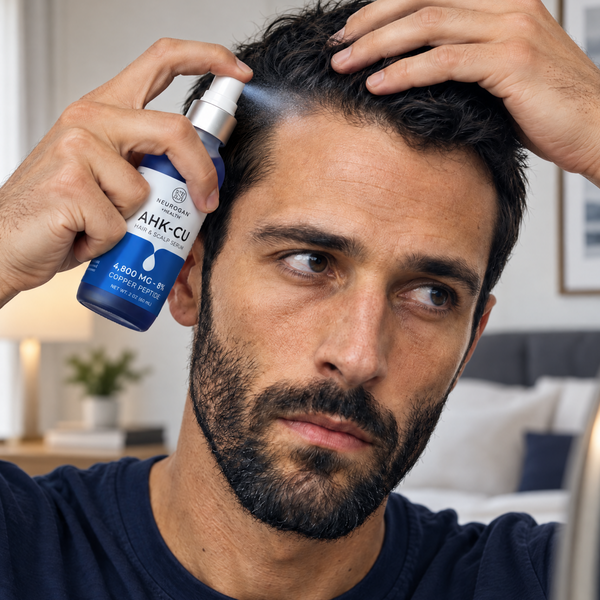
How you use AHK-Cu depends on the finished product. A leave-on scalp serum, shampoo and conditioner all contain AHK-Cu in different formats, so there is no single application method that applies to every AHK-Cu product.
For a leave-on AHK-Cu scalp serum, the practical goal is to apply the formula directly to the scalp rather than mainly coating the hair lengths. Follow the amount, frequency and scalp-condition instructions on the specific product label.
What research does not give us is a clinically established AHK-Cu application protocol. There is no controlled human AHK-Cu trial showing that morning is better than night, twice-daily use is better than once-daily use, or application to damp scalp produces better hair-growth outcomes.
That distinction is important: product directions explain how a finished formula was designed to be used; they are not the same thing as a clinically validated AHK-Cu treatment schedule.
How to Use AHK-Cu at a Glance
| Question | Practical Answer |
|---|---|
| Where should a scalp serum go? | Apply it to the scalp areas specified by the product rather than mainly coating the hair lengths. |
| How often should you use AHK-Cu? | Follow the finished product directions. There is no clinically established optimal AHK-Cu frequency. |
| Morning or night? | Follow the product directions and choose a schedule that fits your routine. Research has not established one time as superior. |
| Wet or dry scalp? | Follow the label. No controlled AHK-Cu study has established that wet, damp or dry application produces better hair outcomes. |
| Do you rinse AHK-Cu out? | Leave-on serums remain on as directed. Shampoos and conditioners are rinse-off products. |
| Can you use it with other hair products? | Often, but do not mix finished formulas together unless they were specifically designed for that use. |
Start With the Type of AHK-Cu Product
AHK-Cu can appear in several hair and scalp formats, including:
- leave-on scalp serums or sprays;
- multi-peptide serums containing AHK-Cu and GHK-Cu;
- shampoos; and
- conditioners.
These products create different types of exposure, so they shouldn't all be treated as though they're interchangeable AHK-Cu “doses.”
Leave-On AHK-Cu Serum
A leave-on scalp serum is designed to remain on the scalp after application.
Neurogan Health's current AHK-Cu Hair Serum directions instruct users to apply the formula directly to a clean, towel-dried or fully dry scalp, parting the hair where needed so the spray reaches the scalp rather than sitting mainly on the hair.
The current product directions also instruct users to massage the formula gently and allow it to dry before applying other hair products.
Those are finished-product directions. They should not be interpreted as evidence that the same frequency, spray count or application method is clinically optimal for every AHK-Cu formula.
AHK-Cu Shampoo
A shampoo is a rinse-off product.
For Neurogan Health's current AHK-Cu + GHK-Cu shampoo, the directions are to massage the product into wet hair and scalp, focus on the roots, allow brief contact, and rinse thoroughly.
A rinse-off shampoo cannot be assumed to produce the same peptide exposure as a leave-on scalp serum.
AHK-Cu Conditioner
A conditioner is also generally a rinse-off format.
Neurogan Health's current AHK-Cu + GHK-Cu conditioner is applied after shampooing, primarily from the mid-lengths to ends, left on briefly and then rinsed.
That makes its cosmetic role different from a leave-on scalp serum designed for direct scalp application.
How to Apply an AHK-Cu Scalp Serum
For a leave-on product intended for the scalp, the basic goal is to get the formula onto the intended scalp area instead of leaving most of it on the hair.
A practical application routine is:
- Follow the product's scalp instructions. Use the formula on dry, towel-dried or otherwise prepared scalp exactly as directed.
- Part the hair where needed. This makes it easier to expose the scalp in the areas you're targeting.
- Apply the specified amount. More product is not automatically better.
- Spread gently if directed. Clean fingertips can help distribute a scalp formula across the intended area.
- Allow a leave-on formula to dry before layering other products.
These are practical cosmetic-use steps. They are not a clinically validated AHK-Cu hair-growth protocol.
Do You Put AHK-Cu on the Hair or the Scalp?
If the product is specifically designed as an AHK-Cu scalp serum, the scalp is the intended application area.
The scientific reason AHK-Cu is discussed in hair research also involves structures beneath the surface of the scalp. The main direct AHK-Cu study evaluated isolated human hair follicles and cultured dermal papilla cells.1
But that does not prove that applying a topical AHK-Cu serum delivers a particular amount of peptide to the dermal papilla in a living person.
Delivery, formulation stability and penetration remain important limitations in peptide-based hair research.2
So the practical rule is simpler:
- Scalp serum: apply to the scalp as directed.
- Shampoo: work through the scalp and roots, then rinse.
- Conditioner: use according to its directions, which may focus more on the hair lengths and ends.
How Often Should You Use AHK-Cu?
There is no clinically established optimal frequency for topical AHK-Cu.
The main direct AHK-Cu hair study used isolated follicles and cultured dermal papilla cells. It did not compare once-daily, twice-daily or less-frequent scalp application in people.1
That means the frequency printed on a product label comes from how that particular formula is intended to be used rather than from a universal AHK-Cu clinical protocol.
For example, Neurogan Health's current leave-on AHK-Cu formulas provide their own frequency directions. Those directions apply to those finished products; they should not be generalized automatically to every AHK-Cu formula.
If you're looking for information about concentration, amount, injection-related questions or what “dose” means in the AHK-Cu research, see our AHK-Cu dosage guide.
Should You Use AHK-Cu in the Morning or at Night?
There is no controlled AHK-Cu study showing that morning application produces better hair outcomes than evening application, or vice versa.
The practical considerations are therefore:
- what the finished product directs;
- when you normally wash your hair;
- whether the formula needs time to dry;
- how it fits with other scalp products; and
- which schedule you're likely to follow consistently.
If a finished product directs morning and evening use, that's the manufacturer's application instruction for that product. It should not be described as proof that twice-daily AHK-Cu has been clinically shown to outperform once-daily use.
Should AHK-Cu Go on a Wet or Dry Scalp?
Follow the directions of the finished formula.
There is no controlled AHK-Cu hair-growth study comparing application to:
- wet scalp;
- damp scalp;
- towel-dried scalp; or
- fully dry scalp.
So claims that one of these conditions makes AHK-Cu clinically “work better” go beyond the current evidence.
Neurogan Health's current leave-on AHK-Cu scalp products are designed for clean, towel-dried or dry scalp. Follow the label for the specific formula you're using.
Should You Massage AHK-Cu Into the Scalp?
If the finished product directs gentle massage, use clean fingertips to spread the formula across the intended scalp area.
Massage can help distribute a liquid product, but there is no direct AHK-Cu study showing that a specific massage duration increases peptide penetration or improves AHK-Cu-related hair outcomes.
So it's better to think of massage as an application step rather than a proven mechanism for increasing AHK-Cu effectiveness.
Do You Need to Wash AHK-Cu Out?
That depends entirely on the formulation.
Leave-On Serum
A leave-on AHK-Cu serum is designed to remain on the scalp according to its directions.
There is no evidence that leaving it on for longer than instructed makes it more effective.
Shampoo
An AHK-Cu-containing shampoo should be rinsed after the contact time specified by the product.
Conditioner
An AHK-Cu-containing conditioner should also be rinsed according to the product directions unless it is specifically formulated as a leave-in conditioner.
This is why comparing a shampoo, conditioner and serum based only on the amount of AHK-Cu listed in the product can be misleading. The formats create very different contact conditions.
Can You Use AHK-Cu and GHK-Cu Together?
Yes, AHK-Cu and GHK-Cu can be formulated together in the same finished cosmetic product.
Neurogan Health currently uses both peptides together in several hair and scalp formulas.
That is different from purchasing separate concentrated products and creating a DIY mixture.
AHK-Cu and GHK-Cu are related copper-binding tripeptides, but they're different molecules with different research histories.
There is no need to invent a homemade AHK-Cu-to-GHK-Cu ratio when professionally formulated products already specify their own composition and directions.
For the differences between the peptides, see our AHK-Cu vs. GHK-Cu guide.
Can You Use AHK-Cu With Minoxidil?
There is no established AHK-Cu + minoxidil clinical protocol that tells us the ideal timing, spacing or mixing method.
That does not mean the two can never appear in the same overall hair-care routine. It means there isn't enough AHK-Cu-specific evidence to prescribe a universal combination schedule.
One thing to avoid is mixing AHK-Cu directly into a bottle of minoxidil or another finished treatment unless that formulation was specifically designed and tested that way.
Changing a finished formula can alter factors such as:
- pH;
- stability;
- solubility;
- preservative performance; and
- the amount delivered with each application.
If you're using an FDA-approved, prescription or over-the-counter hair-loss treatment and aren't sure how to add another scalp product, ask a healthcare professional or pharmacist rather than relying on a DIY mixing protocol.
Can You Use AHK-Cu After Microneedling?
This is an area where the practical advice online is often more confident than the evidence.
Microneedling creates controlled injury to the skin and temporarily changes the skin barrier.
The FDA notes that microneedling devices have not been cleared for use with another cosmetic, topical medication or similar product, meaning the agency has not reviewed the safety or effectiveness of combining microneedling devices with those products.3
The FDA also notes that microneedling devices have not been cleared for treating hair loss.3
There is currently no controlled human study establishing the safety, delivery or hair-growth benefit of applying AHK-Cu to freshly microneedled scalp.
That means greater penetration should not automatically be interpreted as greater benefit. Changing the barrier can also change irritation, exposure and tolerability.
Do not assume that a cosmetic AHK-Cu serum is intended for freshly microneedled skin unless the product and device instructions specifically support that use.
Can You Use AHK-Cu With Other Hair and Scalp Products?
For most cosmetic products, the practical question is whether the finished formulas layer comfortably and whether the routine causes irritation.
A comprehensive AHK-Cu-specific interaction map has not been established in human clinical research.
Useful general principles include:
- follow the directions of each finished product;
- avoid combining separate formulas in the same container;
- allow a leave-on scalp serum to dry before adding heavy styling products if directed;
- introduce several new active scalp products gradually if your scalp is sensitive; and
- stop using a product if significant irritation develops.
The absence of a documented AHK-Cu interaction with every cosmetic ingredient should not be interpreted as proof that every possible combination has been clinically studied.
How Long Before AHK-Cu Results?
There is no clinically established AHK-Cu hair-growth timeline.
The main direct research did not follow people applying an AHK-Cu scalp product for a defined number of weeks or months, so specific timelines repeated online should not be treated as clinical AHK-Cu outcomes.1
For the research behind AHK-Cu, human hair follicles and dermal papilla cells, see our AHK-Cu hair growth research guide.
Common AHK-Cu Usage Mistakes
Using More Because You Think More Works Better
There is no established human AHK-Cu dose-response curve showing that applying more topical product produces better hair outcomes.
Use the amount specified by the finished product.
Applying a Scalp Serum Mainly to the Hair
If a product is designed for scalp use, part the hair where needed so the formula reaches the intended scalp area.
Treating an Internet Routine as a Clinical Protocol
Once-daily, twice-daily, morning-only, night-only and post-microneedling AHK-Cu routines are all discussed online.
That does not mean those schedules have been compared in controlled human AHK-Cu studies.
Mixing AHK-Cu Into Other Finished Products
DIY mixing can change the chemistry and stability of a finished formula.
Use products as formulated unless you're working with appropriate professional formulation guidance.
Confusing Application With Dosage
Topical application directions and injection-related dosing discussions are different questions.
Neurogan Health's AHK-Cu hair and scalp products are topical cosmetic products, not injectable AHK-Cu preparations.
How to Use AHK-Cu FAQ
How often should I use AHK-Cu?
Follow the directions for the finished product. There is no clinically established optimal topical AHK-Cu frequency based on controlled human hair-growth trials.
Can I use AHK-Cu every day?
Some finished AHK-Cu products are designed for daily use. Whether your specific formula should be used daily depends on its directions and how your scalp tolerates it.
Should I use AHK-Cu in the morning or at night?
Research has not established one time of day as more effective. Follow the finished product directions and choose a schedule you can use consistently.
Should AHK-Cu be applied to wet or dry hair?
For a scalp serum, the target is the scalp rather than the hair shaft. Follow the formula's directions regarding whether the scalp should be towel-dried or fully dry.
Do I have to wash AHK-Cu out?
A leave-on scalp serum normally remains on according to the product directions. AHK-Cu shampoos and conditioners are rinse-off products unless the label specifically says otherwise.
Can I use AHK-Cu with GHK-Cu?
Yes. The two peptides can be formulated together in a finished cosmetic product. That is different from creating a DIY mixture from separate concentrates.
Can I use AHK-Cu with minoxidil?
There is no established AHK-Cu + minoxidil clinical protocol defining an ideal mixing or timing schedule. Avoid altering either finished formula unless it was specifically designed for combined use.
Can I apply AHK-Cu after microneedling?
There is no controlled human study establishing the safety or effectiveness of applying AHK-Cu to freshly microneedled scalp. FDA has also not cleared microneedling devices for use with other topical products.3
How long does AHK-Cu take to work?
Human research has not established a clinical AHK-Cu hair-growth timeline. For the evidence behind hair-growth claims, see our AHK-Cu hair growth guide.
How to Use AHK-Cu: The Bottom Line
Using AHK-Cu correctly starts with one simple rule: follow the directions of the finished product rather than treating AHK-Cu as though it has one universal protocol.
For a leave-on scalp serum, that generally means applying the specified amount to the intended scalp areas, allowing it to dry, and using it at the frequency listed on the product.
For rinse-off products such as shampoo and conditioner, follow their own application and contact-time instructions.
What research does not currently establish is that one application time, one frequency, one scalp condition or one combination with another treatment produces superior AHK-Cu hair-growth results.
If you're asking how much AHK-Cu rather than how to apply a topical product, see our AHK-Cu dosage guide.
If you're asking whether AHK-Cu actually has evidence for hair growth, see our AHK-Cu hair growth research guide.
The practical instructions can be clear even when the clinical evidence is still limited.
References
- Pyo HK, Yoo HG, Won CH, Lee SH, Kang YJ, Eun HC, Cho KH, Kim KH. The effect of tripeptide-copper complex on human hair growth in vitro. Archives of Pharmacal Research. 2007;30(7):834-839. doi:10.1007/BF02978833. PMID: 17703734. View study.
- Fan C, Chen Y, Huang Q, et al. Overview of Short Peptides for Hair Loss. Biomedicines. 2026;14(4):864. doi:10.3390/biomedicines14040864. View review.
- U.S. Food and Drug Administration. Microneedling Devices: Getting to the Point on Benefits, Risks and Safety. Accessed October 2026. View FDA guidance.